IB Chemistry SL Structure 1: Particulate Nature of Matter

Explore how particulate models explain matter, from states and mixtures to atomic structure, electron configurations, the mole and ideal gases. Use experimental data, spectra and…

Syllabus
First assessment 2025
Topic
Level
SL

Structure 1. Models of the particulate nature of matter question 1

[Maximum number: 2]

Iron(II) sulfide can be produced by heating powdered iron and sulfur together.

Describe the difference between an element and a compound.

Structure 1. Models of the particulate nature of matter question 2

[Maximum number: 2]

Titanium is a transition metal.

Question (a)

(a)

State the number of protons, neutrons and electrons in the 2248Ti{ }_{22}^{48} \mathrm{Ti} atom.

Protons:

Neutrons:

Electrons:

[ 1 ]

Question (b)

(b)

State the full electron configuration of the 2248Ti2+{ }_{22}^{48} \mathrm{Ti}^{2+} ion.

[ 1 ]

Structure 1. Models of the particulate nature of matter question 3

[Maximum number: 10]

Lithium and boron are elements in period 2 of the periodic table. Lithium occurs in group 1 (the alkali metals) and boron occurs in group 3. Isotopes exist for both elements.

Question (a)

(a)

Deduce the electron arrangements of the lithium ion, Li+\mathrm{Li}^{+}, and the boron atom, B .
Li+\mathrm{Li}^{+}:
B:

[ 2 ]

Question (b)

(b)

Naturally occurring boron exists as two isotopes with mass numbers of 10 and 11 . Calculate the percentage abundance of the lighter isotope, using this information and the relative atomic mass of boron in Table 5 of the Data Booklet.

[ 2 ]

Question (c)

(c)

Every element has its own unique line emission spectrum.

[ 6 ]

Question (i)

(i)

Distinguish between a continuous spectrum and a line spectrum.

[ 2 ]

Question (ii)

(ii)

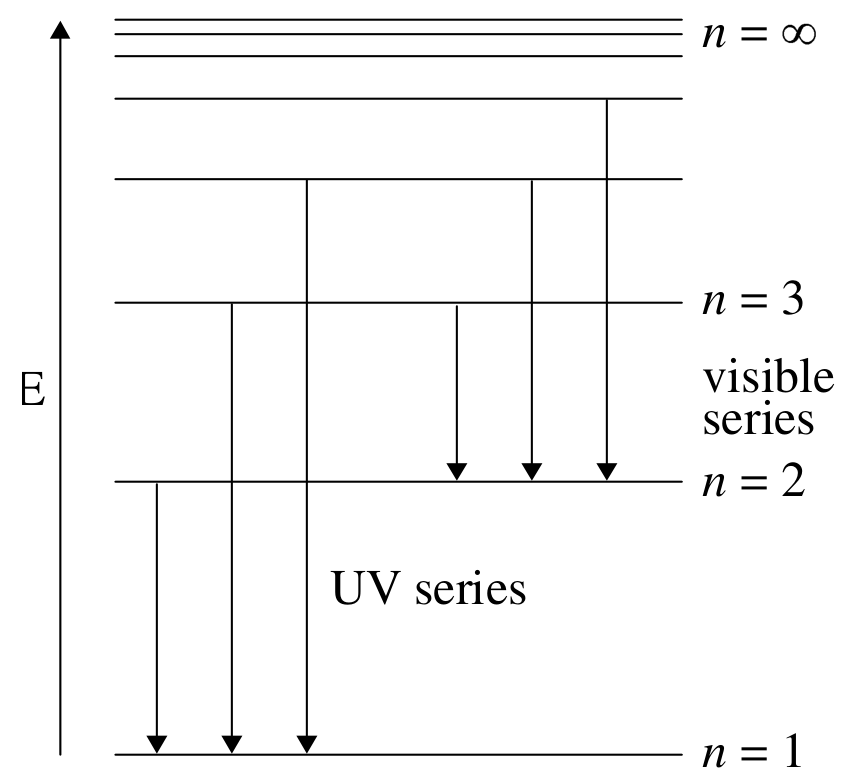
Draw a diagram to show the electron transitions between energy levels in a hydrogen atom that are responsible for the two series of lines in the ultraviolet and visible regions of the spectrum. Label your diagram to show three transitions for each series.

[ 4 ]

Structure 1. Models of the particulate nature of matter question 4

[Maximum number: 1]

How many ions are present in 0.20 mol of (NH4)2SO4\left(\mathrm{NH}_{4}\right)_{2} \mathrm{SO}_{4} ?

A

0.20×1×6×10230.20 \times 1 \times 6 \times 10^{23}

B

0.20×2×6×10230.20 \times 2 \times 6 \times 10^{23}

C

0.20×3×6×10230.20 \times 3 \times 6 \times 10^{23}

D

0.20×7×6×10230.20 \times 7 \times 6 \times 10^{23}

Structure 1. Models of the particulate nature of matter question 5

[Maximum number: 6]

Alkanes are commonly occurring organic compounds.

Question (a)

(a)

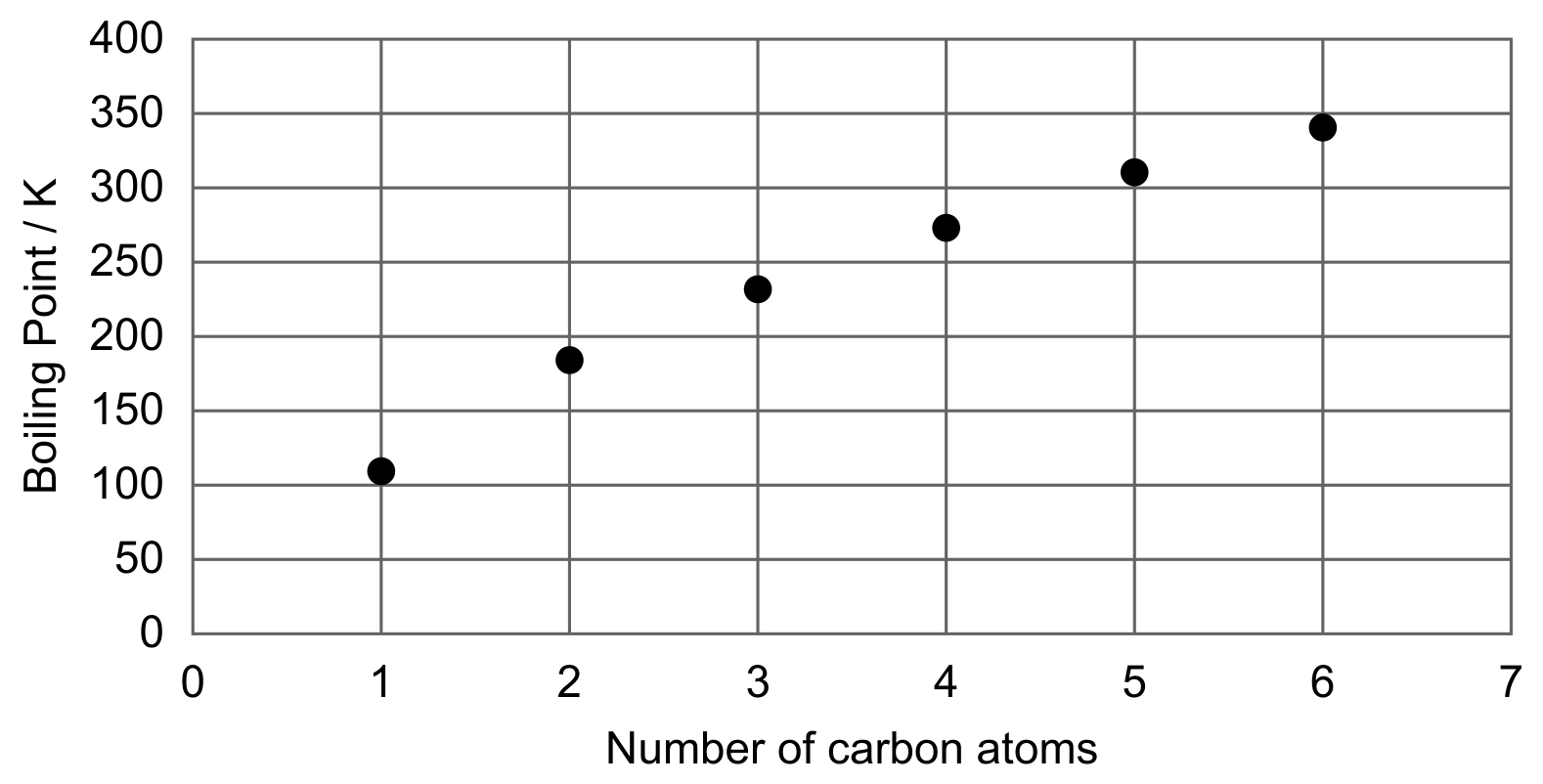
The first four straight chain alkanes are gases at room temperature.

Boiling points of straight chain alkanes

Boiling points of straight chain alkanes

[ 6 ]

Question (i)

(i)

Explain why the volume occupied by a sample of propane increases sharply when the sample is heated up from 200 to 250 K at constant pressure.

[ 2 ]

Question (ii)

(ii)

Calculate the volume, in dm3\mathrm{dm}^{3}, occupied by 6.45 g of propane gas at 100 kPa and 15C15^{\circ} \mathrm{C}.

[ 2 ]

Question (iii)

(iii)

Outline why the volume occupied by propane(g) at very high pressure is higher than the value calculated using PV=nRT.

[ 2 ]

Structure 1. Models of the particulate nature of matter question 6

[Maximum number: 5]

Chlorine occurs in Group 7, the halogens.

Question (a)

(a)

Two stable isotopes of chlorine are 35Cl{ }^{35} \mathrm{Cl} and 37Cl{ }^{37} \mathrm{Cl} with mass numbers 35 and 37 respectively.

[ 5 ]

Question (i)

(i)

Define the term isotopes of an element.

[ 2 ]

Question (ii)

(ii)

Using the mass numbers of the two isotopes and the relative atomic mass of chlorine from Table 5 of the Data Booklet, determine the percentage abundance of each isotope.

Percentage abundance 35Cl{ }^{35} \mathrm{Cl} :

Percentage abundance 37Cl{ }^{37} \mathrm{Cl} :

[ 2 ]

Question (iii)

(iii)

Deduce the electron arrangement for the chloride ion, Cl\mathrm{Cl}^{-}.

[ 1 ]
All question bank results loaded