IB Chemistry SL Structure 3: Classification of Matter

Explore how periodic organisation and functional groups classify chemical behaviour. Practise linking electron configuration to position and trends, comparing elemental and oxide…

Syllabus
First assessment 2025
Topic
Level
SL

Structure 3. Classification of matter question 1

[Maximum number: 1]

Lithium and boron are elements in period 2 of the periodic table. Lithium occurs in group 1 (the alkali metals) and boron occurs in group 3. Isotopes exist for both elements.

Distinguish between the terms group and period.

Structure 3. Classification of matter question 2

[Maximum number: 2]

Strychnine, C21H22 N2O2(Mr=334.4)\mathrm{C}_{21} \mathrm{H}_{22} \mathrm{~N}_{2} \mathrm{O}_{2}\left(M_{\mathrm{r}}=334.4\right), is a white crystalline solid obtained from plants.

Question (a)

(a)

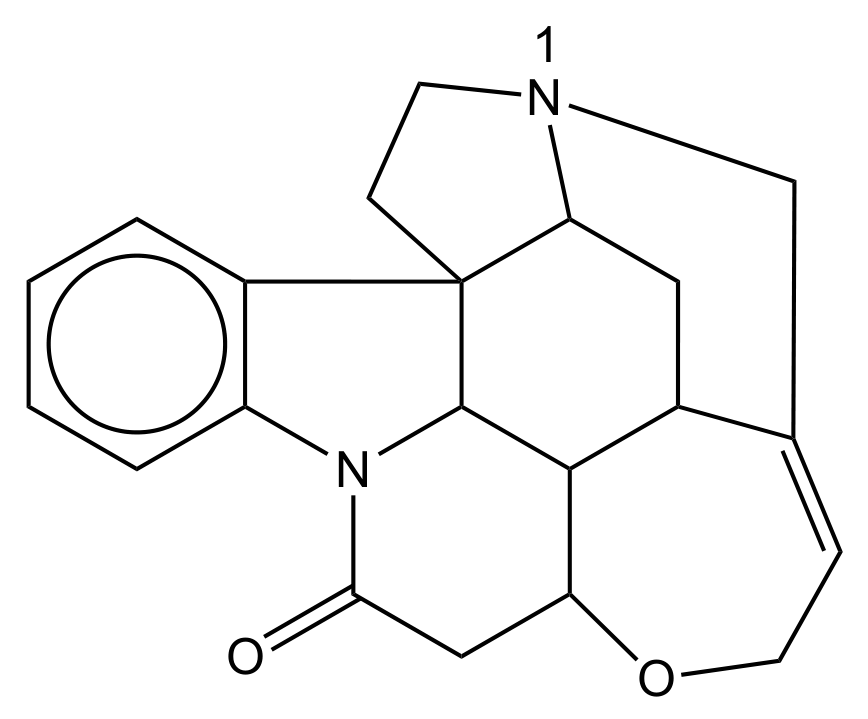
The formula of strychnine is:

Figure for Question (a) — IB Chemistry SL
[ 2 ]

Question (i)

(i)

State the type of structural formula shown.

[ 1 ]

Question (ii)

(ii)

State the name of the functional group containing the nitrogen atom labelled "1".

[ 1 ]

Structure 3. Classification of matter question 3

[Maximum number: 5]

Iron rusts in the presence of oxygen and water. Rusting is a redox process involving several steps that produces hydrated iron(III) oxide, Fe2O3nH2O\mathrm{Fe}_{2} \mathrm{O}_{3} \bullet \mathrm{nH}_{2} \mathrm{O}, as the final product. The half-equations involved for the first step of rusting are given below.

Half-equation 1: Fe(s)Fe2+(aq)+2e\quad \mathrm{Fe}(\mathrm{s}) \rightarrow \mathrm{Fe}^{2+}(\mathrm{aq})+2 \mathrm{e}^{-}

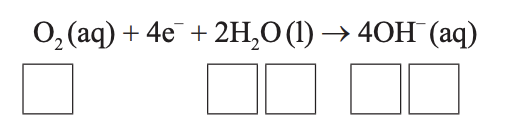
Half-equation 2: O2(aq)+4e+2H2O(l)4OH(aq)\quad \mathrm{O}_{2}(\mathrm{aq})+4 \mathrm{e}^{-}+2 \mathrm{H}_{2} \mathrm{O}(\mathrm{l}) \rightarrow 4 \mathrm{OH}^{-}(\mathrm{aq})

Question (a)

(a)

Identify the oxidation number of each atom in the three species in half-equation 2.

Figure for Question (a) — IB Chemistry SL
[ 2 ]

Question (b)

(b)

State the property that determines the order in which elements are arranged in the periodic table.

[ 1 ]

Question (c)

(c)

State the relationship between the electron arrangement of an element and its group and period in the periodic table.

[ 2 ]

Structure 3. Classification of matter question 4

[Maximum number: 5]

Chlorine undergoes many reactions.

Question (a)

(a)

State, giving a reason, whether the chlorine atom or the chloride ion has a larger radius.

[ 1 ]

Question (b)

(b)

Outline why the chlorine atom has a smaller atomic radius than the sulfur atom.

[ 2 ]

Question (c)

(c)

2.67 g of manganese(IV) oxide was added to 200.0 cm3200.0 \mathrm{~cm}^{3} of 2.00moldmm3HCl2.00 \mathrm{moldm} \mathrm{m}^{-3} \mathrm{HCl}.

MnO2( s)+4HCl(aq)Cl2( g)+2H2O(l)+MnCl2(aq)\mathrm{MnO}_{2}(\mathrm{~s})+4 \mathrm{HCl}(\mathrm{aq}) \rightarrow \mathrm{Cl}_{2}(\mathrm{~g})+2 \mathrm{H}_{2} \mathrm{O}(\mathrm{l})+\mathrm{MnCl}_{2}(\mathrm{aq})
[ 2 ]

Question (i)

(i)

State the oxidation state of manganese in MnO2\mathrm{MnO}_{2} and MnCl2\mathrm{MnCl}_{2}.
MnO2:\mathrm{MnO}_{2}:MnCl2\mathrm{MnCl}_{2} :

[ 2 ]

Structure 3. Classification of matter question 5

[Maximum number: 2]

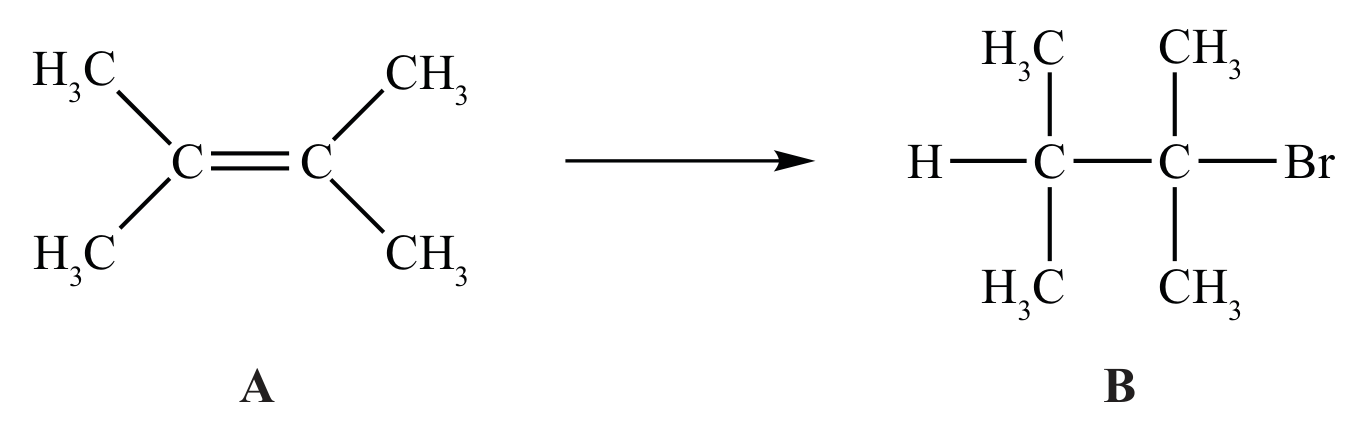
Alkenes, such as A (shown below), are important intermediates in the petrochemical industry because they undergo addition reactions to produce a wide variety of products, such as the conversion shown below.

Figure for Question Structure 3. Classification of matter question 5 — IB Chemistry SL

Question (a)

(a)

Applying IUPAC rules, state the name of A.

[ 1 ]

Question (b)

(b)

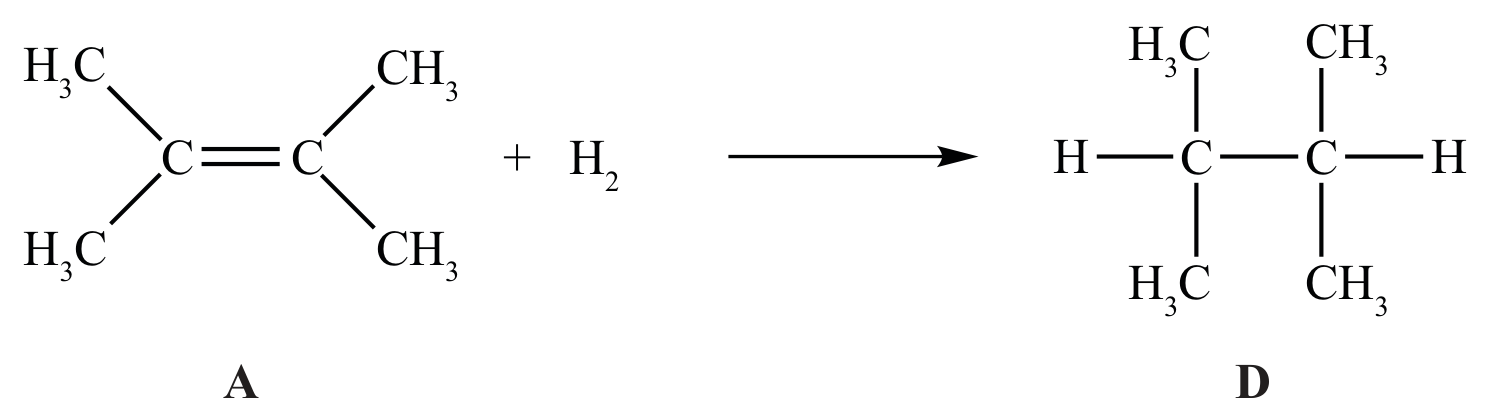
In the gas phase, A reacts with hydrogen to form D.

Figure for Question (b) — IB Chemistry SL
[ 1 ]

Question (i)

(i)

State the homologous series to which D belongs.

[ 1 ]
All question bank results loaded