IB Chemistry SL Reactivity 2: How Much, How Fast and How Far?

Practise quantifying chemical change from balanced equations, measuring and explaining reaction rates and predicting equilibrium position. Connect stoichiometric amounts, kinetic…

Syllabus
First assessment 2025
Topic
Level
SL

Reactivity 2. How much, how fast and how far? question 1

[Maximum number: 1]

Iron may be extracted from iron (II) sulfide, FeS.

The first step in the extraction of iron from iron (II) sulfide is to roast it in air to form iron (III) oxide and sulfur dioxide.

Write the equation for this reaction.

Reactivity 2. How much, how fast and how far? question 2

[Maximum number: 7]

Iron rusts in the presence of oxygen and water. Rusting is a redox process involving several steps that produces hydrated iron(III) oxide, Fe2O3nH2O\mathrm{Fe}_{2} \mathrm{O}_{3} \bullet \mathrm{nH}_{2} \mathrm{O}, as the final product. The half-equations involved for the first step of rusting are given below.

Half-equation 1: Fe(s)Fe2+(aq)+2e\quad \mathrm{Fe}(\mathrm{s}) \rightarrow \mathrm{Fe}^{2+}(\mathrm{aq})+2 \mathrm{e}^{-}

Half-equation 2: O2(aq)+4e+2H2O(l)4OH(aq)\quad \mathrm{O}_{2}(\mathrm{aq})+4 \mathrm{e}^{-}+2 \mathrm{H}_{2} \mathrm{O}(\mathrm{l}) \rightarrow 4 \mathrm{OH}^{-}(\mathrm{aq})

Question (a)

(a)

Hydrogen peroxide decomposes according to the equation below.

2H2O2(aq)2H2O(l)+O2( g)2 \mathrm{H}_{2} \mathrm{O}_{2}(\mathrm{aq}) \rightarrow 2 \mathrm{H}_{2} \mathrm{O}(\mathrm{l})+\mathrm{O}_{2}(\mathrm{~g})

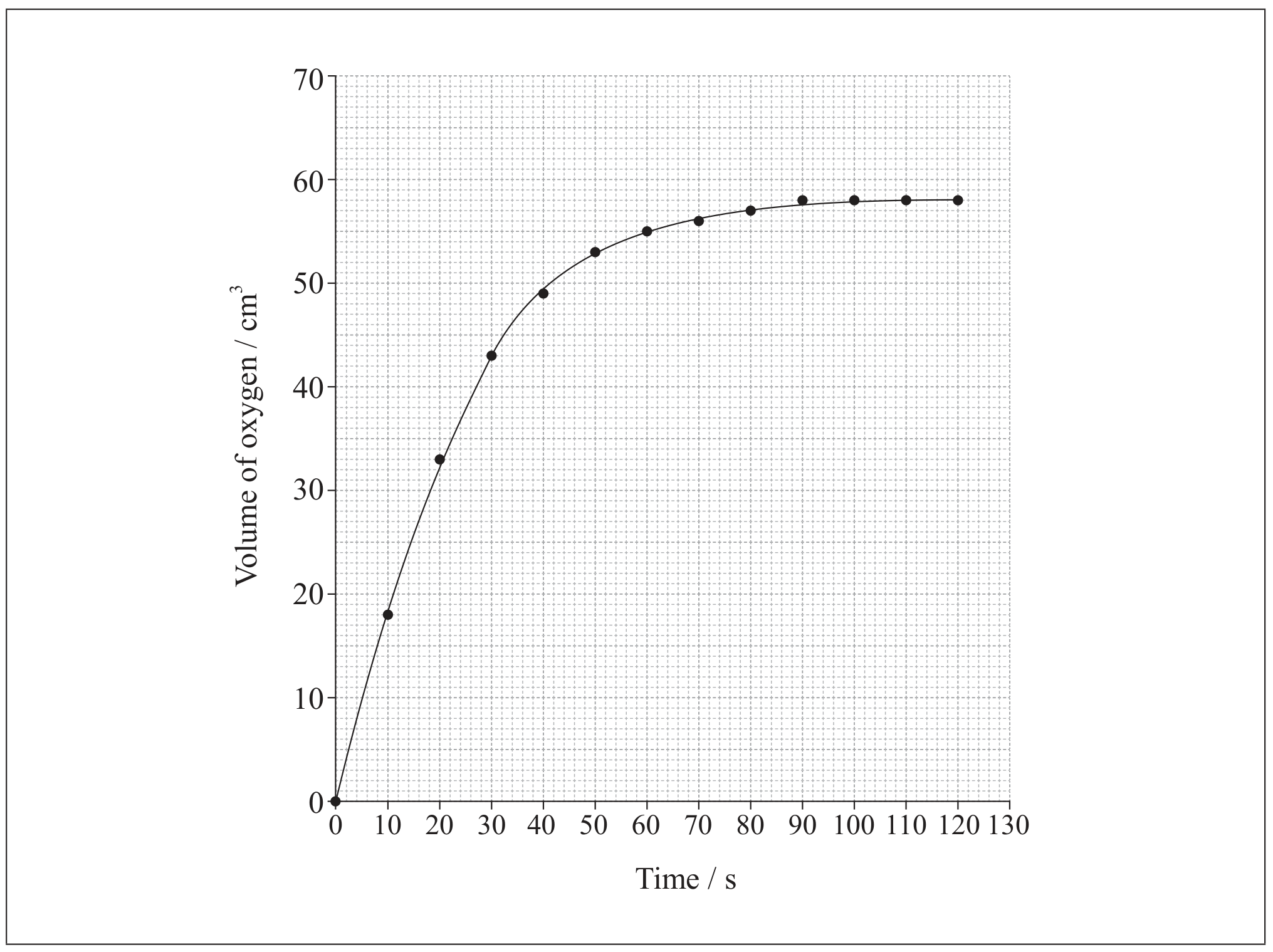
The rate of the decomposition can be monitored by measuring the volume of oxygen gas released. The graph shows the results obtained when a solution of hydrogen peroxide decomposed in the presence of a CuO catalyst.

Figure for Question (a) — IB Chemistry SL
[ 7 ]

Question (i)

(i)

The experiment is repeated with the same amount of a more effective catalyst, MnO2\mathrm{MnO}_{2}, under the same conditions and using the same concentration and volume of hydrogen peroxide. On the graph above, sketch the curve you would expect.

[ 1 ]

Question (ii)

(ii)

Outline how the initial rate of reaction can be found from the graph.

[ 2 ]

Question (iii)

(iii)

Outline a different experimental procedure that can be used to monitor the decomposition rate of hydrogen peroxide.

[ 1 ]

Question (iv)

(iv)

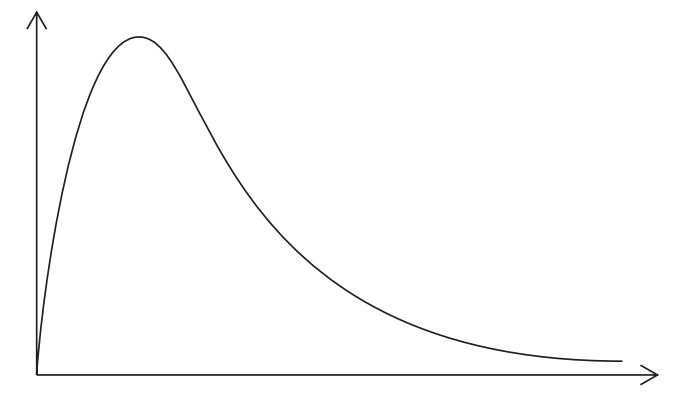
A Maxwell-Boltzmann energy distribution curve is drawn below. Label both axes and explain, by annotating the graph, how catalysts increase the rate of reaction.

Figure for Question (iv) — IB Chemistry SL
[ 3 ]

Reactivity 2. How much, how fast and how far? question 3

[Maximum number: 5]

Question (a)

(a)

Describe two characteristics of a reaction at equilibrium.

[ 2 ]

Question (b)

(b)

Describe how a catalyst increases the rate of a reaction.

[ 2 ]

Question (c)

(c)

Ethanoic acid reacts with ethanol to form the ester ethyl ethanoate.

CH3COOH(l)+CH3CH2OH(l)H+CH3COOCH2CH3(l)+H2O(l)\mathrm{CH}_{3} \mathrm{COOH}(\mathrm{l})+\mathrm{CH}_{3} \mathrm{CH}_{2} \mathrm{OH}(\mathrm{l}) \stackrel{\mathrm{H}^{+}}{\rightleftharpoons} \mathrm{CH}_{3} \mathrm{COOCH}_{2} \mathrm{CH}_{3}(\mathrm{l})+\mathrm{H}_{2} \mathrm{O}(\mathrm{l})

The esterification reaction is exothermic. State the effect of increasing temperature on the value of the equilibrium constant ( KcK_{\mathrm{c}} ) for this reaction.

[ 1 ]

Reactivity 2. How much, how fast and how far? question 4

[Maximum number: 6]

The reaction between ethanoic acid and ethanol is homogeneous and reversible.

C2H6O(l)+C2H4O2(l)C4H8O2(l)+H2O(l)ΔHθr=4 kJ mol1\mathrm{C}_{2} \mathrm{H}_{6} \mathrm{O}(\mathrm{l})+\mathrm{C}_{2} \mathrm{H}_{4} \mathrm{O}_{2}(\mathrm{l}) \rightleftharpoons \mathrm{C}_{4} \mathrm{H}_{8} \mathrm{O}_{2}(\mathrm{l})+\mathrm{H}_{2} \mathrm{O}(\mathrm{l}) \quad \Delta H^{\theta}{ }_{\mathrm{r}}=-4 \mathrm{~kJ} \mathrm{~mol}^{-1}

Question (a)

(a)

Deduce the expression for the equilibrium constant, K, for this reaction.

[ 1 ]

Question (b)

(b)

0.6\quad 0.6 moles each of ethanol and ethanoic acid at 60C60^{\circ} \mathrm{C} reacted in the presence of an acid catalyst. The volume remained constant. At equilibrium 0.2 moles of ethanoic acid remained in the reaction mixture.

Calculate the amounts, in mol, of ethanol, ethyl ethanoate and water at equilibrium.

[ 2 ]

Question (c)

(c)

Explain the effect of reducing the temperature on the value of the equilibrium constant.

[ 1 ]

Question (d)

(d)

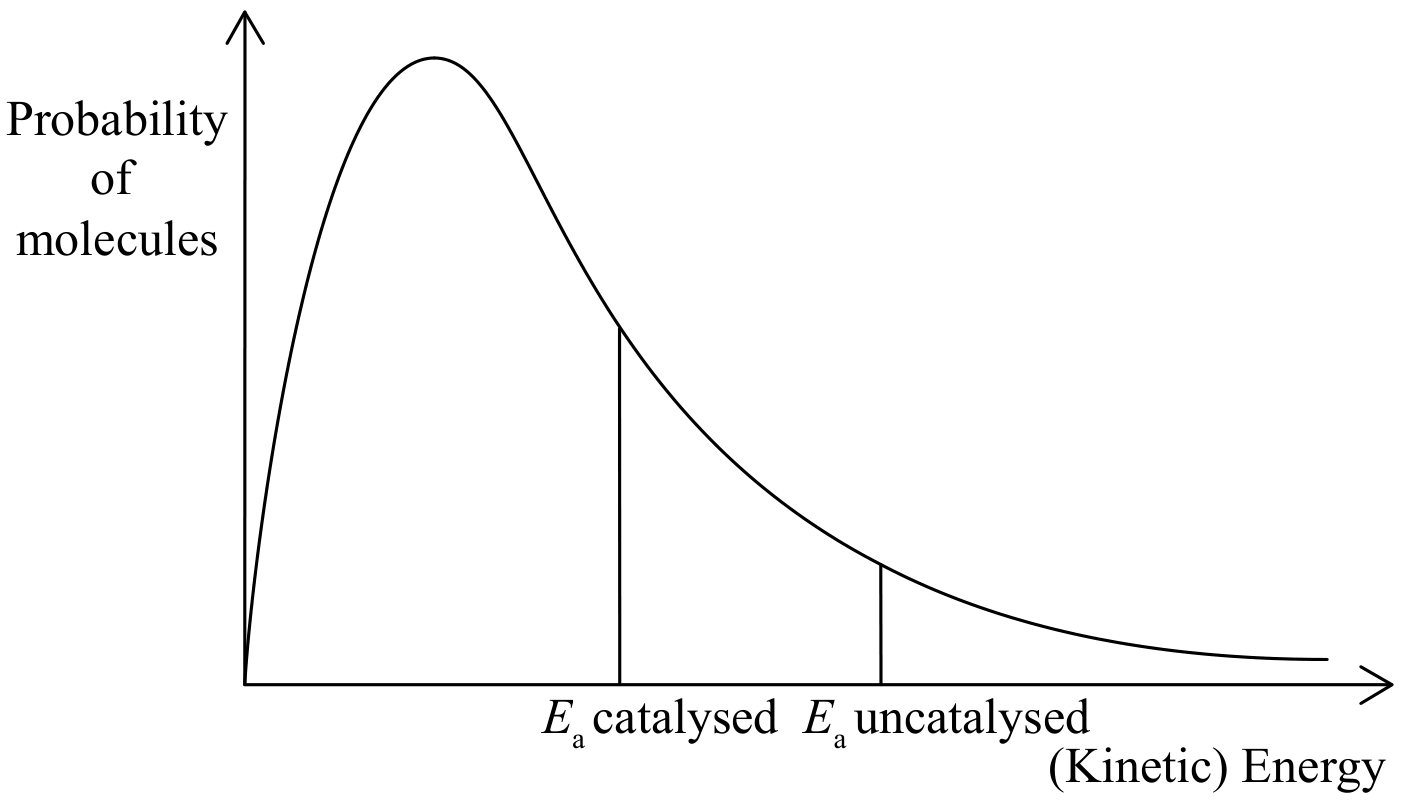
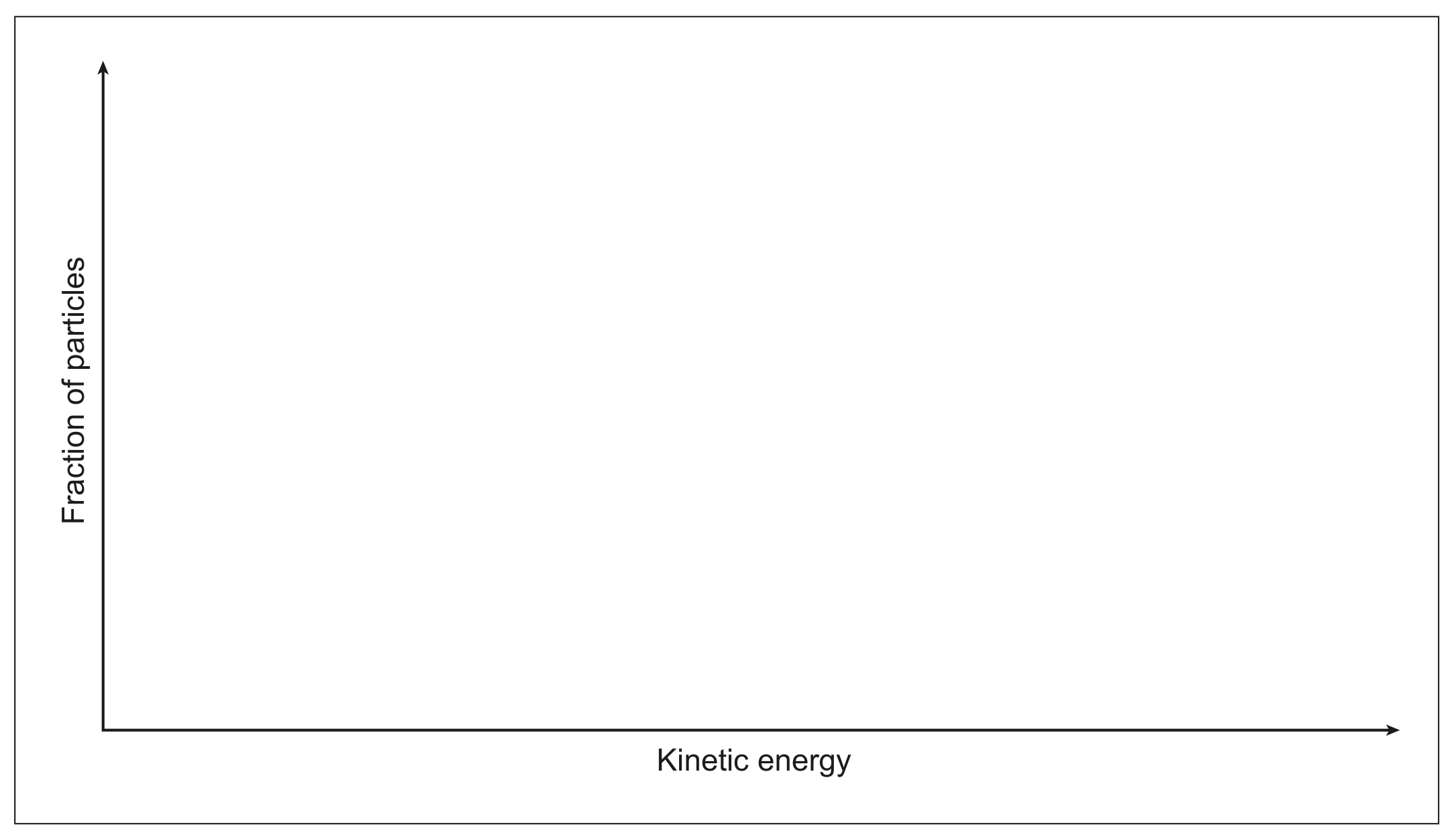
Sketch the Maxwell-Boltzmann energy distribution curve for this reaction. Label the activation energy with and without a catalyst on the diagram.

Figure for Question (d) — IB Chemistry SL
[ 2 ]

Reactivity 2. How much, how fast and how far? question 5

[Maximum number: 9]

Question (a)

(a)

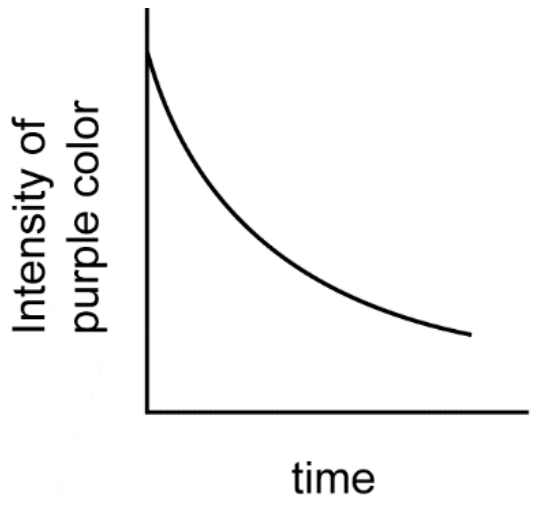
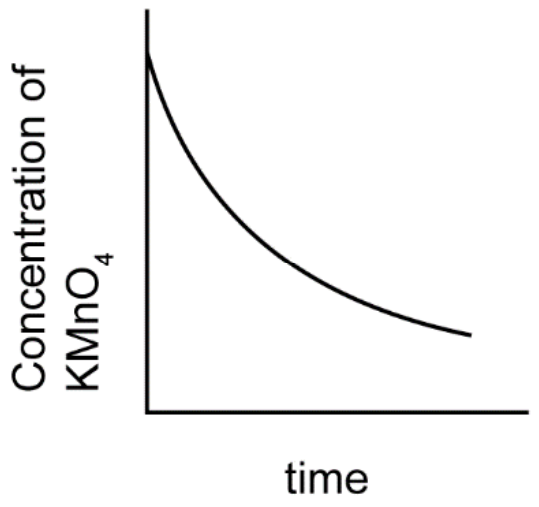
A purple solution of potassium manganate( VII),KMnO4), \mathrm{KMnO}_{4}, reacts with ethanedioate ions according to the following equation.

2MnO4(aq)+5C2O42(aq)+16H+(aq)10CO2( g)+2Mn2+(aq)+8H2O(l)2 \mathrm{MnO}_{4}^{-}(\mathrm{aq})+5 \mathrm{C}_{2} \mathrm{O}_{4}^{2-}(\mathrm{aq})+16 \mathrm{H}^{+}(\mathrm{aq}) \rightarrow 10 \mathrm{CO}_{2}(\mathrm{~g})+2 \mathrm{Mn}^{2+}(\mathrm{aq})+8 \mathrm{H}_{2} \mathrm{O}(\mathrm{l})
[ 9 ]

Question (i)

(i)

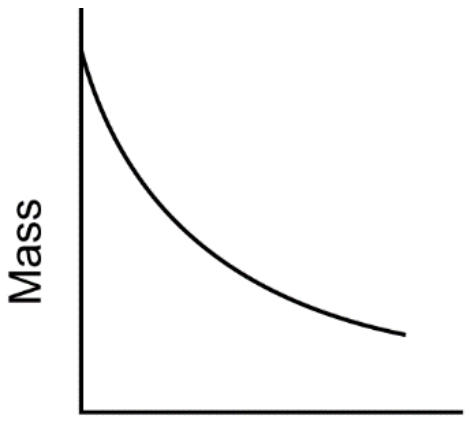
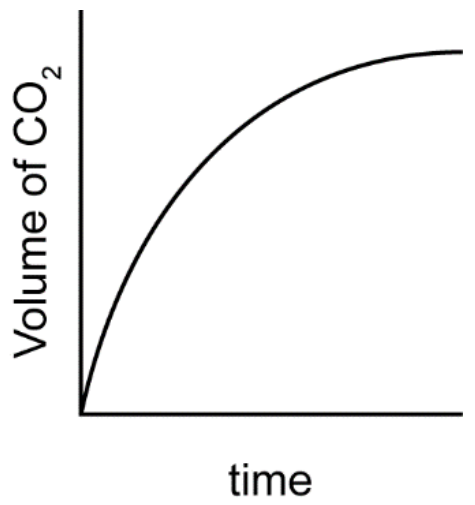
Outline an experimental procedure which may be used to measure the rate of this reaction.

[ 3 ]

Question (ii)

(ii)

Sketch a graph to show the results of the experimental procedure outlined in (a) (i).

[ 2 ]

Question (iii)

(iii)

Outline how the rate of reaction at a particular time could be determined from the graph.

[ 1 ]

Question (iv)

(iv)

Discuss, in terms of collision theory, the effect of increasing temperature on the rate of this reaction.

[ 3 ]
All question bank results loaded