CAIE A-Level Economics 6.4 Exchange Rates Question Bank

CAIE A-Level Economics 6.4 Exchange Rates Question Bank
Cambridge International AS & A Level Economics 9708 syllabus for exams in 2026, 2027 and 20282026–2028

Practise reading currency quotations, calculating appreciation or depreciation and explaining floating-rate demand and supply before evaluating trade, inflation and output effects.

Exam points

  • interpret the quotation direction before calculating a percentage appreciation or depreciation
  • shift currency demand or supply for trade, inflation, interest-rate or capital-flow changes
  • evaluate exchange-rate effects on export prices, import costs, AD, inflation and employment

Question 1

[Maximum number: 12]

Russia's economic problems are getting worse

Russia's currency, the rouble (RUB), has been falling rapidly in value.

Content removed due to copyright restrictions

An index of the real exchange rate fell from a value of 100 in 2010 to 75.8 in 2015 and this should have the effect of eventually helping to encourage exports.

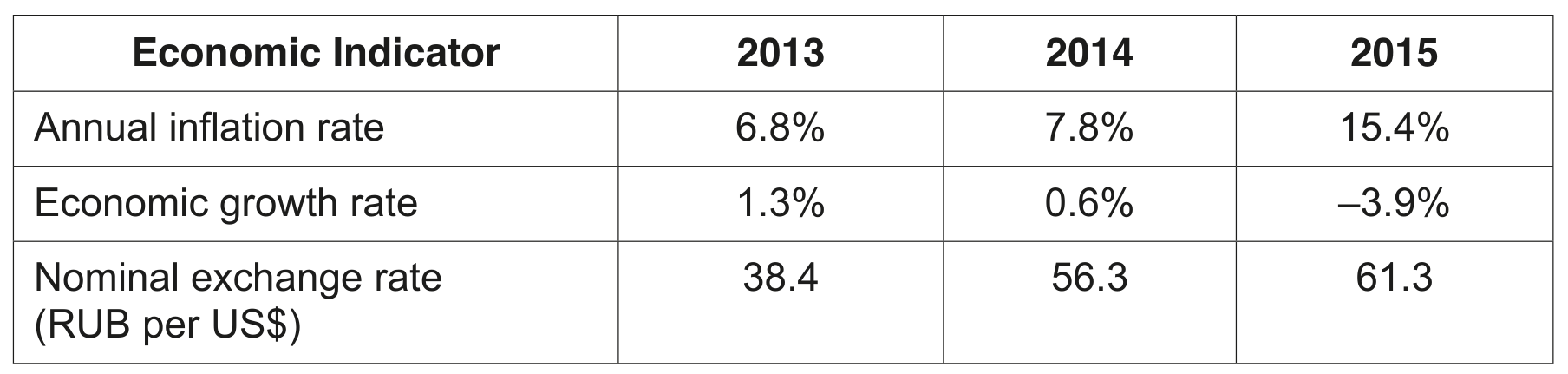
Table 1.1: Selected economic indicators for Russia 2013-2015

Table 1.1: Selected economic indicators for Russia 2013-2015

Question 1(a)(ii)

(a)

Explain the difference between a nominal exchange rate and a real exchange rate.

[ 2 ]

Question 1(b)

(b)

Explain, using a demand and supply diagram, how the fall in the price of a barrel of oil contributed to a decline in the value of the rouble.

[ 4 ]

Question 1(c)

(c)

Analyse the likely impact the depreciation of the rouble could have on the Russian economy.

[ 6 ]

Question 1

[Maximum number: 9]

Economic problems in Kyrgyzstan

Rouble decline affects Kyrgyzstan

Kyrgyzstan is a developing economy which has a border with Russia. At the local market in the capital, Bishkek, the price of meat increased by 9% in six weeks in 2014. A local butcher said that as a result sales had fallen. 'I usually sell 400 kilos of meat every month, but in September I sold only 250 kilos,' she complained. In Bishkek, food prices increased by up to 25% over 12 months. Another shopkeeper increased what he charged for flour by 15%, but sales did not decline by very much. 'We all need flour because we all need to eat bread, macaroni, dough,' he said. 'It's not something people can cut back even if it becomes very expensive.'

Meanwhile, a sharp decline in the value of Russia's currency, the rouble, since early September is having an impact upon countries across Central Asia, where economies are dependent on remittances (transfers of income) from workers in Russia. By October 2014 the value of the rouble had fallen 20\% against the US dollar since the start of the year. The fall had accelerated in September as the price of oil - Russia's main export - dropped to a four-year low. As local currencies followed the value of the rouble downward, the costs of imported essentials rose.

In Kyrgyzstan, remittances from the millions of workers in Russia have started to fall. In recent years, these cash transfers have contributed the equivalent of about 30% of national income to Kyrgyzstan's economy. As the rouble depreciates, however, it purchases fewer US dollars to send home. Any further drop may significantly reduce consumer demand.

This month the International Monetary Fund said it expects consumer prices in Kyrgyzstan to increase by 8.0% in 2014 and 8.9% in 2015, compared with 6.6% last year. One factor that could have an effect is a policy shift at Russia's central bank, which has already spent over US$50 billion this year attempting to protect the value of the rouble. Some people have condemned efforts to support the currency, arguing that a weaker rouble is good for exports.

In Kyrgyzstan the central bank has used some of its limited reserves to reduce the fall in the currency. Nevertheless, Kyrgyzstan's currency, the som, has fallen in value by 12% against the US dollar this year.

Source: Adapted from Asia Times Online, October 2014

Question 1(b)

(a)

With the help of a supply and demand diagram, explain how the Russian central bank is 'attempting to protect the value of the rouble'.

[ 3 ]

Question 1(d)

(b)

Discuss whether the actions of the Russian and Kyrgyzstan governments in protecting the value of their currencies are likely, on balance, to have benefited their economies.

Answer any one question.

[ 6 ]

Question 17

[Maximum number: 1]

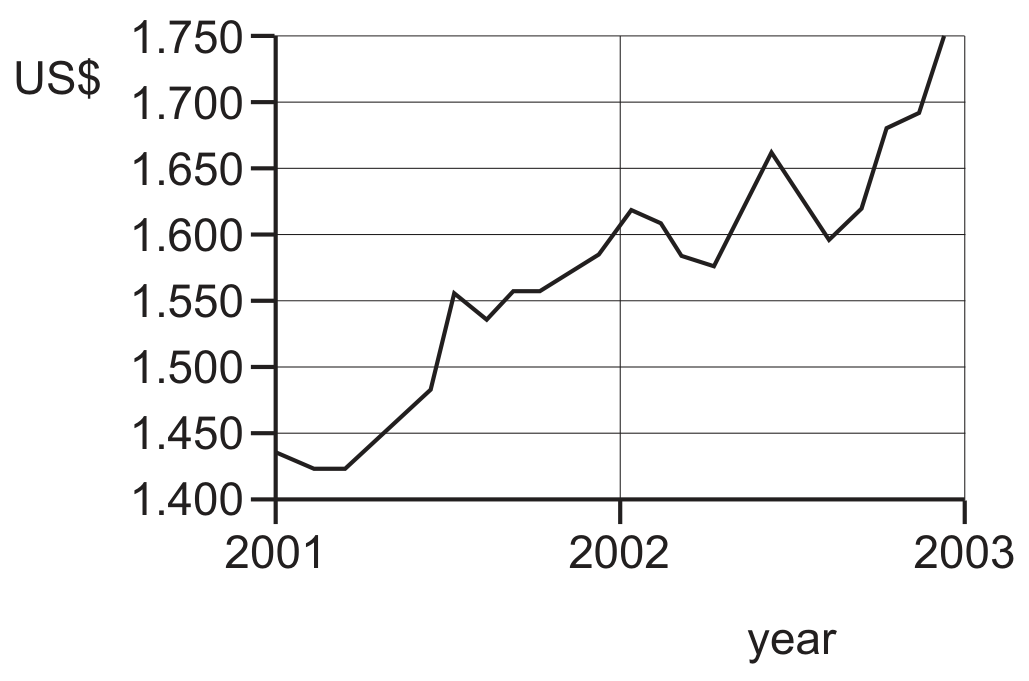
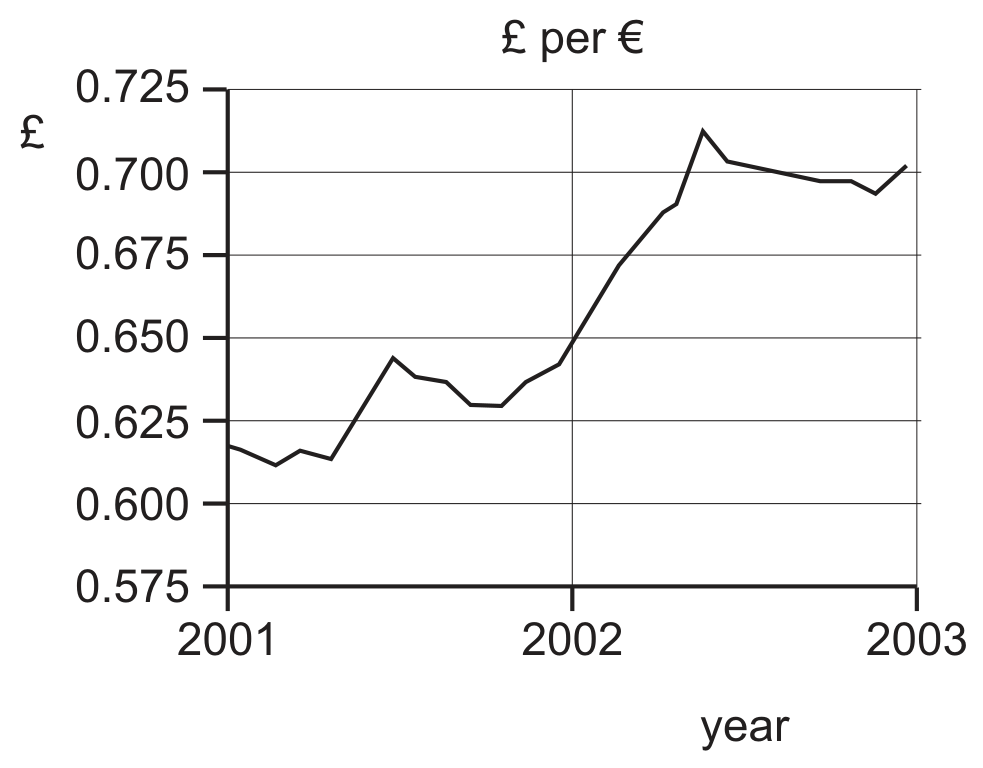
The graphs show the changes in the exchange rates of the pound sterling ( £ ) against the US dollar (US$) and the euro (€) between the years 2001 and 2003.

US\$ per £

US\$ per £

Figure for Question 17 — CAIE A-Level Economics

What happened to the value of the £ between the years 2001 and 2003?

A

The £ appreciated against the US $ and depreciated against the €.

B

The £ appreciated against the US $ and the €.

C

The £ depreciated against the US $ and appreciated against the €.

D

The £ depreciated against the US $ and the €.

Question 28

[Maximum number: 1]

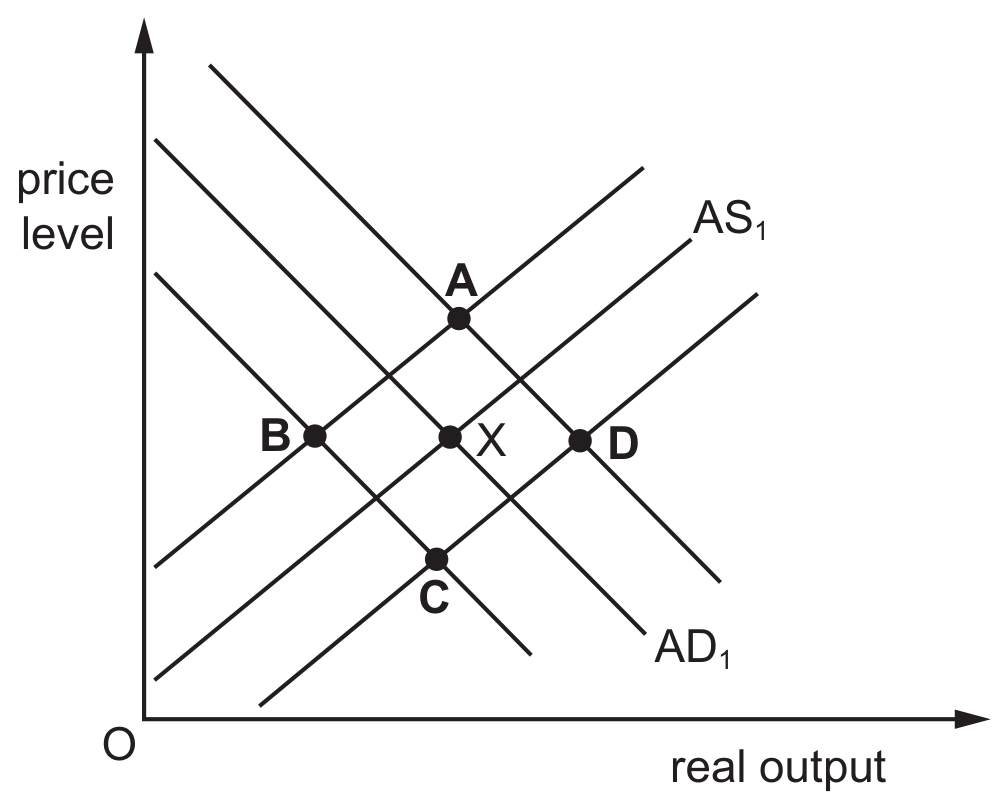
Between June and the end of July 2016, the UK pound sterling depreciated by 11%11 \% against a

basket of currencies of the UK's major trading partners.

The diagram shows the original aggregate demand curve AD1\mathrm{AD}_{1} and the original aggregate supply

curve AS1\mathrm{AS}_{1} for the UK economy before June 2016. The equilibrium is at X .

What would have been the new equilibrium for the UK economy as a result of the depreciation of

the pound sterling?

Figure for Question 28 — CAIE A-Level Economics
A
Option A shown in diagram

Option A shown in diagram

B
Option B shown in diagram

Option B shown in diagram

C
Option C shown in diagram

Option C shown in diagram

D
Option D shown in diagram

Option D shown in diagram

Question 30

[Maximum number: 1]

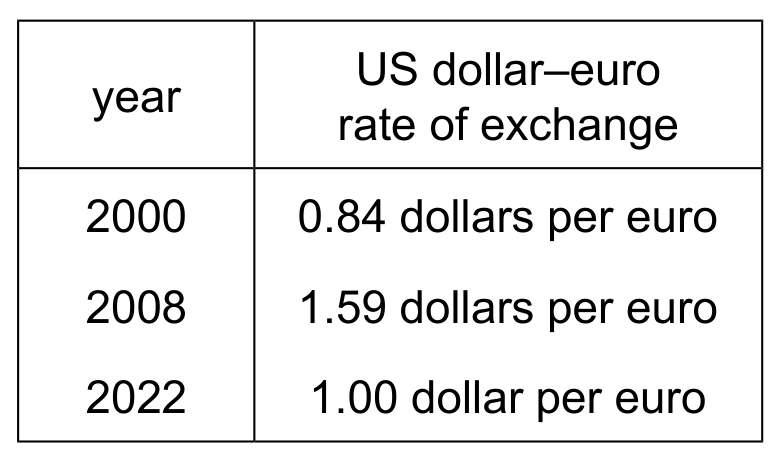
Both the US and the EU operate in floating exchange rate markets.
The rate of exchange fluctuated greatly during the period shown.

Table for Question 30 — CAIE A-Level Economics

What would explain the changes in the US dollar-euro rate of exchange?

A

changes in the supply and demand for dollars and euros in the foreign exchange market

B

continuous appreciation of the US dollar throughout the period

C

continuous depreciation of the US dollar throughout the period

D

restraints placed by trade agreements on the rate of exchange