CAIE A-Level Economics 6.1 Reasons for International Trade Question Bank

CAIE A-Level Economics 6.1 Reasons for International Trade Question Bank
Cambridge International AS & A Level Economics 9708 syllabus for exams in 2026, 2027 and 20282026–2028

Practise calculating absolute and comparative advantage, tracing gains from specialisation and free trade and interpreting terms-of-trade changes and their limitations.

Exam points

  • calculate opportunity costs from output or PPC data to identify comparative advantage
  • use a trading possibility curve to show consumption gains after specialisation and exchange
  • calculate terms of trade and evaluate gains using elasticities, trade volumes and real income

Question 1(e)

[Maximum number: 6]

How do we make sure cocoa bean farmers get paid a living wage?

Chocolate is very big business.

Content removed due to copyright restrictions.

Perhaps the long-term solution is to reduce the country's dependence on cocoa bean exports and diversify into other products that can offer more and better paid job opportunities.

Assess the advantages and disadvantages of Ivory Coast continuing to specialise in the production and export of cocoa beans.

Answer one question.

EITHER
Question 27

[Maximum number: 1]

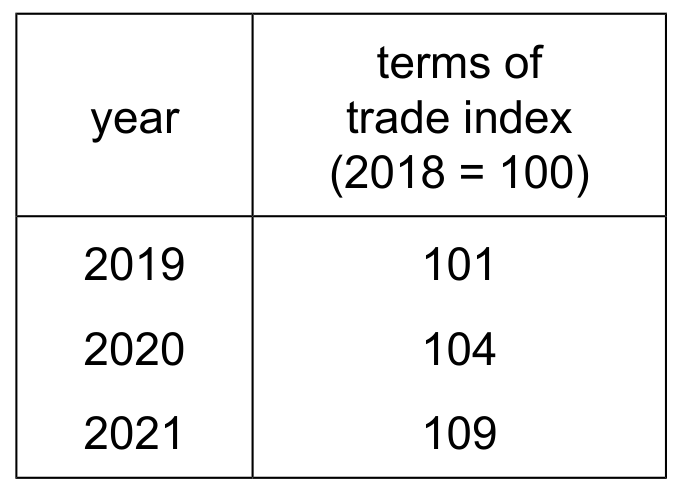
The table shows the terms of trade for an economy expressed as an index number for the period 2019 to 2021.

Table for Question 27 — CAIE A-Level Economics

What can be concluded from the table?

A

The quantity of imports rose relative to the quantity of exports.

B

The price of exports rose relative to the price of imports.

C

The price of imports rose relative to the price of exports.

D

The value of exports rose relative to the value of imports.

Question 28

[Maximum number: 1]

What is meant by comparative advantage?

A

One country can produce a product at a lower opportunity cost than another country.

B

One country can produce more of a product than another country, using a given level of resources.

C

One country has lower barriers to trade than another country.

D

One country is making more efficient use of factors of production than another country.

Question 28

[Maximum number: 1]

What is not a limitation of the theory of comparative advantage?

A

the movement of factors of production between countries

B

governments' imposition of trade restrictions

C

one country being more efficient in the production of all goods

D

transport costs outweighing any comparative advantage