CAIE A-Level Economics 2.1 Demand and Supply Curves Question Bank

CAIE A-Level Economics 2.1 Demand and Supply Curves Question Bank
Cambridge International AS & A Level Economics 9708 syllabus for exams in 2026, 2027 and 20282026–2028

Practise defining effective demand, aggregating individual curves and distinguishing movements from shifts when income, related prices, costs, technology or policy changes.

Exam points

  • distinguish effective demand from desire by requiring willingness and ability to pay
  • aggregate quantities horizontally at each price to construct market demand or supply
  • separate a movement caused by own price from a curve shift caused by a non-price determinant

Question 5

[Maximum number: 1]

What ensures that demand for a product is effective?

A

The consumer must have the ability to buy the product.

B

The consumer must purchase in the private sector of the economy.

C

The consumer must receive consumer surplus.

D

The consumer must want to buy the product.
Question 2(a)

[Maximum number: 8]

Explain the determinants of supply for an agricultural product, such as rice, and consider which of these determinants is likely to be of the greatest significance at the present time. [8]

Question 7

[Maximum number: 1]

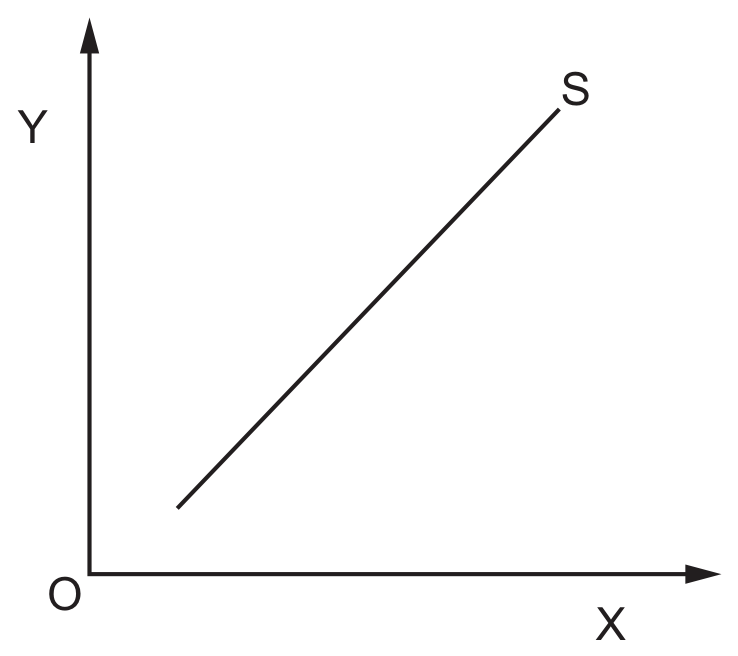
The diagram shows a market supply curve (S).

Figure for Question 7 — CAIE A-Level Economics

What is measured on the X -axis and the Y -axis?

X-axis

Y-axis

quantity

income

quantity

price

price

income

income

quantity

Question 7

[Maximum number: 1]

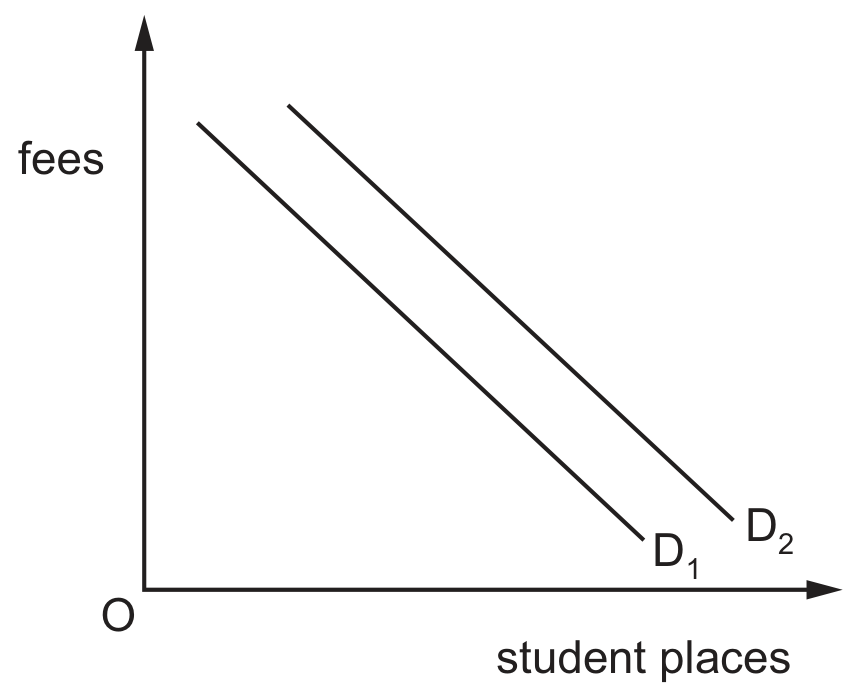
In the diagram, D1\mathrm{D}_{1} is the initial demand curve for student places at universities.

Figure for Question 7 — CAIE A-Level Economics

What could cause the demand curve to shift to D2\mathrm{D}_{2} ?

A

a decrease in student fees for universities

B

a decrease in the level of youth unemployment

C

an increase in graduate earnings compared with non-graduate earnings

D

higher A Level grades demanded for university entrance

Question 13

[Maximum number: 1]

What is likely to affect the position of the demand curve for tickets to pop concerts but not the position of the supply curve?

A

a change in incomes of potential customers

B

a change in price of tickets to the concerts

C

a change in rents charged by venue owners

D

a change in seating capacity of concert venues