Question 1(c)
Inequality and globalisation
A government commission published a report saying that global poverty and inequality were worsening and there was a risk that the gap between the rich and the poor would increase.
But, according to a newspaper, a lot of what is said about inequality is wrong. It overlooks the fact that the past 50 years saw a period of dramatic reduction in global inequality. The normal measurement of relative inequality is the Gini coefficient. The figure for global inequality in 1975 was 0.75 , in 2020 it was 0.72 and in 2022 it was 0.67 .
It is important to understand this trend rather than make the mistake of the commission.
The fall in global inequality should not come as a surprise. For about two hundred years the benefits of industrialisation went mainly to countries in Europe and North America. Income inequality between these countries and poorer countries worsened. The spread of globalisation in recent decades has meant this difference has lessened. Countries such as China and India have benefited from large increases in per capita (average) income, as shown in Table 1.1.
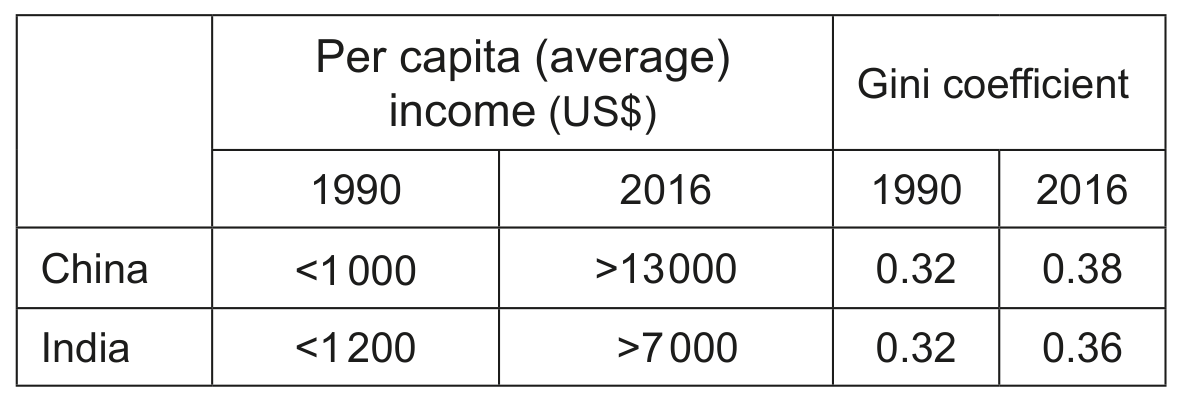
Table 1.1 Per capita (average) income and Gini coefficient for China and India 1990 and 2016
With such an increase in per capita incomes maybe some level of inequality does not matter. Indeed, it might be a necessary condition for economic growth. Instead of concentrating on eliminating inequality perhaps the focus should be on the absolute position of the poorest.
If the attention is on the relief of poverty rather than the wealth of the richest, improvements can be seen. Life expectancy has increased, most noticeably by ten years in the past two decades in the poorest region of sub-Saharan Africa. Literacy rates have also increased. Those in absolute poverty across the world have fallen from more than a third to under a tenth of the world's population. And all this while the world's population has increased.
Critics of globalisation and foreign direct investment (FDI) by multinational companies point to the possible negative environmental effects, the weakening of individual cultures and the reliance on international financial institutions that can fail. They also claim there can be exploitation of workers leading to greater wage inequality and possible increases in domestic unemployment as cheaper goods are imported.
With reference to the article, explain the idea of globalisation and assess whether there is enough evidence to conclude that globalisation has a net benefit for everyone.
Answer one question.
EITHER