EduNinja

A-Level CAIE Biology AS2.1 Testing for Biological MoleculesQuestion Bank

Question 1

Question 1(b)

Question 1(b)(i)

(a)
(i)

Cell structure Y in Fig. 1.1 contains a large starch granule (grain).

Name the chemical reagent used to test for starch and state the colour change that will be seen if starch is present.
reagent
colour change

[ 2 ]
Question 2

[Maximum number: 3]

Lipase is an enzyme with many commercial uses. Some species of bacteria are of great interest as they produce large quantities of lipase.

Question 2(b)

(a)

To measure the activity of the bacterial lipase during their investigations, the researchers used a method based on the biological test for triglycerides.

Outline a biological test that could be carried out to show the presence of triglyceride in a liquid mixture and describe the positive result for this test.

[ 3 ]

Question 5

[Maximum number: 1]

The size of the measles virus is approximately 150 nm .
The Mimivirus is approximately 4.5 times larger than the measles virus, whilst the Pandoravirus is approximately 1.5 times larger than the Mimivirus.

Which viruses can be seen using both a light microscope with a maximum resolution of 0.25μ m0.25 \mu \mathrm{~m} and an electron microscope?

measles virus

Mimivirus

Pandoravirus

key

✓ = can be seen

χ=\boldsymbol{\chi}= cannot be seen

x

x

χ\boldsymbol{\chi}

χ\chi

x

×

Question 5

[Maximum number: 1]

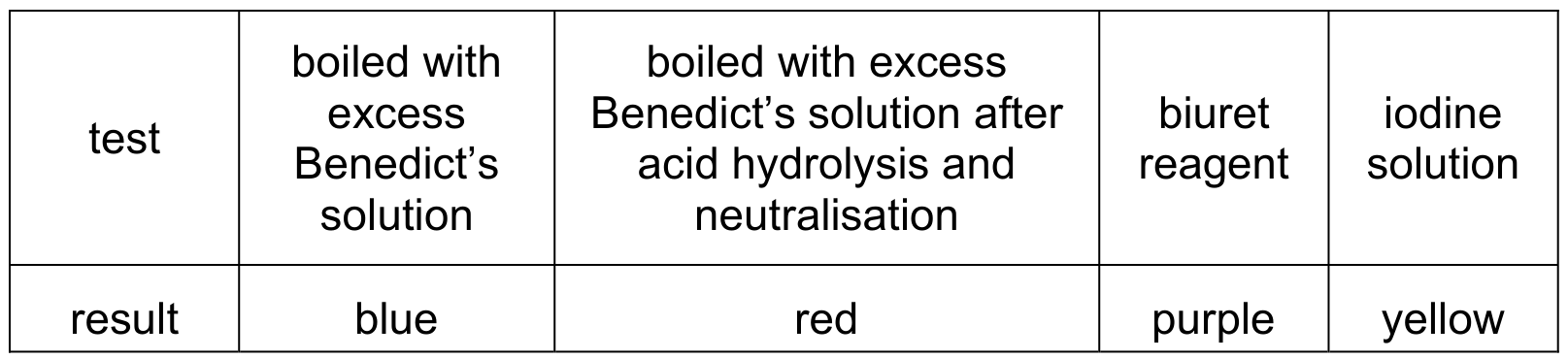
Tests on four samples from a mixture of biological molecules gave the results shown in the table.

Table

Which biological molecules were in the mixture?

A

reducing sugar and protein

B

reducing sugar, non-reducing sugar and starch

C

non-reducing sugar and protein

D

non-reducing sugar and starch only

Question 5

[Maximum number: 1]

After boiling a sample of milk with Benedict's solution, a yellow colour is observed.
Which conclusion about the sample of milk is correct?

A

Reducing sugars are not present.

B

Reducing sugars are present.

C

There is a high concentration of fructose.

D

There is a low concentration of sucrose.

Question 5

[Maximum number: 1]

Steps 1-4 are used to test for a non-reducing sugar.
1 Put 5 cm35 \mathrm{~cm}^{3} of solution into a test-tube.
2 Add a few drops of acid.
3 Neutralise with alkali.
4 Add 6 cm36 \mathrm{~cm}^{3} Benedict's solution.
When is the solution boiled?

A

between steps 1 and 2

B

between steps 2 and 3 and after step 4

C

between steps 2 and 3 only

D

after step 4 only

Question 5

[Maximum number: 1]

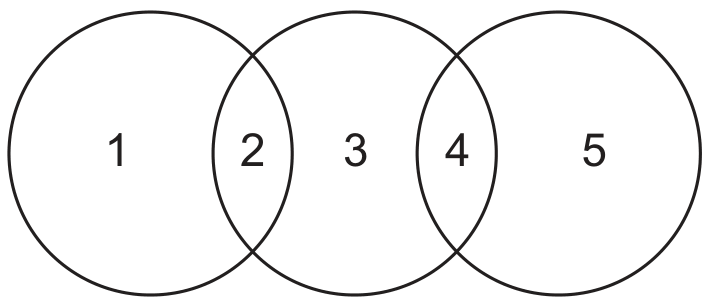
The diagram shows some similarities between chloroplasts, mitochondria and typical prokaryotes.

Question image

Which row is correct?

1

2

3

4

5

chloroplasts

circular DNA

mitochondria

linear DNA

prokaryotes

mitochondria

linear DNA

chloroplasts

70S ribosomes

prokaryotes

mitochondria

70S ribosomes

chloroplasts

linear DNA

prokaryotes

prokaryotes

70S ribosomes

mitochondria

70S ribosomes

chloroplasts

Question 6

[Maximum number: 1]

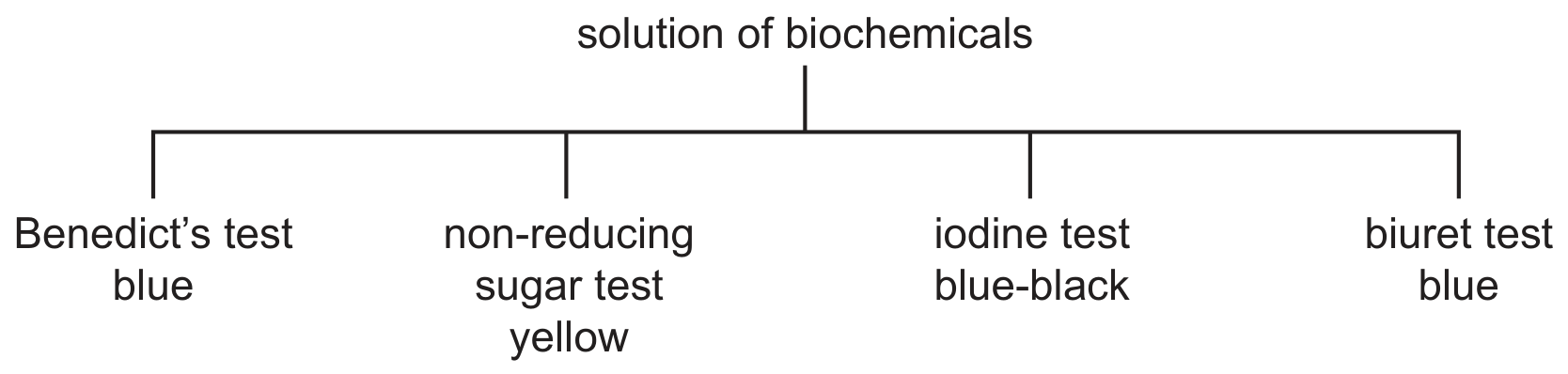
The diagram shows the results of a number of tests on a solution of biochemicals.

Question image

Which substances are present in the solution?

A

non-reducing sugar and starch only

B

protein, non-reducing sugar and starch

C

starch and reducing sugar

D

starch only

Question 6

[Maximum number: 1]

The table shows the observations recorded from tests for biological molecules on four samples, A, B, C and D.

Which conclusion is correct?

Benedict's solution

biuret reagent

iodine solution

conclusion

blue

blue

blue-black

contains starch only

blue

purple

orange

contains reducing sugar only

green

blue

orange

contains reducing sugar and protein

red

blue

blue-black

contains starch and protein

Question 6

[Maximum number: 1]

Two solutions, 1 and 2, one containing starch and sucrose, and the other containing glucose and protein, were tested with a variety of reagents to confirm their identity.

The table shows the conclusions from the results recorded for the various tests.
Which row identifies the two solutions?

1

2

1

2

1

2

1

2

+

-

+

-

-

+

-

+

-

+

+

-

+

-

-

+

+ = biological molecule present

+

-

-

+

+

-

-

+

- = biological molecule absent

-

+

+

-

+

+

+

-

0 selected