EduNinja

A-Level CAIE Biology AS1.1 The Microscope in Cell StudiesQuestion Bank

Question 1

[Maximum number: 1]

Which steps are needed to find the actual width of a xylem vessel viewed in transverse section using a ×40\times 40 objective lens?

1 Convert from mm to μm\mu \mathrm{m} by multiplying by 10310^{-3}.
2 Calibrate the eyepiece graticule using a stage micrometer on ×10\times 10 objective lens.
3 Measure the width of the xylem vessel using an eyepiece graticule.
4 Multiply the number of eyepiece graticule units by the calibration of the eyepiece graticule.

A

1, 2, 3 and 4

B

2, 3 and 4 only

C

1 and 2 only

D

3 and 4 only

Question 1

[Maximum number: 1]

What best describes an electron microscope in comparison with a light microscope?

magnification

resolution

higher

higher

higher

lower

lower

higher

lower

lower

Question 1

[Maximum number: 1]

Which structure is measured in the units shown using a light microscope?

structure

unit

cell surface membrane

nm

cell wall

nm

chloroplast

μm\mu \mathrm{m}

ribosome

μm\mu \mathrm{m}

Question 1

[Maximum number: 1]

An eyepiece graticule can be calibrated using a stage micrometer.
What is the correct reason why an eyepiece graticule is calibrated?

A

An eyepiece graticule can be used to make measurements.

B

An eyepiece graticule is magnified by the objective lens.

C

An eyepiece graticule magnifies the specimen.

D

An eyepiece graticule makes comparisons.

Question 1

[Maximum number: 1]

A light microscope is used to observe two membranes that are 200 nm apart.
How far apart are the membranes when the objective lens is changed from low power (×40)(\times 40) to high power ( ×400\times 400 )?

A

2μ m2 \mu \mathrm{~m}

B

20μ m20 \mu \mathrm{~m}

C

200 nm

D

2000 nm

Question 1

[Maximum number: 1]

Which size ranges can be viewed using a light microscope?

Question image
A

4 only

B

1 and 2 only

C

2 and 3 only

D

3 and 4 only

Question 1

[Maximum number: 1]

Which eyepiece and objective lens combination of a light microscope enables you to see the greatest number of cells in the field of view?

eyepiece lens

objective lens

×5\times 5

×10\times 10

×5\times 5

×40\times 40

×10\times 10

×10\times 10

×10\times 10

×40\times 40

Question 1

[Maximum number: 1]

Using a stage micrometer scale, one unit of an eyepiece graticule was calculated as 0.005 mm . The diameter of a spongy mesophyll cell was counted as 3.5 units on the eyepiece graticule.

What is the estimate of the diameter of the cell?

A

0.18μ m0.18 \mu \mathrm{~m}

B

1.8μ m1.8 \mu \mathrm{~m}

C

18.0μ m18.0 \mu \mathrm{~m}

D

180μ m180 \mu \mathrm{~m}

Question 1

[Maximum number: 3]

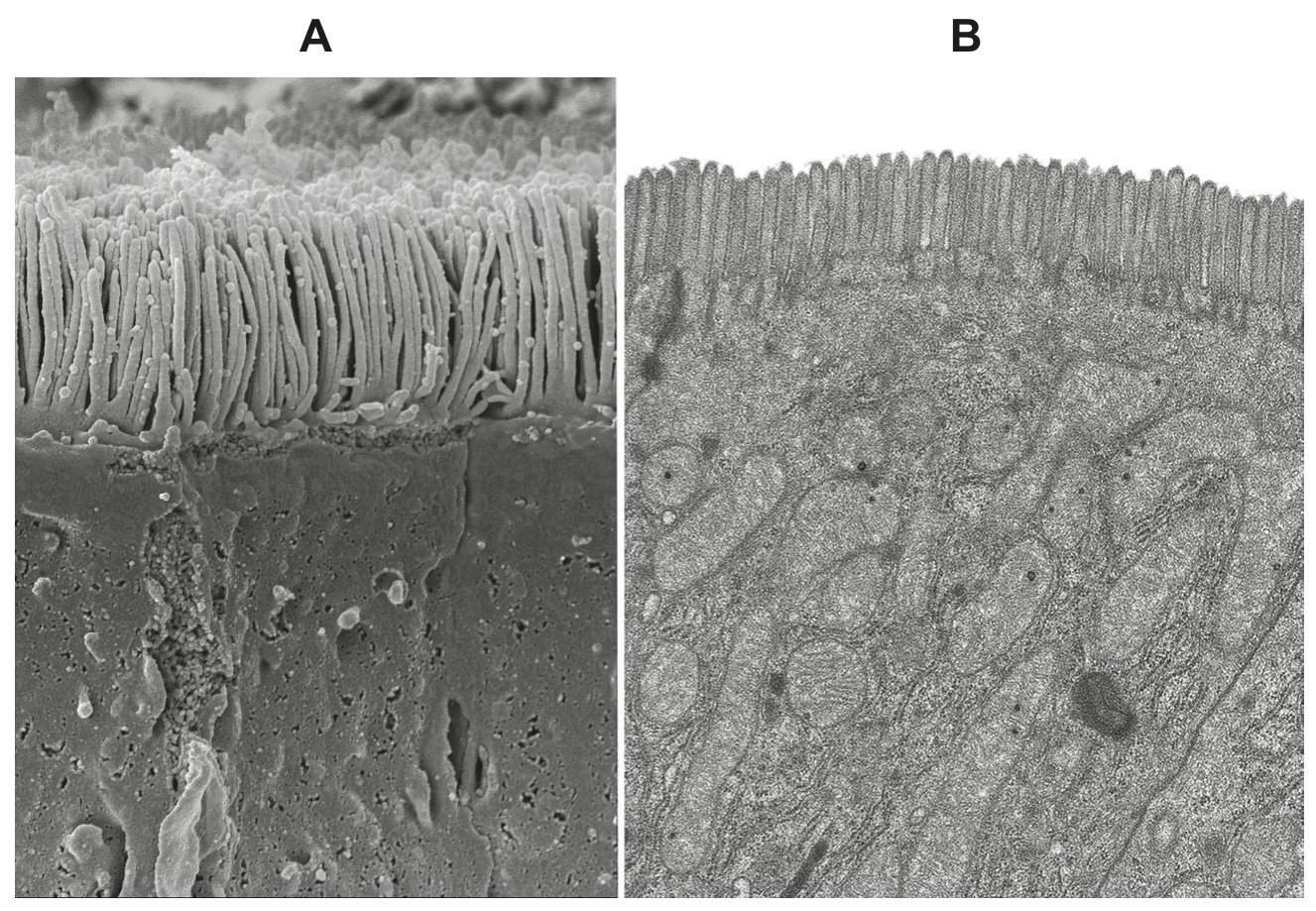
Epithelial cells in the small intestine have cell structures known as microvilli. The microvilli of these cells are found only on the surface that borders the gut lumen.

Fig. 1.1 shows images of microvilli of intestinal epithelial cells. These images have been obtained using a scanning electron microscope and a transmission electron microscope.

Fig. 1.1 A is at a different magnification to Fig. 1.1B.

Fig. 1.1

Fig. 1.1

Question 1(a)

(a)

With reference to Fig. 1.1, state how it is possible to distinguish between a scanning electron micrograph and a transmission electron micrograph.

[ 1 ]

Question 1(b)

(b)

The approximate length of a microvillus is 1μ m1 \mu \mathrm{~m}.

Outline the method you would use to estimate the magnifications of the images shown in Fig. 1.1.

[ 2 ]

Question 1

Question 1(b)

(a)

Explain the advantages of using a transmission electron microscope compared with a light microscope when viewing a liver cell.

[ 3 ]
0 selected