2.1.1—Ion formation

Syllabus
First assessment 2025
Objective
2.1.1
Level
HL

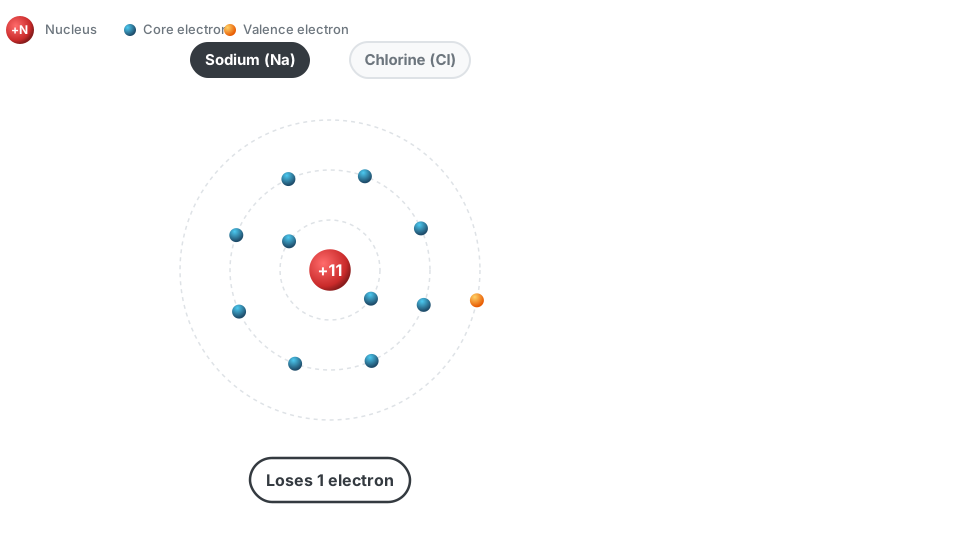
Forming Ions

Atom tendency Electron change Ion formed
Metal atom Loses electrons Positive cation
Non-metal atom Gains electrons Negative anion

Use the electron configuration to see how many electrons are needed to reach the relevant stable arrangement. The number lost or gained determines the magnitude of the ion charge.

Loss of electrons leaves more protons than electrons and gives a positive charge. Gain of electrons gives more electrons than protons and gives a negative charge.

Read the outer-shell electrons before predicting charge: Al loses three electrons to form Al³⁺, while O gains two to form O²⁻. Check the sign by recounting protons and electrons after transfer; do not assume that every metal, especially a transition metal, has only one possible charge.

Predicting Ion Formation

Assessment in practice

1 mark in each selected multiple-choice example marks
How it is assessed

Questions ask how many electrons an atom gains or loses or how a metal forms its stable ion.

Command terms

determine

What earns marks

Read the configuration or metal identity, choose electron gain or loss, and match the number of electrons to the resulting ion charge.

Watch for

Reversing gain and loss or giving the magnitude of charge with the wrong sign.

Representative question

Question 1

[Maximum number: 1]

How many electrons will be gained or lost when the element with electron configuration 1s22s22p31 s^{2} 2 s^{2} 2 p^{3} forms an ionic bond?

A

Two electrons lost

B

Two electrons gained

C

Three electrons lost

D

Three electrons gained

The Ionic Model Summary

Retrieve the chain: atoms gain or lose electrons to form ions; oppositely charged ions attract and balance into empirical formulae; the three-dimensional lattice explains volatility, solubility, and conductivity.

When checking an answer, ask: Did I state gain or loss and charge? Did I define the bond as electrostatic attraction? Did I connect the property to lattice arrangement and ion mobility?