2.1.3—Ionic compounds
- Syllabus
- First assessment 2025
- Objective
- 2.1.3
- Level
- HL
An ionic lattice is a three-dimensional, repeating arrangement of cations and anions. Its empirical formula gives the simplest whole-number ion ratio, not a molecule.
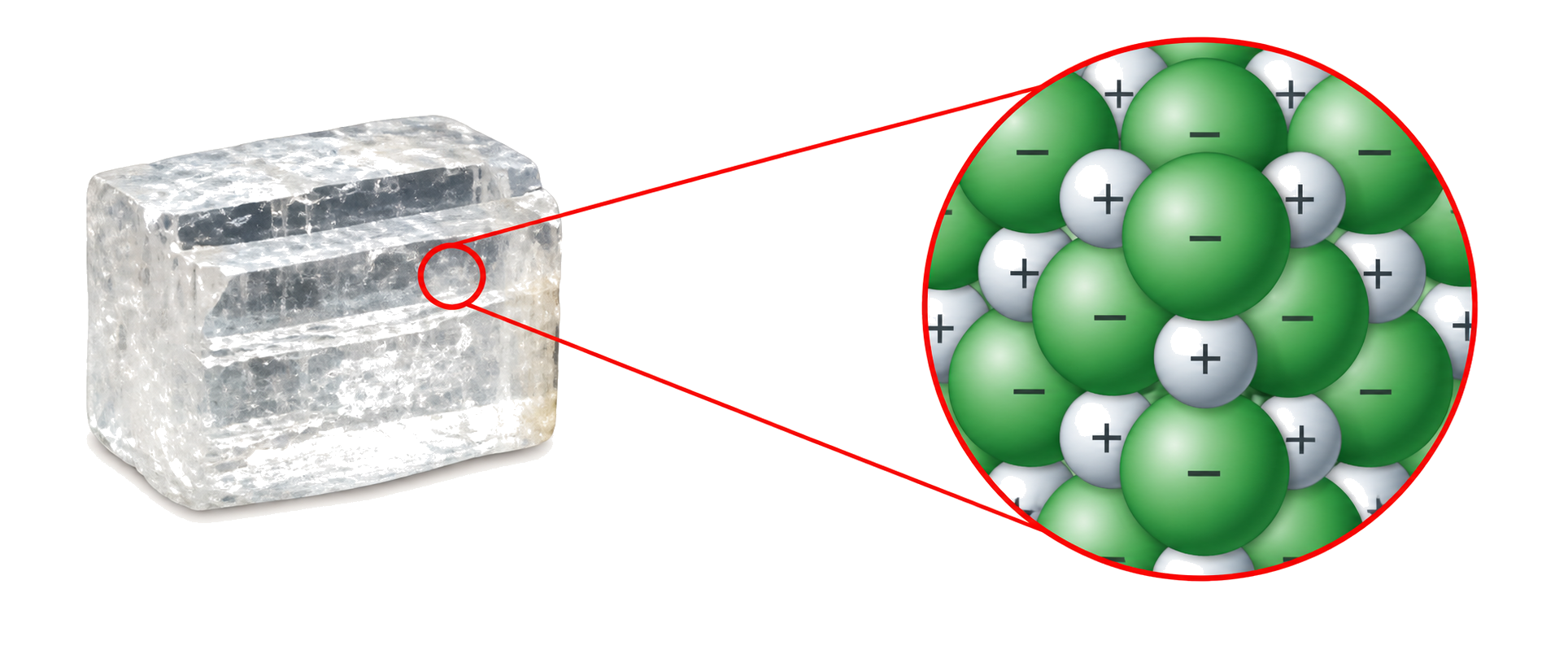
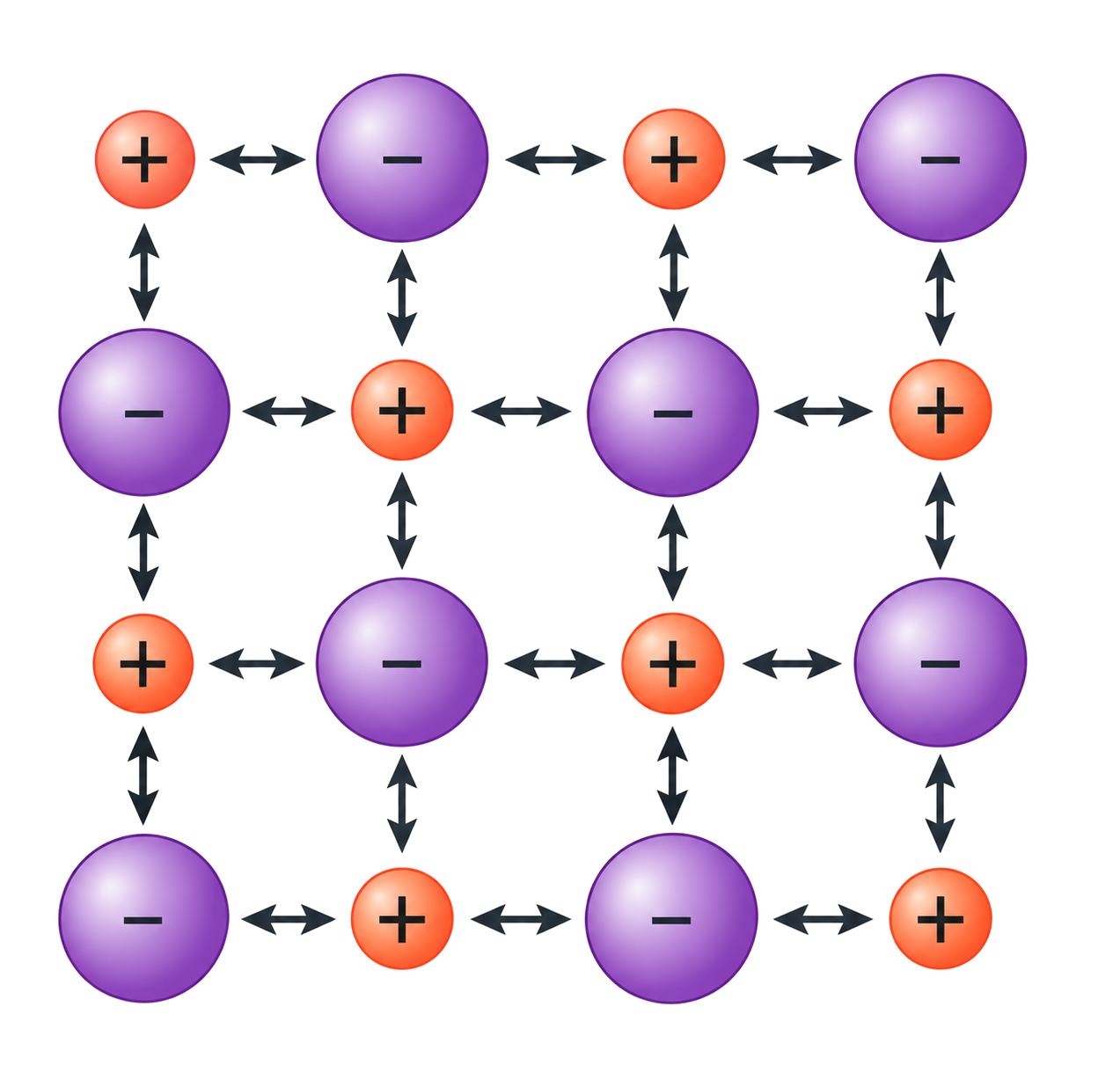
Lattice dissociation enthalpy is the positive enthalpy change for separating one mole of a solid lattice into gaseous ions. It becomes larger when ionic charges are higher or ionic radii are smaller, because the electrostatic attraction is stronger.
| Property | Structure-based explanation |
|---|---|
| High melting point / low volatility | Strong electrostatic attractions act throughout the lattice |
| Brittle | A layer shift can bring like charges together, causing repulsion and fracture |
| Solid conductivity | Ions are fixed and cannot carry charge through the solid |
| Molten/aqueous conductivity | Ions are mobile and can carry charge |
| Solubility | Depends on the balance between lattice attraction and ion–solvent attraction |
Use charge density to compare lattice strength: MgO has stronger attractions than NaCl because both ions carry ±2 rather than ±1, so its melting point is higher. For conductivity, the presence of charged particles is not enough—solid NaCl does not conduct until its ions can move. Water often hydrates ions, but solubility still depends on the energy balance rather than on polarity alone.