D4.3.4—Polar habitat changes

Polar habitat changes alter ice-dependent breeding, feeding, migration, decomposition, species distributions, and food-web interactions in Arctic and Antarctic ecosystems today.

Syllabus
First assessment 2025
Objective
D4.3.4
Level
SL

Exam analysis

Chance of appearing5%of analysed past papers
Latest appearanceMay 2015
Most common paperPaper2
Typical marks1–6

Common command terms

  • Outline
  • State
  • Distinguish
  • Describe
  • Analyse
  • Discuss

Scoring notes

Common mistake
Assuming all polar sea ice changes have the same direction in Arctic and Antarctic data.

Recent exam appearances

May 2015Paper2 ["SL"] · TZ17(b)[ 6 ]D4.3.4—Polar habitat changes
May 2014Paper1 ["SL"] · TZ122[ 1 ]D4.3.4—Polar habitat changes
May 2013Paper1 ["SL"] · TZ121[ 1 ]D4.3.4—Polar habitat changes
May 2012Paper2 ["SL"] · TZ27(b)[ 6 ]D4.3.4—Polar habitat changes
May 2012Paper2 ["SL"] · TZ14(a)[ 2 ]D4.3.4—Polar habitat changes
Practice this objective

Coverage 2010–2015 · Updated 16 Jul 2026

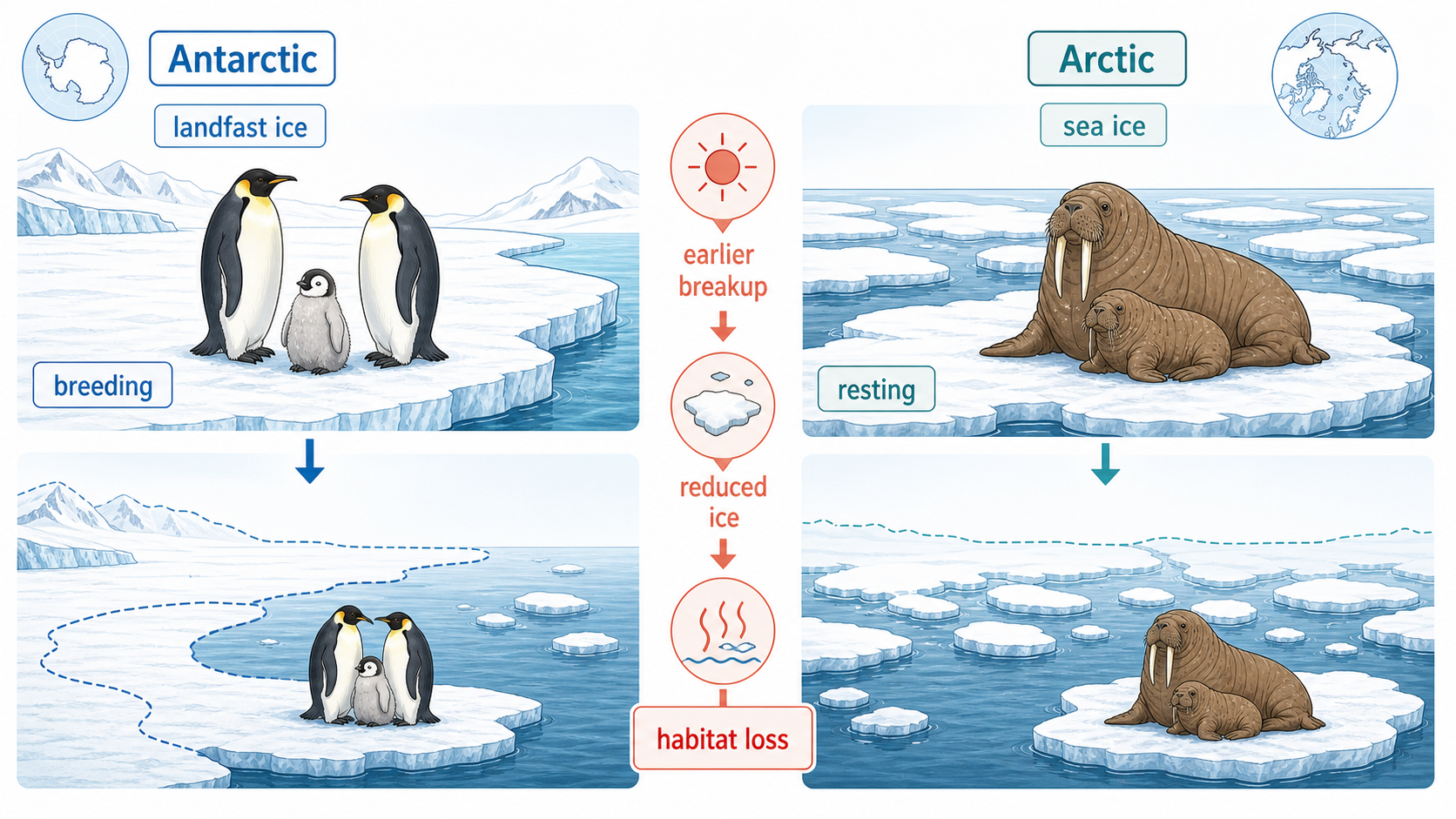
Polar Ice Loss Removes Breeding and Resting Habitat

Climate warming changes polar habitat by causing earlier Antarctic landfast-ice breakout and reducing Arctic sea ice.

Ice change Species-level consequence
Earlier breakup of Antarctic landfast ice Emperor penguins (Aptenodytes forsteri) may lose stable breeding grounds before chicks complete development
Loss of Arctic sea-ice floes Walruses lose resting platforms between feeding dives; calves are especially dependent on the habitat

Ice is physical habitat, not only frozen water: its seasonal timing and position control access to breeding, resting and feeding areas.

Landfast ice is attached to coast, seabed shoals or grounded icebergs; sea-ice extent and ecological effects vary by region and season.

Polar habitat changes

Assessment in practice

1–5 marks
How it is assessed

This objective is assessed through essay response, data analysis, commonly using Outline / State / Distinguish.

Command terms

Outline / State / Distinguish / Describe / Analyse / Discuss

What earns marks

Build the answer around this relationship: Loss of ice habitat can reduce survival and reproduction of ice-dependent species.

Watch for

Assuming all polar sea ice changes have the same direction in Arctic and Antarctic data.

Representative question

Question 1

[Maximum number: 3]

Discuss the use of Adélie penguins in studying the effects of global warming.

Retrieve the SL Climate Chain

Core D4.3 is secure when every climate impact is explained as a chain: human greenhouse-gas sources or feedbacks change climate conditions, which alter habitats, oceans, carbon stores, or species distributions. Carbon sequestration is the mitigation chain that stores atmospheric CO2.

  • human gases and positive feedbacks amplify warming
  • boreal forests, ice habitats, upwelling and reefs shift through specific mechanisms
  • species may move poleward, upslope, contract, or lose ice/reef habitat
  • afforestation, agroforestry, regeneration and peatland rewetting store CO2

Climate Effects on Ecosystems

Core climate-change transfer answers should not list endangered examples. They should identify the climate driver, explain the physical or chemical mechanism, then state the biological consequence. Use this for greenhouse gases, feedbacks, boreal forests, ice-dependent species, upwelling, range shifts, reefs, and carbon sequestration.

  • Link human activities to increased greenhouse gases and enhanced warming.
  • Explain ecosystem impacts using mechanisms such as positive feedback, carbon sink/source shifts, habitat ice loss, reduced upwelling, range shifts, bleaching or acidification.
  • Explain carbon sequestration by naming the storage pathway in biomass, forests, soils or peatlands.

Concept essentials

  • Loss of ice habitat can reduce survival and reproduction of ice-dependent species.
  • Warmer polar conditions can increase decomposition, pests, pathogens, and temperate-species range expansion.
  • Penguin colony data can indicate climate effects, but regional sea-ice trends may differ.