Q BankQuestion BankDocsDocuments

D4.3.1—Anthropogenic causes

Anthropogenic climate change is driven by human releases of greenhouse gases that increase long-wave radiation absorption and global heating over time.

Syllabus
First assessment 2025
Objective
D4.3.1
Level
SL

Exam analysis

Chance of appearing14%of analysed past papers
Latest appearanceMay 2025
Most common paperPaper1
Typical marks1–3

Common command terms

  • Explain
  • Outline
  • Discuss
  • Describe
  • State

Scoring notes

Common mistake
Confusing the greenhouse effect with ozone-layer depletion or ultraviolet radiation reaching Earth.

Recent exam appearances

May 2025Paper2 ["SL"] · TZ17(c)[ 7 ]D4.3.1—Anthropogenic causes
November 2024Paper2 ["SL"] · TZ14[ 3 ]D4.3.1—Anthropogenic causes
November 2024Paper1 ["SL"] · TZ220[ 1 ]D4.3.1—Anthropogenic causes
November 2024Paper1 ["SL"] · TZ119[ 1 ]D4.3.1—Anthropogenic causes
May 2024Paper1 ["SL"] · TZ219[ 1 ]D4.3.1—Anthropogenic causes
Practice this objective

Coverage 2010–2025 · Updated 16 Jul 2026

Human Activities Add Greenhouse Forcing

Anthropogenic climate change occurs when human activities alter atmospheric composition and energy flows, increasing warming or other climate drivers.

Fossil-fuel combustion, land-use change and agriculture add greenhouse gases or reduce sinks. The gases change radiative balance, which shifts temperature and circulation.

Trace source; atmospheric change; energy effect; observed climate response.; separate driver, mechanism, response and timescale

Burning coal adds CO2 that persists in the atmosphere and increases outgoing-heat absorption, contributing to warming. This gives a concrete prediction from the stated climate condition.

One weather event cannot prove the cause of climate change; attribution uses long-term data and models. Interpret the result within the stated evidence and scenario limits.

Anthropogenic causes

Assessment in practice

1–3 marks
How it is assessed

This objective is assessed through structured response, commonly using Explain / Outline / Discuss.

Command terms

Explain / Outline / Discuss / Describe / State

What earns marks

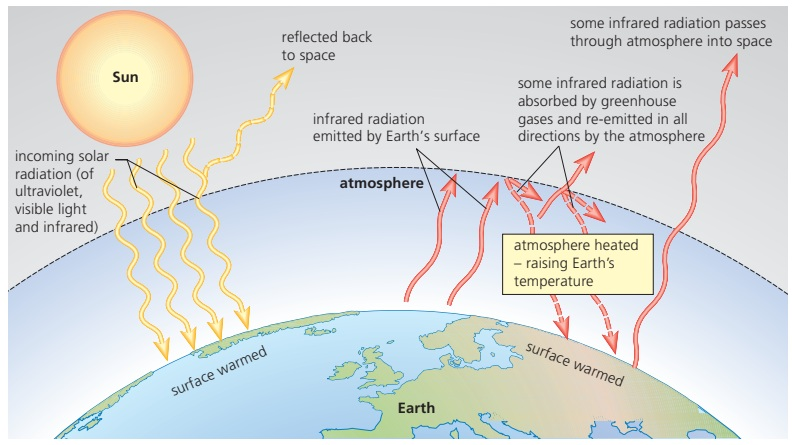
Build the answer around this relationship: The greenhouse effect is natural, but human activity enhances it by increasing greenhouse gas concentrations.

Watch for

Confusing the greenhouse effect with ozone-layer depletion or ultraviolet radiation reaching Earth.

Representative question

Question 1

[Maximum number: 7]

Explain the impact of anthropogenic activity on climate change.

Retrieve the SL Climate Chain

Core D4.3 is secure when every climate impact is explained as a chain: human greenhouse-gas sources or feedbacks change climate conditions, which alter habitats, oceans, carbon stores, or species distributions. Carbon sequestration is the mitigation chain that stores atmospheric CO2.

  • human gases and positive feedbacks amplify warming
  • boreal forests, ice habitats, upwelling and reefs shift through specific mechanisms
  • species may move poleward, upslope, contract, or lose ice/reef habitat
  • afforestation, agroforestry, regeneration and peatland rewetting store CO2

Climate Effects on Ecosystems

Core climate-change transfer answers should not list endangered examples. They should identify the climate driver, explain the physical or chemical mechanism, then state the biological consequence. Use this for greenhouse gases, feedbacks, boreal forests, ice-dependent species, upwelling, range shifts, reefs, and carbon sequestration.

  • Link human activities to increased greenhouse gases and enhanced warming.
  • Explain ecosystem impacts using mechanisms such as positive feedback, carbon sink/source shifts, habitat ice loss, reduced upwelling, range shifts, bleaching or acidification.
  • Explain carbon sequestration by naming the storage pathway in biomass, forests, soils or peatlands.

Concept essentials

  • The greenhouse effect is natural, but human activity enhances it by increasing greenhouse gas concentrations.
  • Carbon dioxide, methane, water vapour, and nitrous oxides absorb long-wave infrared radiation.
  • Fossil fuel combustion and deforestation are repeated causes of rising atmospheric carbon dioxide.
ConceptIB Biology SL