D3.1.5—Ovarian and uterine cycles

Ovarian and uterine cycles coordinate follicle growth, ovulation, endometrium maintenance and menstruation through FSH, LH, estrogen and progesterone feedback loops.

Syllabus
First assessment 2025
Objective
D3.1.5
Level
SL

Exam analysis

Chance of appearing12%of analysed past papers
Latest appearanceNovember 2021
Most common paperPaper1
Typical marks1

Common command terms

  • Sketch
  • Identify
  • Outline
  • Explain

Scoring notes

Common mistake
Confusing LH with FSH or progesterone when identifying the hormone that triggers ovulation.

Recent exam appearances

November 2021Paper1 ["SL"] · TZ030[ 1 ]D3.1.5—Ovarian and uterine cycles
May 2021Paper1 ["SL"] · TZ128[ 1 ]D3.1.5—Ovarian and uterine cycles
November 2019Paper1 ["SL"] · TZ030[ 1 ]D3.1.5—Ovarian and uterine cycles
November 2018Paper1 ["SL"] · TZ030[ 1 ]D3.1.5—Ovarian and uterine cycles
November 2017Paper2 ["SL"] · TZ06(b)[ 8 ]D3.1.5—Ovarian and uterine cycles

Coverage 2010–2021 · Updated 16 Jul 2026

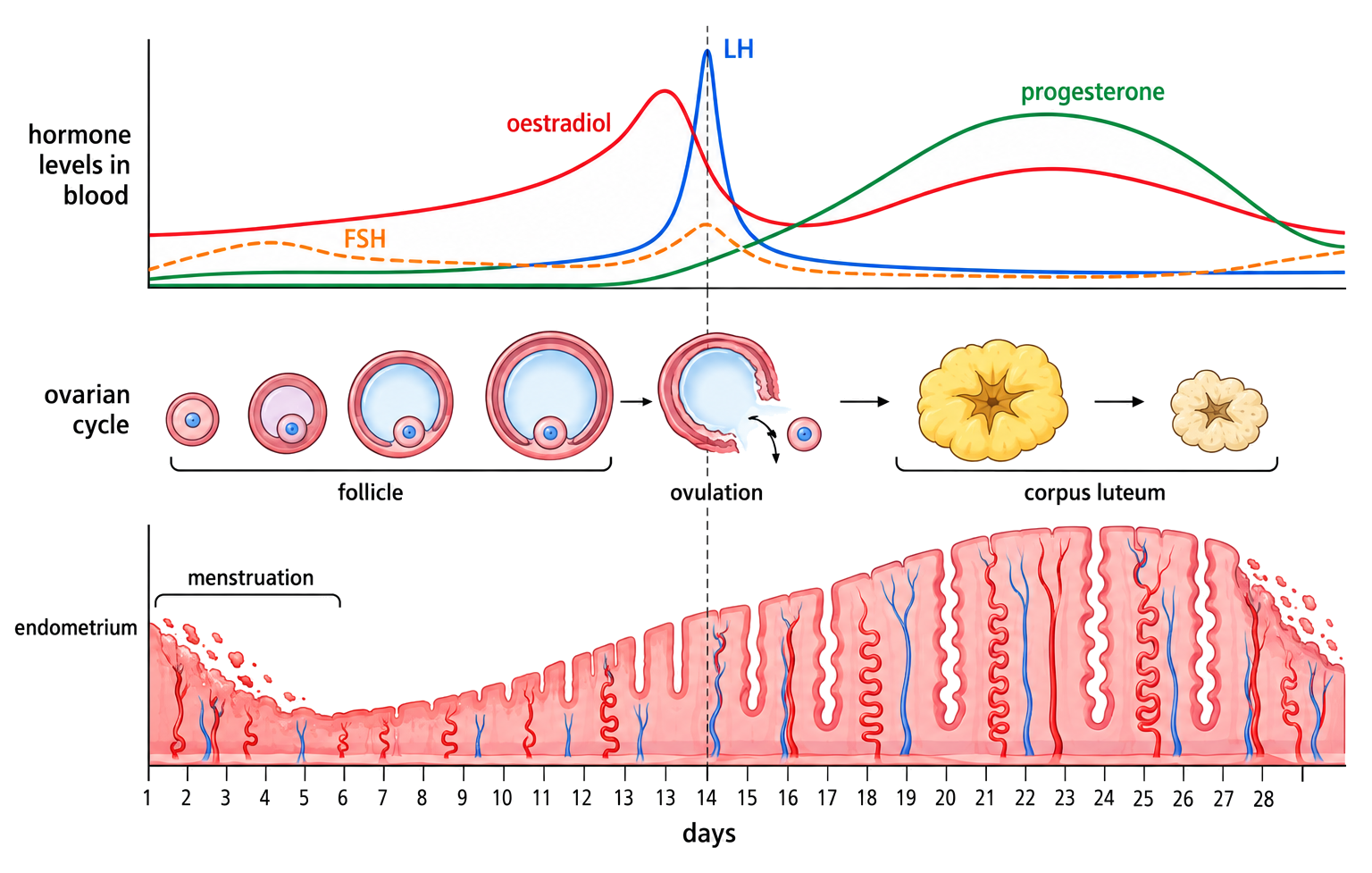
One Timeline Aligns the Ovarian and Uterine Cycles

Approximate time Ovary Dominant signal Endometrium
days 1–5 new follicles begin developing FSH rises menstruation
days 5–13 one follicle becomes dominant rising oestradiol rebuilds
around day 14 ovulation LH surge remains prepared
days 15–28 corpus luteum active, then degenerates if no pregnancy progesterone rises, then falls maintained, then shed

Twenty-eight days and day 14 are useful averages, not fixed dates for every person or every cycle. Interpret event order and hormone relationships before relying on a calendar number.

A 28-day timeline aligns FSH, LH, oestradiol and progesterone curves with follicle growth, ovulation, corpus luteum and endometrial change.

FSH and Oestradiol Build the Pre-Ovulatory State

FSH from anterior pituitary → follicle growth → follicle secretes oestradiol → endometrium proliferates

Oestradiol condition Feedback effect Functional consequence
rising during follicle development supports further follicle responsiveness and oestradiol production one follicle becomes dominant
high before mid-cycle suppresses FSH but stimulates strong LH release limits additional follicles and prepares ovulation

FSH primarily stimulates follicle development. LH is not a substitute name for FSH; its surge triggers the later ovulation transition.

The LH Surge Switches the Cycle into the Luteal Phase

1

high oestradiol → LH surge → ovulation → ruptured follicle becomes corpus luteum

2

corpus luteum → progesterone plus oestradiol → endometrium maintained and FSH/LH inhibited

3

If pregnancy does not begin: corpus luteum degenerates → progesterone and oestradiol fall → endometrium is no longer maintained → menstruation; loss of inhibition allows FSH to rise for a new cycle.

Ovulation is caused by the LH surge. Menstruation is caused later by loss of ovarian steroid support; the two events are not simultaneous.

Human Reproduction Coordinates Ploidy, Place and Hormone Timing

meiosis halves chromosome-set number and reshuffles alleles → specialized haploid gametes form → random fertilization restores diploidy → mitosis grows the genetically unique zygote

Transition Main location Key control or structure
sperm production and maturation testis → epididymis FSH/testosterone; seminiferous tubules
follicle growth and ovulation ovary FSH, oestradiol and LH surge
fertilization upper oviduct gamete encounter and membrane fusion
implantation preparation endometrium oestradiol and progesterone
IVF intervention clinic/laboratory → uterus controlled stimulation, retrieval, culture and transfer

When explaining a reproductive event, name the chromosome state, the anatomical location and the controlling signal. Mixing these three levels is the main source of fragmented answers.

Ovarian and uterine cycles

[ 8 ]

Explain the roles of specific hormones in the menstrual cycle, including positive and negative feedback mechanisms.

Drawing canvas

Concept essentials

  • FSH promotes follicle development and estrogen secretion.
  • A high estrogen concentration stimulates the LH surge that triggers ovulation.
  • Progesterone maintains the endometrium and inhibits further FSH and LH secretion.