D2.3.2—Water movement
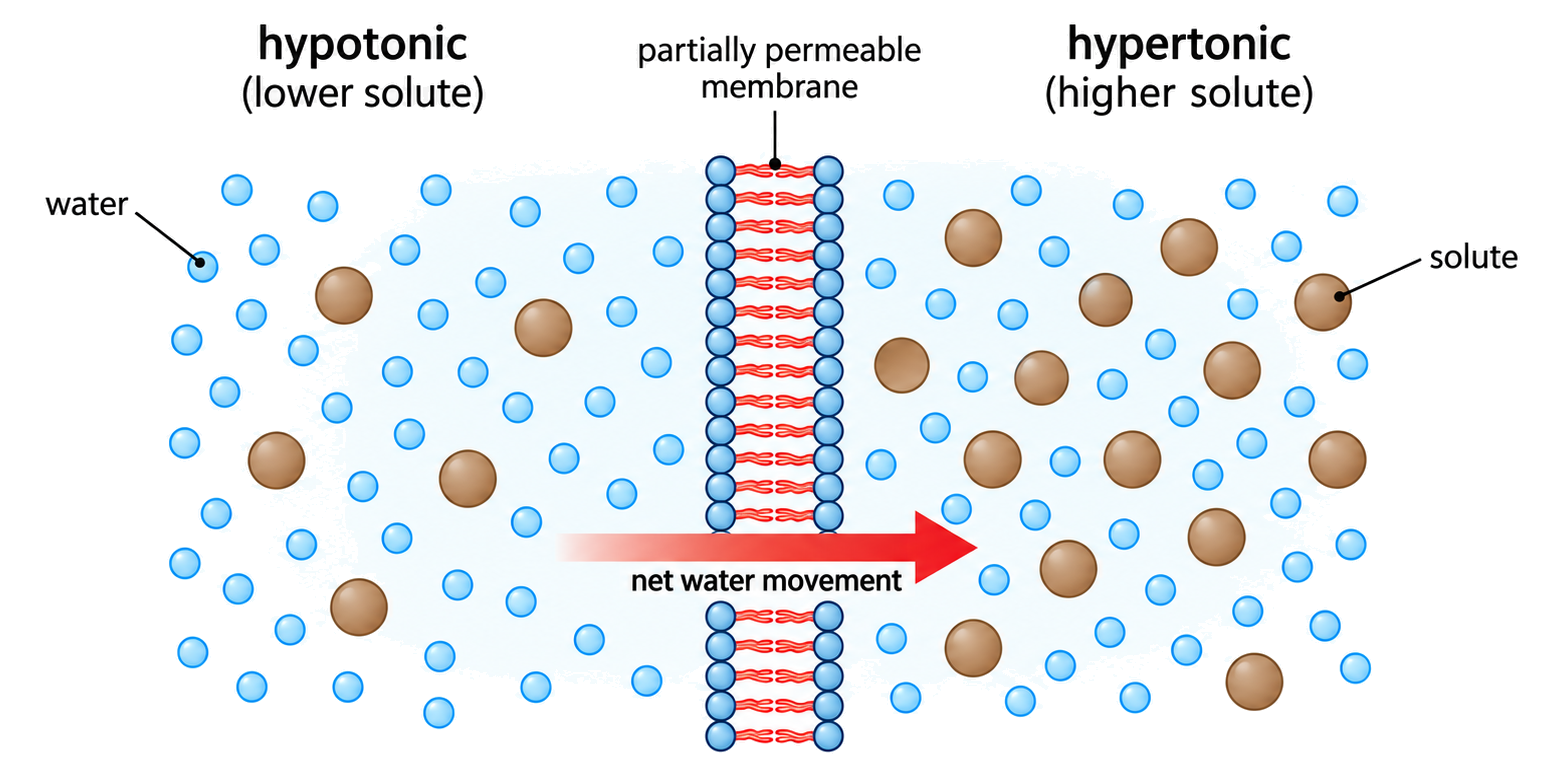
Water moves by osmosis through partially permeable membranes from lower solute concentration toward higher solute concentration in cells and biological systems.
- Syllabus
- First assessment 2025
- Objective
- D2.3.2
- Level
- SL
Water moves by osmosis through partially permeable membranes from lower solute concentration toward higher solute concentration in cells and biological systems.

Coverage 2015–2024 · Updated 16 Jul 2026
Across a partially permeable membrane, net water movement is from the less concentrated solution toward the more concentrated solution.
| Comparison term | Solute concentration relative to the other solution | Expected net water movement |
|---|---|---|
| Hypotonic | Lower | Away from this solution |
| Hypertonic | Higher | Toward this solution |
| Isotonic | Equal effective concentration | No net movement |
If solution A is 0.10 mol dm⁻³ sucrose and solution B is 0.40 mol dm⁻³, A is hypotonic to B and net water movement is from A to B if water can cross but sucrose cannot.
At SL, express the comparison using solute concentration—not 'high water concentration'. Tonicity is relative and depends on solutes that do not freely cross the membrane.
This objective is assessed through structured response, multiple choice, commonly using Explain / Outline.
Explain / Outline
Build the answer around this relationship: Osmosis requires a partially permeable membrane.
Saying solute moves by osmosis instead of water.
Representative question
Outline the conditions necessary for osmosis to occur.
| a | partially/semi permeable/selective membrane (to water); |
| b | solute molecules/ions cannot pass through membrane; |
| c | different solute/water concentrations/concentration gradients/osmolarity; |
| d | suitable temperature (for osmosis to occur); |
Water forms hydration shells around ions and polar solutes; hydrogen bonding and charge attraction reduce free water movement. Water moves by osmosis across partially permeable membranes from hypotonic/lower solute solutions toward hypertonic/higher solute solutions. Osmosis direction depends on internal and external solute concentration; isotonic conditions have dynamic water movement but no net osmosis. Plant tissue changes mass or length in sucrose solutions; percentage change graphs estimate isotonic or osmotic concentration. Animal cells can lyse in hypotonic solutions and crenate in hypertonic solutions; freshwater protists use contractile vacuoles to expel excess water. Plant cells become turgid in hypotonic solutions as vacuoles swell; hypertonic solutions cause flaccidity and plasmolysis from water loss. Isotonic saline prevents harmful water gain or loss in body cells; IV fluids and transplant organ baths must match tissue osmotic concentration.