Q BankQuestion BankDocsDocuments

B2.1.1—Lipid bilayers as basis

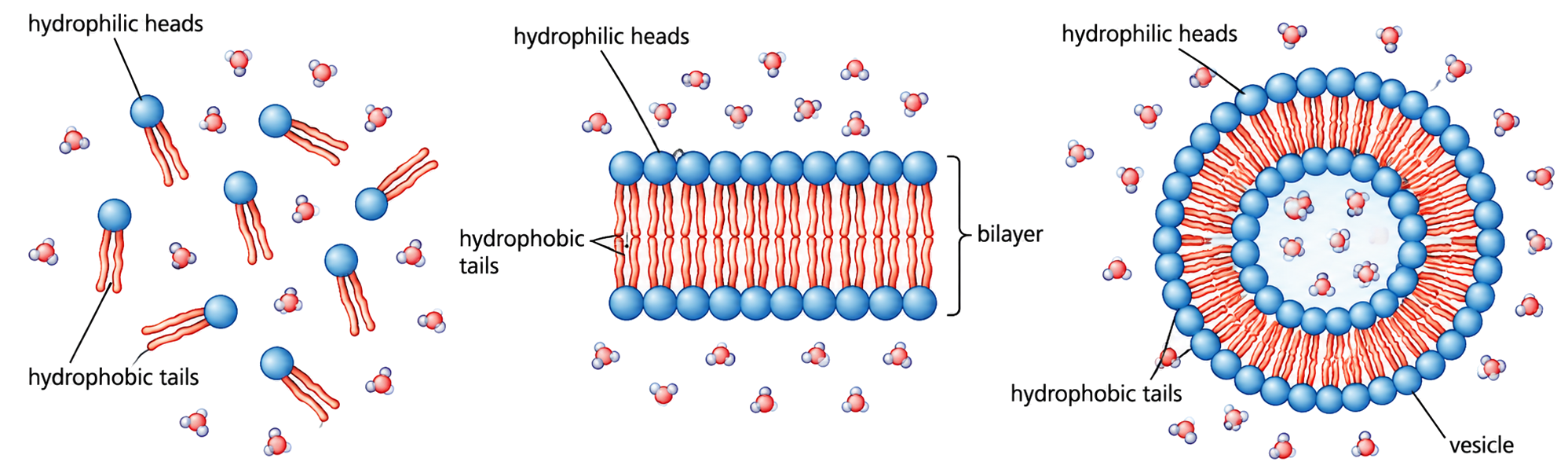
Amphipathic phospholipids organize membranes by placing hydrophilic heads toward water and hydrophobic tails inward, forming stable bilayers and vesicles; This foundation explains compartment boundaries, surface orientation, and flexible membrane construction.

Syllabus
First assessment 2025
Objective
B2.1.1
Level
SL

Exam analysis

Chance of appearing6%of analysed past papers
Latest appearanceNovember 2024
Most common paperPaper2
Typical marks1–4

Common command terms

  • Identify
  • Explain
  • State
  • Outline
  • Draw
  • Label

Scoring notes

Common mistake
Saying phospholipids are only hydrophobic or only hydrophilic instead of amphipathic.

Recent exam appearances

November 2024Paper2 ["SL"] · TZ16(a)[ 4 ]B2.1.1—Lipid bilayers as basis
May 2024Paper2 ["SL"] · TZ12(b)[ 3 ]B2.1.1—Lipid bilayers as basis
May 2021Paper1 ["SL"] · TZ23[ 1 ]B2.1.1—Lipid bilayers as basis
November 2020Paper2 ["SL"] · TZ03(a)[ 2 ]B2.1.1—Lipid bilayers as basis
May 2019Paper3 ["SL"] · TZ11(c)[ 2 ]B2.1.1—Lipid bilayers as basis
Practice this objective

Coverage 2015–2024 · Updated 15 Jul 2026

Concept essentials

  • Phospholipids have hydrophilic phosphate heads and hydrophobic fatty acid tails.
  • Bilayers form because tails avoid water while heads remain exposed to aqueous surroundings.
  • Vesicles and many cellular membranes depend on phospholipid bilayer structure.
  • Correct diagrams show heads at the membrane surfaces and tails directed toward the centre.
ConceptIB Biology SL