B2.1 Membranes and membrane transport

Membranes and membrane transport link bilayer structure, membrane proteins, selective permeability, gradients, and vesicle movement to cellular control; Students connect membrane structure to transport mechanisms across cellular boundaries.

Syllabus
First assessment 2025
Topic
B2.1
Level
SL

Learning objectives

B2.1.1Lipid bilayers as basis• Amphipathic phospholipids have hydrophilic heads and hydrophobic tails• In water they spontaneously form continuous closed bilayers• Lipid bilayers are the structural basis of plasma membranes and vesiclesB2.1.2Bilayers as barriers• Hydrophobic fatty acid tails form a stable membrane core• The core has low permeability to ions and large or hydrophilic molecules• Membranes separate aqueous compartments and control entry and exitB2.1.3Simple diffusion• Diffusion is passive movement down a concentration gradient using kinetic energy• Small non-polar molecules such as oxygen and carbon dioxide diffuse through the bilayer• Diffusion rate depends on factors such as gradient, distance, surface area, and temperatureB2.1.4Integral and peripheral proteins• Integral proteins are embedded in one or both lipid layers and may span the membrane• Integral proteins can act as channels, carriers, pumps, receptors, enzymes, or antigens• Peripheral proteins attach to membrane surfaces and can act as receptors or scaffoldsB2.1.5Osmosis and aquaporins• Osmosis is passive net movement of water across a partially permeable membrane• Water moves from lower solute concentration to higher solute concentration• Aquaporins are protein pores that increase water diffusion across membranesB2.1.6Channel proteins• Channel proteins provide hydrophilic pores for facilitated diffusion• Polar molecules, ions, ADP, ATP, and water use specific channels or transporters• Channels are selective and move substances down gradients without ATPB2.1.7Pump proteins• Pump proteins use ATP from respiration for active transport• They move specific molecules or ions against concentration gradients• Active transport is selective and uses carrier or pump proteins, not channel proteinsB2.1.8Selectivity in permeability• Simple diffusion depends mainly on particle size and hydrophobic or hydrophilic properties• Facilitated diffusion and active transport use proteins to create selective permeability• Selective transport is essential in roots, intestines, kidneys, and neuronsB2.1.9Glycoproteins and glycolipids• Glycoproteins and glycolipids have short carbohydrate chains on the extracellular surface• Together they form the glycocalyx• The glycocalyx supports recognition, adhesion, signalling, and interaction with waterB2.1.10Fluid mosaic model• The fluid mosaic model describes mobile lipids and proteins in a phospholipid bilayer• Membranes include integral proteins, peripheral proteins, cholesterol, glycoproteins, and glycolipids• Freeze-etching, protein extraction, and fluorescent tagging supported the model

Amphipathic Lipids Close into a Bilayer

A phospholipid has a hydrophilic phosphate head and two hydrophobic fatty-acid tails. In water, these interactions drive spontaneous bilayer formation.

Bilayer formation from phospholipids in water, starting from scattered molecules and ending with a closed bilayer vesicle.

heads face water + tails hide from water → continuous bilayer → exposed edges close → sealed membrane or vesicle

The Hydrophobic Core Creates Unequal Permeability

The bilayer core allows small non-polar molecules through most easily, slows small uncharged polar molecules, and strongly blocks ions and large hydrophilic solutes.

O₂ and CO₂ → simple diffusion.
Water → limited bilayer diffusion, much faster through aquaporins.
Ions, glucose and large polar molecules → specific proteins or vesicles.

A membrane separates aqueous compartments because it is selectively permeable, not completely impermeable.

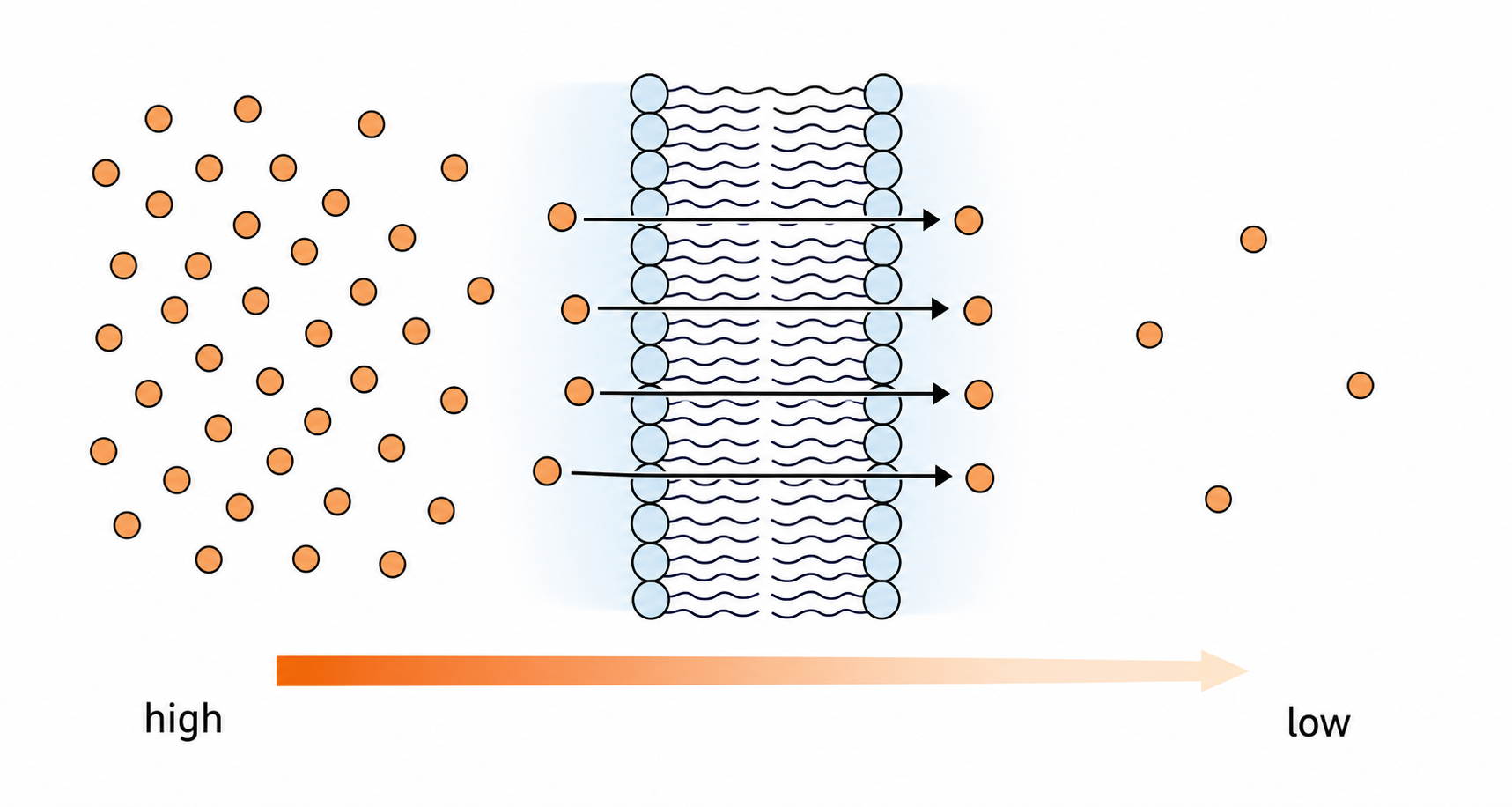
Random Motion Produces Net Diffusion

Diffusion is passive net movement from higher to lower concentration, driven by random kinetic motion. Particles continue moving both ways at equilibrium, but net movement becomes zero.

Show gradient-driven membrane crossing so the learner can track Simple Diffusion.

Steeper gradient + larger surface area + higher temperature → faster diffusion. Greater distance or membrane thickness → slower diffusion.

Protein Position Constrains Membrane Function

Integral proteins enter the hydrophobic bilayer and may span it; peripheral proteins attach to one membrane surface or to another protein.

The figure shows peripheral and integral proteins of the plasma membrane.

Integral: channels, carriers, pumps, receptors, enzymes.
Peripheral: signalling partners, enzymes, cytoskeletal anchors and scaffolds.

Osmosis Follows a Water-Potential Difference

Osmosis is passive net movement of water across a partially permeable membrane from higher water potential to lower water potential.

Two solutions separated by a partially permeable membrane: hypotonic left, hypertonic right, water arrow to hypertonic side.

Lower solute concentration → higher water potential.
Higher solute concentration → lower water potential.
Aquaporins raise the rate but do not change the direction.

Channels Provide Selective Downhill Routes

A channel is a hydrophilic pore that permits selected ions or molecules to diffuse down an electrochemical gradient without ATP.

Show hydrophilic pore selectivity so the learner can choose The Right Channel.

Pore diameter + charge + chemical lining determine selectivity. Some channels remain open; gated channels change between closed and open states.

ATP Drives a Pump Uphill

A pump binds a specific solute and couples ATP hydrolysis to a shape change that moves it against its concentration or electrochemical gradient.

Show ATP-driven pumping cycle so the learner can how Pumps Spend ATP.

bind on one side → ATP transfers energy, often by phosphorylation → conformation changes → solute released uphill → pump resets

Selectivity Emerges from Lipids, Proteins and Energy

Choose a transport route from particle chemistry and gradient direction: the bilayer sorts by size and polarity; proteins add molecular recognition; ATP permits uphill movement.

Show compare transport routes by particle property so the learner can read Selective Permeability.

small non-polar + downhill → simple diffusion
ion/polar + downhill → channel or carrier
solute + uphill → pump or coupled transporter
very large cargo → vesicle

The Glycocalyx Forms an Outward Cell Interface

Short carbohydrate chains on glycoproteins and glycolipids project only from the extracellular membrane surface. Together they form the glycocalyx.

recognition + cell adhesion + receptor interactions + antigen identity + hydration and protection at the cell surface

The carbohydrate chain does not span the bilayer and is not exposed to the cytoplasm; its orientation records membrane asymmetry.

Evidence Supports a Fluid Protein Mosaic

The fluid mosaic model describes laterally mobile lipids and many proteins arranged asymmetrically in a phospholipid bilayer.

A labeled lipid bilayer shows a protein traversing the membrane, proteins attached to one side, and a channel protein forming a pore toward the cell interior.

freeze fracture → particles within membrane faces
protein extraction → integral vs peripheral attachment
fluorescent cell fusion → labelled proteins spread laterally

SL Summary: Choose a Membrane Route

Particle property → gradient → route → energy.
Non-polar: bilayer. Water: osmosis/aquaporin. Ion or polar solute downhill: channel/carrier. Uphill: ATP-coupled pump.

The bilayer creates the barrier; proteins make it selective; carbohydrates create an outward interface; component mobility makes the membrane adaptable.

Lipid bilayers as basis

8 marks

Cell membranes separate aqueous environments in cells. Explain how the properties of phospholipids help to maintain the structure of cell membranes.

Bilayers as barriers

1 mark

Neural pathways in living brains can now be mapped by tracking the movement of water molecules inside axons. What keeps water molecules inside axons?

Simple diffusion

3 marks

Explain how the rate of diffusion of oxygen into a cell is affected by the concentration of oxygen outside of the cell.

Integral and peripheral proteins

4 marks

Describe the functions of proteins in cell membranes.

Osmosis and aquaporins

4 marks

Describe transport across cell membranes by osmosis.

Channel proteins

3 marks

Explain facilitated diffusion.

Pump proteins

3 marks

Calcium is absorbed from food in the human gut by both active and passive processes. Outline active transport, including the benefits of the process.

Selectivity in permeability

1 mark

Which molecule is paired with the component of the cell membrane that allows it to pass through the membrane?

Molecule

Component of the
cell membrane

insulin

aquaporin

glycogen

channel protein

oestradiol

phospholipid bilayer

carbon dioxide

pump protein

Glycoproteins and glycolipids

1 mark

Which part of the membrane allows cell recognition?

Fluid mosaic model

6 marks

Draw and label a diagram to show the structure of membranes.