IB Biology DNA and RNA: Structure, Base Pairing and Chargaff's Rule
Revise IB Biology DNA and RNA structure with Chargaff's rule, complementary base pairing, nucleotide structure and common exam calculation mistakes.
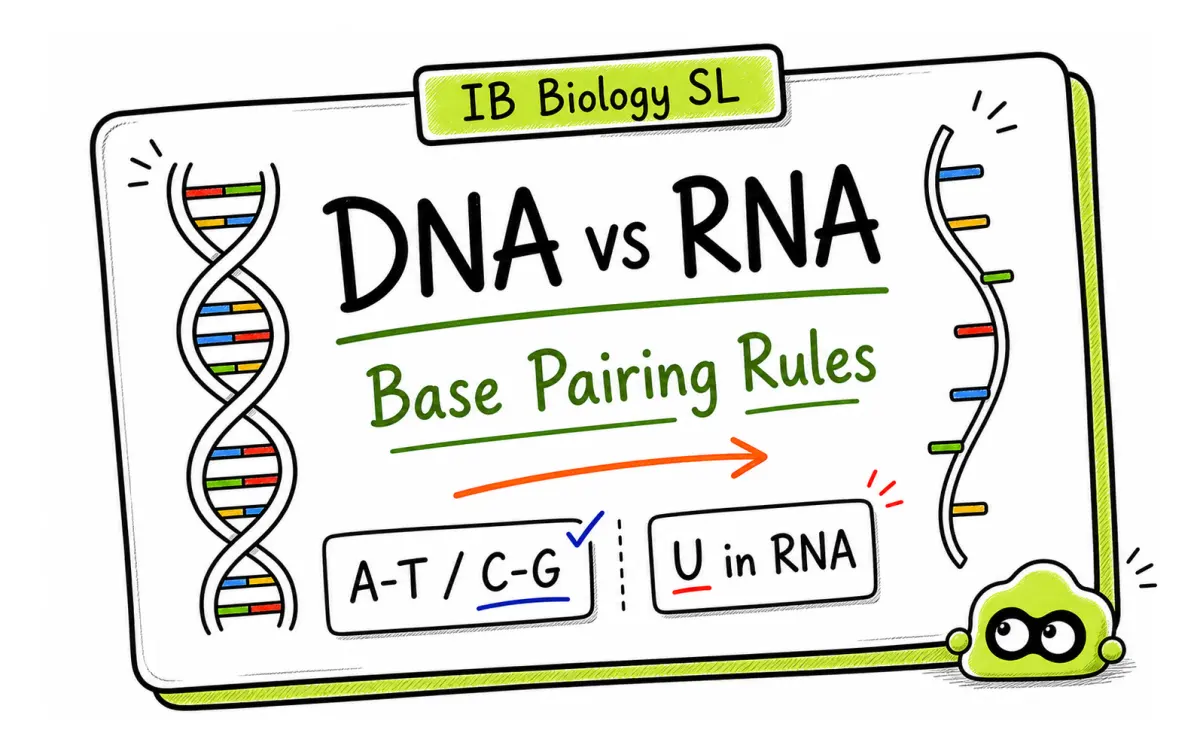
IB Biology A1.2 covers DNA and RNA structure, complementary base pairing and Chargaff's rule. This guide gives the structure differences, hydrogen-bond rules and percentage method students need for nucleic-acid questions.
Current syllabus map: This article is aligned to the IB Biology first assessment 2025 roadmap, especially A1.2 nucleic acids, DNA/RNA structure, complementary base pairing and nucleotide sequence.
This guide uses EduNinja's real IB Biology PDF resource, IB Biology SL Notes - 2.6 Structure of DNA and RNA, then turns it into a practical revision plan. The goal is not to memorize a paragraph about DNA. The goal is to be able to draw a nucleotide, compare DNA and RNA, explain complementary base pairing, and practise the topic without wasting time on passive rereading.
Use the relevant EduNinja course pages as your base:
Do not open every link at once. Start with the notes or topic page, then move into question practice and use any PDF resource only when it helps clarify the exact idea you are revising.
Quick Answer
For IB Biology DNA and RNA structure, you need to know that:
- DNA and RNA are nucleic acids made from nucleotide monomers.
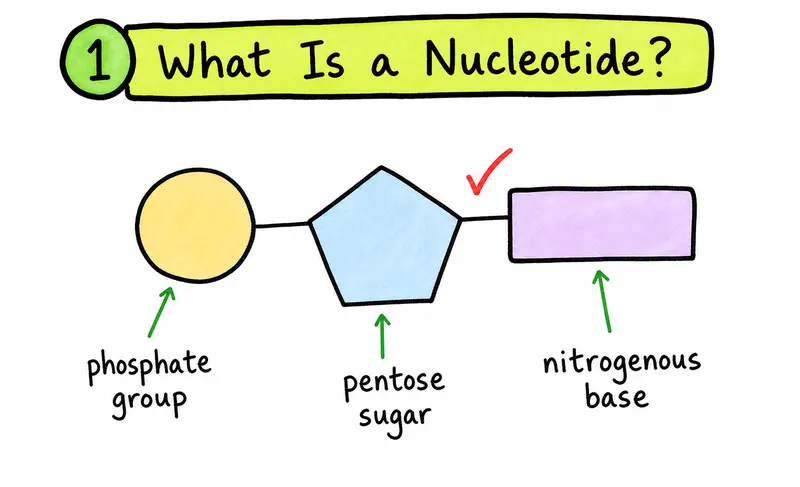
- Each nucleotide contains a phosphate group, a pentose sugar, and a nitrogenous base.
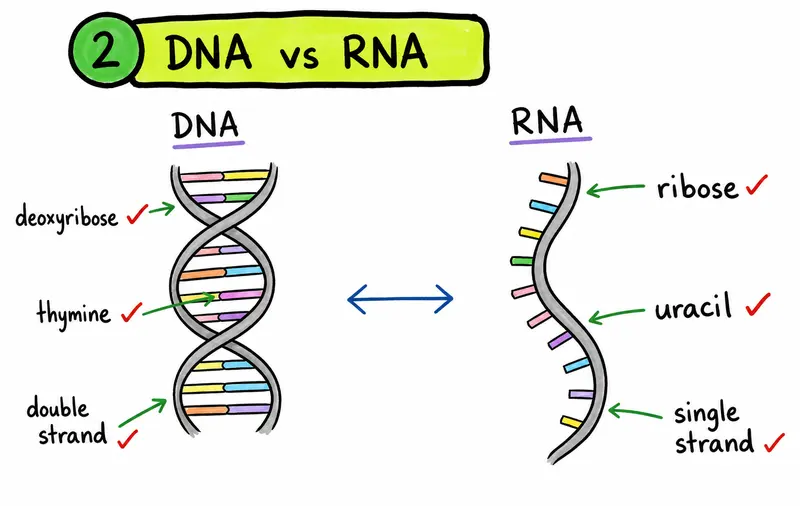
- DNA uses deoxyribose sugar, while RNA uses ribose sugar.
- DNA uses thymine, while RNA uses uracil.
- DNA is usually double-stranded, while RNA is usually single-stranded.
- DNA forms a double helix with two antiparallel strands.
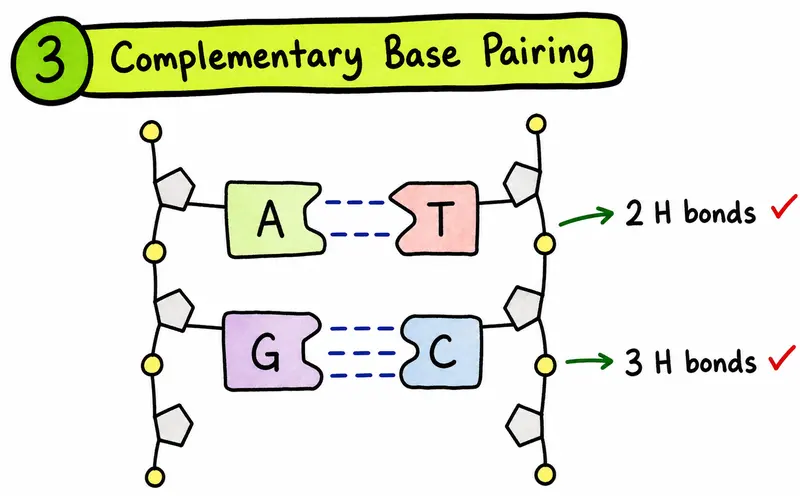
- Complementary base pairing links A with T and G with C in DNA.
- A-T pairs form two hydrogen bonds; G-C pairs form three hydrogen bonds.
- Chargaff's rule follows from complementary base pairing: A = T and G = C in double-stranded DNA.
- Watson and Crick used model building to explain DNA's double-helix structure.
What Is a Nucleotide?
A nucleotide is the basic subunit of DNA and RNA. In IB Biology, you should be able to describe it and draw it simply.
Each nucleotide has three parts:
- a phosphate group
- a pentose sugar
- a nitrogenous base
For drawing questions, keep the diagram simple. Use a circle for the phosphate, a pentagon for the sugar, and a rectangle for the base. The point is not artistic detail. The point is showing the correct relationship between the three parts.
This is where many students lose easy marks. They remember "phosphate, sugar, base" but draw the parts in a messy order, label the wrong sugar, or forget that the base is attached to the sugar, not directly to the phosphate.
DNA vs RNA: The Differences That Actually Matter
DNA and RNA are both nucleic acids, but IB Biology expects you to compare them precisely.
| Feature | DNA | RNA |
|---|---|---|
| Sugar | Deoxyribose | Ribose |
| Bases | A, T, G, C | A, U, G, C |
| Strand structure | Usually double-stranded | Usually single-stranded |
| Base difference | Thymine | Uracil |
The most common exam mistake is writing that RNA is "half of DNA" or that RNA is simply "single DNA". That is too vague. You need the structural differences: ribose instead of deoxyribose, uracil instead of thymine, and a single-stranded structure instead of a double-stranded helix.
If you need to rebuild the topic from notes, start with DNA as a double helix notes, then move into base pairing practice.
How DNA Strands Are Joined
Nucleotides do not float separately in DNA. They are linked into strands.
The phosphate group of one nucleotide bonds with the sugar of another nucleotide. These covalent bonds are called phosphodiester bonds. Together, they form the sugar-phosphate backbone.
That phrase is worth knowing because it helps you separate two different kinds of bonding:
- phosphodiester bonds hold nucleotides together within one strand
- hydrogen bonds hold complementary bases together between two DNA strands
Students often mix these up. If the question asks how nucleotides are linked in one strand, do not answer hydrogen bonds. If the question asks how the two strands are held together, do not answer phosphodiester bonds.
Use sugar-phosphate bonding notes when you want to check this distinction.
Complementary Base Pairing
Complementary base pairing is one of the safest high-value ideas to revise because it appears in DNA structure, DNA replication, transcription, translation, and genetics.
In DNA:
- adenine pairs with thymine
- guanine pairs with cytosine
- A-T pairs form two hydrogen bonds
- G-C pairs form three hydrogen bonds
The two DNA strands must run in opposite directions so that bases can face each other correctly. That is why DNA is described as antiparallel.
To practise this skill directly, use A1.2 nucleic-acid practice. Then review complementary base pairing notes for any wording you missed.
What Is Chargaff's Rule?
Chargaff's rule is one of the fastest ways to turn base-pairing knowledge into exam marks. In double-stranded DNA, adenine pairs with thymine and guanine pairs with cytosine. That means the percentage of adenine equals the percentage of thymine, and the percentage of guanine equals the percentage of cytosine.
Use this exam-safe wording:
- In double-stranded DNA, A = T and G = C because bases pair complementarily.
- A and T are joined by two hydrogen bonds.
- G and C are joined by three hydrogen bonds.
- All four bases should add to 100 percent.
How to use Chargaff's rule in percentage questions
If a question gives one base percentage, write the matching base first, then split the remaining percentage between the other complementary pair.
Example:
If adenine is 20 percent, thymine is also 20 percent. Adenine plus thymine is 40 percent, so guanine plus cytosine must be 60 percent. Because G = C, guanine is 30 percent and cytosine is 30 percent.
| Given information | First step | Final answer |
|---|---|---|
| A = 20 percent | T = 20 percent | G = 30 percent, C = 30 percent |
| G = 35 percent | C = 35 percent | A = 15 percent, T = 15 percent |
| T = 18 percent | A = 18 percent | G = 32 percent, C = 32 percent |
The common mistake is to make all four bases equal. Chargaff's rule does not mean A, T, G and C are each 25 percent in every DNA molecule. It means A matches T, and G matches C.
Chargaff's rule vs complementary base pairing
Complementary base pairing explains which bases pair together. Chargaff's rule is the percentage pattern that follows from that pairing in double-stranded DNA.
| Idea | What to say in an answer |
|---|---|
| Complementary base pairing | A pairs with T, and G pairs with C in DNA |
| Chargaff's rule | The percentage of A equals T, and the percentage of G equals C |
| Hydrogen bonds | A-T has two hydrogen bonds; G-C has three hydrogen bonds |
This is a good flashcard topic because it is quick to test and easy to forget under pressure.
Watson and Crick
Watson and Crick are usually tested as part of the story of DNA structure rather than as a biography question.
The key points are:
- they used model building
- the final model showed DNA as a double helix
- the strands are antiparallel
- bases pair by complementary base pairing
You do not need to turn this into a long essay. A concise exam answer should connect their model to the structural features of DNA. Mentioning "double helix" without base pairing or antiparallel strands is usually too thin.
Worked Example: Chargaff's Rule Calculation
Question: If adenine makes up 30% of the bases in a double-stranded DNA sample, what percentage of the bases are guanine?
Answer guide:
- T = 30% because A = T.
- A + T = 60%.
- G + C = 40% remains.
- G = 20% because G = C.
- C = 20%.
The check is 30 + 30 + 20 + 20 = 100%.
A 20-Minute Revision Plan
Use this short routine when you want to revise DNA and RNA structure efficiently.
- Draw one DNA nucleotide and one RNA nucleotide.
- Label phosphate, pentose sugar, and nitrogenous base.
- Write three DNA/RNA differences without looking.
- Draw two paired DNA bases and label hydrogen bonds.
- Explain the difference between phosphodiester bonds and hydrogen bonds.
- Do a short question-bank set on complementary base pairing.
- Turn any missed detail into a flashcard.
This works better than rereading the same note twice because it forces retrieval. You will quickly see whether you can actually use the words "ribose", "deoxyribose", "uracil", "antiparallel", and "phosphodiester" correctly.
Common Exam Mistakes
Watch out for these:
- saying RNA contains thymine
- saying DNA contains ribose
- mixing up phosphodiester bonds and hydrogen bonds
- forgetting that DNA strands are antiparallel
- writing that G-C has two hydrogen bonds
- drawing a nucleotide without a phosphate group
- describing base pairing without using the word complementary
- memorizing Watson and Crick without linking them to the model
Most of these are not hard concepts. They are precision problems. IB Biology often rewards students who can use the right word in the right place.
How EduNinja Helps
Start with the PDF note, IB Biology SL Notes - 2.6 Structure of DNA and RNA, for a compact overview. If you want a broader topic review, use IB Biology Revision Notes 2 - Nucleic Acids.
Then move into active practice:
- Review the structure using topic notes.
- Practise IB Biology SL complementary base pairing questions.
- Use the IB Biology SL Question Bank for nearby nucleic-acid questions.
- Turn mistakes into short flashcards.
EduNinja is independently developed and is not endorsed by the International Baccalaureate Organization.
Worked Examples
Worked Example 1: Move From Definition to Application
Question: A student can define DNA and RNA Structure but loses marks in exam questions. What should they add?
Worked answer: Add the specific structure, process, or evidence from the question. In Biology, a definition is rarely enough by itself. The answer should connect the named concept to function, data, or an example in the stimulus.
Markscheme-style answer: Correct biological term used; relevant structure or process identified; answer linked to the question context; no unsupported general statement.
Worked Example 2: Use Data or a Diagram Precisely
Question: How should a student answer a DNA and RNA Structure question that includes a diagram, graph, or table?
Worked answer: First describe what the data shows, then explain it using biology. If there are numbers, quote them. If there is a diagram, name the labelled structure and explain its role instead of writing a memorised paragraph.
Markscheme-style answer: Uses evidence from the figure or data; includes a correct biological explanation; compares values where relevant; avoids copying the question wording without analysis.
Question-Type Breakdown: DNA and RNA
DNA and RNA questions often look similar, but they are testing different thinking moves. Use this table to choose the right answer route.
| Question type | What it is really asking | First move | Common trap |
|---|---|---|---|
| Compare DNA and RNA | Identify structural differences | Organise by sugar, base, strand number, and role | Listing random facts without comparison |
| Draw or label a nucleotide | Show the three parts clearly | Start with phosphate, pentose sugar, and base | Forgetting that the base attaches to the sugar |
| Explain base pairing | Link bases to hydrogen bonding | State A-T and C-G for DNA | Mixing uracil into DNA answers |
| Apply Chargaff's rules | Use percentages logically | If A is known, T matches; C and G share the rest | Assuming all four bases are equal |
| Explain DNA structure | Connect antiparallel strands and base pairs | Mention sugar-phosphate backbone and complementary bases | Saying the bases form the backbone |
Weak Answer vs Mark-Worthy Answer
Weak answer:
- DNA is double-stranded and RNA is single-stranded.
Mark-worthy answer:
- DNA usually contains two antiparallel polynucleotide strands with a deoxyribose-phosphate backbone and complementary base pairing between A-T and C-G. RNA is usually single-stranded, contains ribose instead of deoxyribose, and uses uracil instead of thymine.
Weak answer:
- Chargaff's rule means the bases are equal.
Mark-worthy answer:
- Chargaff's rule means adenine pairs with thymine and cytosine pairs with guanine in double-stranded DNA, so the percentage of A equals T and the percentage of C equals G.
When you practise in the Questionbank, mark answers for the exact comparison words: "whereas", "instead of", "pairs with", and "backbone". Those small words often decide whether the answer is specific enough.
Practice This Topic
Try this exam-style question: A double-stranded DNA sample contains 28% adenine. Calculate the percentages of thymine, guanine and cytosine.
Answer guide:
- A = T, so thymine is 28%.
- A + T = 56%, leaving 44% for G + C.
- G = C, so guanine and cytosine are 22% each.
- Check: 28 + 28 + 22 + 22 = 100%.
Practise IB Biology A1.2 nucleic-acid questions.
Related Study Links
FAQ
What is Chargaff's rule in IB Biology?
Chargaff's rule says that in double-stranded DNA, the percentage of adenine equals the percentage of thymine, and the percentage of guanine equals the percentage of cytosine. In short: A = T and G = C.
How do you calculate DNA base percentages?
Match the complementary base first, then subtract both from 100 percent and split the remainder equally between the other pair. For example, if A is 20 percent, T is 20 percent, leaving 60 percent for G and C, so G is 30 percent and C is 30 percent.
What is the main difference between DNA and RNA?
DNA is usually double-stranded and contains deoxyribose and thymine. RNA is usually single-stranded and contains ribose and uracil instead of thymine.
What are complementary base pairing rules?
In DNA, adenine pairs with thymine and cytosine pairs with guanine. In RNA, adenine pairs with uracil. These rules are essential for replication, transcription, and sequence questions.
Why is DNA described as a double helix?
DNA has two antiparallel polynucleotide strands twisted into a helix. Hydrogen bonds between complementary bases hold the strands together while allowing separation during replication or transcription.
How do I answer nucleotide structure questions?
Name the three parts: phosphate group, pentose sugar, and nitrogenous base. Then state the sugar and base differences when comparing DNA and RNA.
How many hydrogen bonds are in A-T and G-C pairs?
A-T pairs have two hydrogen bonds. G-C pairs have three hydrogen bonds.
Related Resources
Put DNA and RNA back into your full IB Biology SL study plan.
Return to the complete course overview, or move directly into the most relevant study tool.
Related articles
More course notes, updates and study resources from the EduNinja blog.
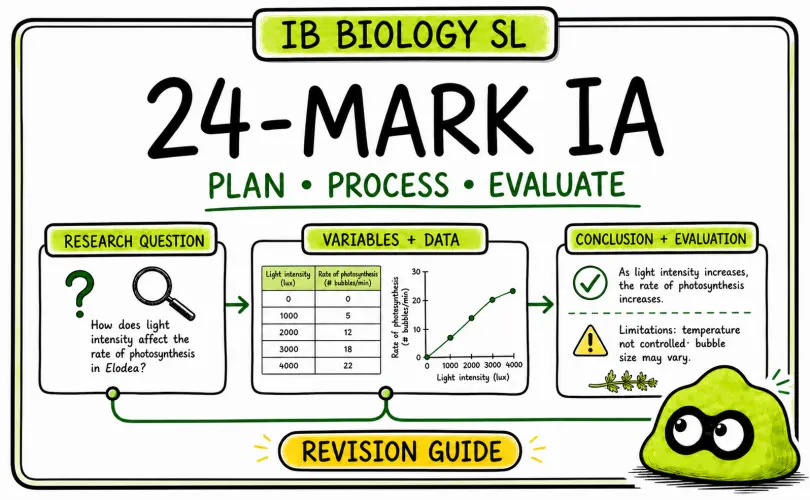
IB Biology Scientific Investigation Guide: How to Build a Strong 24-Mark IA
A practical IB Biology guide to the 24-mark Scientific Investigation: choose a workable research question, control variables, process data, draw a supported conclusion and evaluate limitations with specific improvements.
Abiotic Factors Explained | IB Biology SL
Revise IB Biology SL abiotic factors, tolerance ranges, limiting factors and how environmental variables affect distribution.
Active Transport vs Passive Transport | A-Level Biology
Revise A-Level Biology active and passive transport with concentration gradients, ATP, carrier proteins, examples, common mistakes and practice.