Question 6
[Maximum number: 1]
Which diagram(s) illustrate(s) semi-conservative replication of DNA?
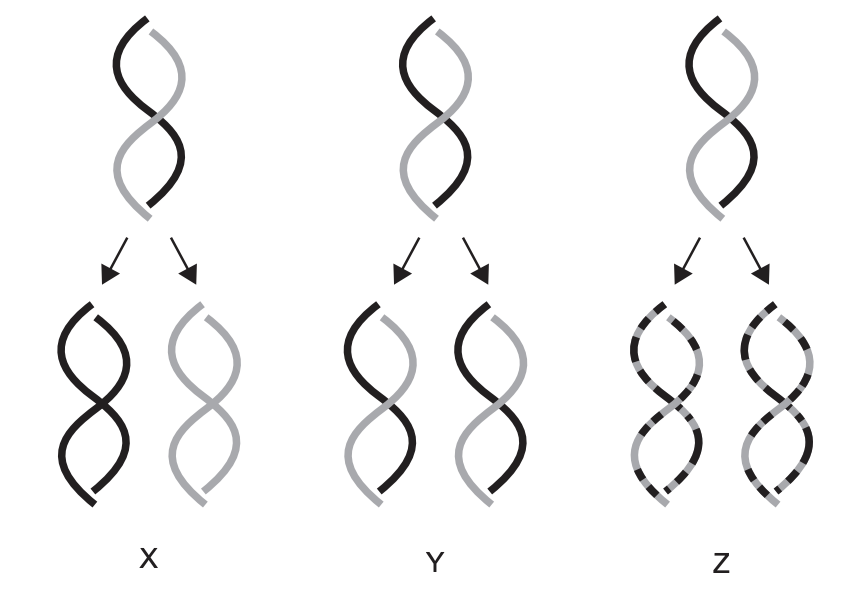
A
X only
B
Y only
C
Z only
D
X and Y only
 EduNinja
Which diagram(s) illustrate(s) semi-conservative replication of DNA?
X only
Y only
Z only
X and Y only
Over 50 years ago, Meselson and Stahl investigated the mechanism of DNA replication. They transferred a rapidly growing population of Escherichia coli from a growth medium containing only to a growth medium with only . DNA samples were centrifuged at high speed in a salt density gradient. In the original published research, DNA molecules of the same density appear as a band in the UV absorption photographs as shown.
Generations
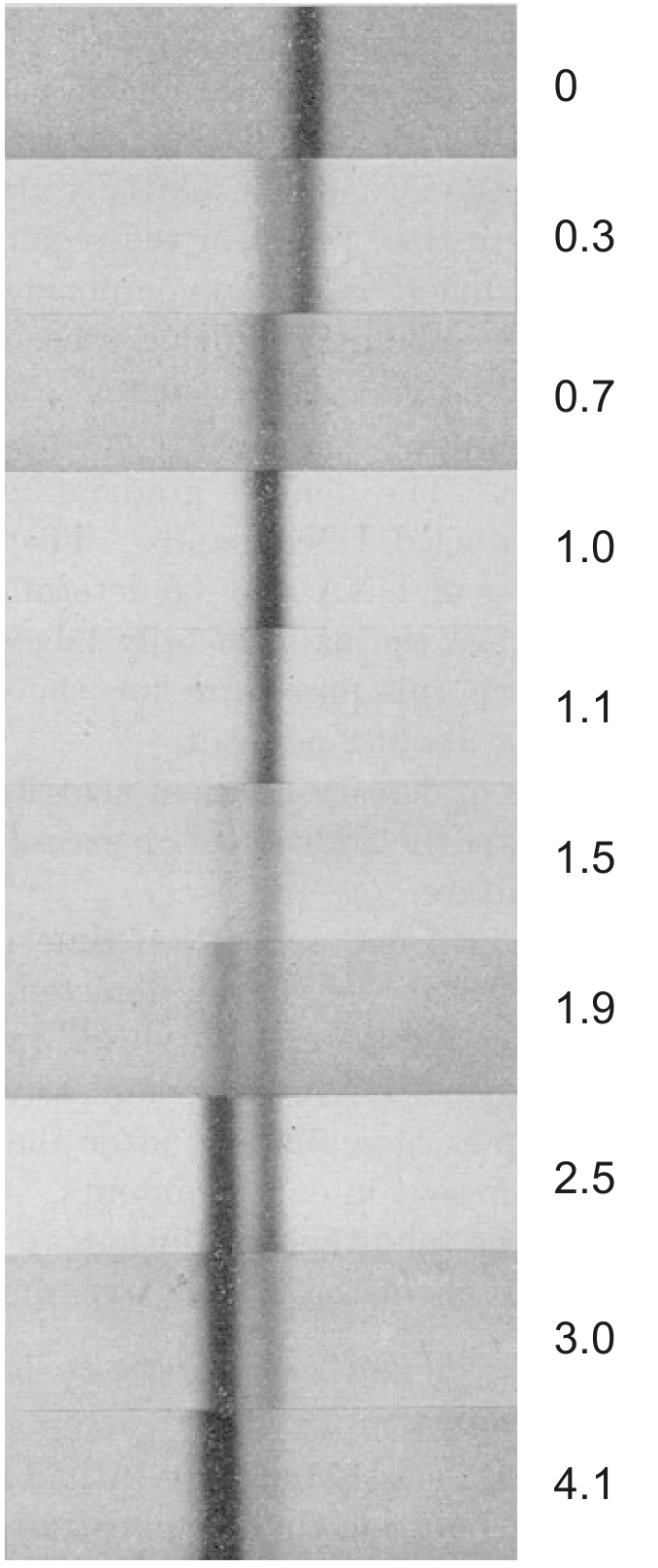
Explain the pattern shown in generation 3.0.
This experiment was designed to demonstrate whether replication was semi-conservative or conservative. Distinguish between semi-conservative replication and conservative replication.
What bonds do the enzymes DNA polymerase and helicase form or break during DNA replication?
DNA polymerase
Helicase
forms sugar-phosphate bonds
breaks hydrogen bonds
forms hydrogen bonds
breaks sugar-phosphate bonds
forms hydrogen bonds
forms sugar-phosphate bonds
forms sugar-phosphate bonds
forms hydrogen bonds
The diagram shows a gel electrophoresis apparatus.
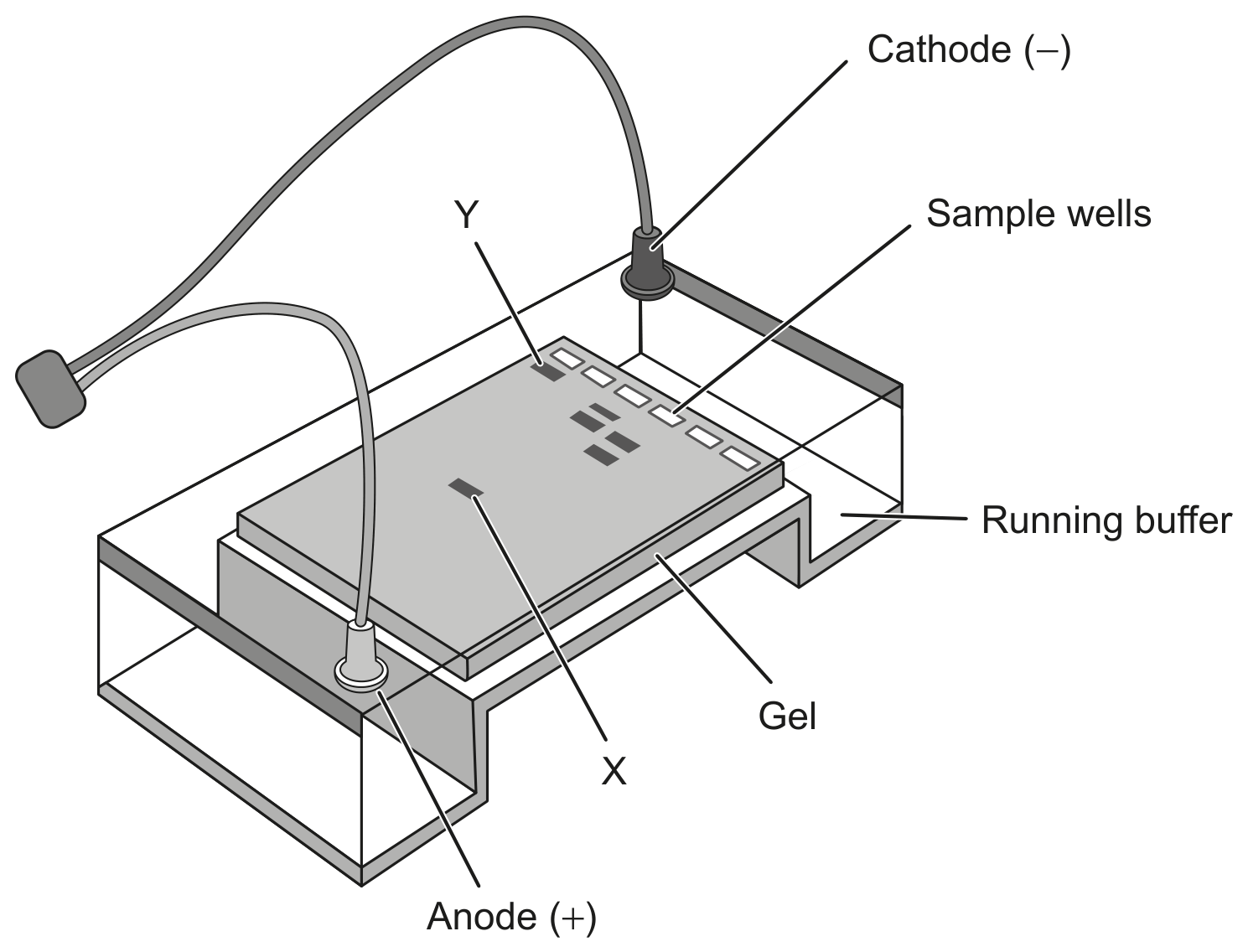
What can be deduced from the diagram?
X is the smallest fragment.
Y is positively charged.
X is moving towards the cathode.
Y travels at the greatest rate.
Meselson and Stahl conducted experiments using the isotopes and which showed that DNA replication is semi-conservative. What would they have observed about the distribution of isotopes in the DNA after one round of replication if DNA replication was conservative rather than semi-conservative?
Only DNA
Only DNA
All DNA half and half
Half the DNA with only and half with only
The percentage of cytosine in the genome of the common octopus (Octopus vulgaris) is 17.6 %.
Scientists can amplify DNA molecules and separate mixtures of DNA molecules in the laboratory for analysis.
State the laboratory method used to amplify DNA.
What occurs during DNA replication?
DNA polymerase separates the two DNA strands.
DNA molecules containing nucleotides from the original molecule are produced.
Adenine forms a base pair with either thymine or uracil.
New bases attach to the original sugar-phosphate backbone.
Which are necessary to make DNA replication semi-conservative?
I. Separation of the strands by RNA polymerase
II. Complementary base pairing
III. Use of a pre-existing strand as a template
I and II only
I and III only
II and III only
I, II and III
What is required to replicate DNA?
Temperature of
Free nucleotides carrying A, C, G and T bases
Plasmids
Endonuclease
Bacteria cultured in a medium containing only were transferred to a medium containing only and allowed to complete one round of replication. The DNA in bacteria produced as a result of replication on the medium was extracted and subjected to caesium chloride centrifugation which separates DNA molecules according to their density.
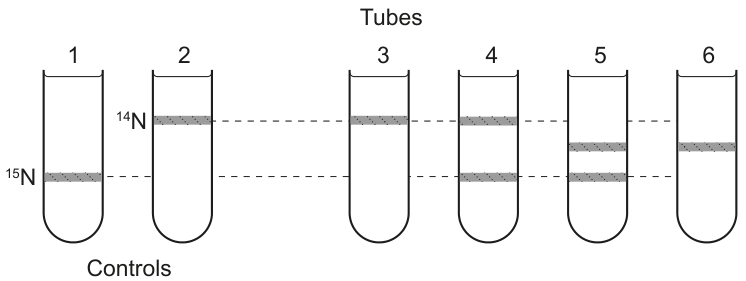
Which centrifuge tube shows the arrangement of bands observed after one round of replication?
Tube 3
Tube 4
Tube 5
Tube 6