Inert Gas vs Noble Gas: IB Chemistry Group 18 Guide
Learn inert gas vs noble gas in IB Chemistry, including Group 18, full outer shells, low reactivity, electron configuration and exam wording.
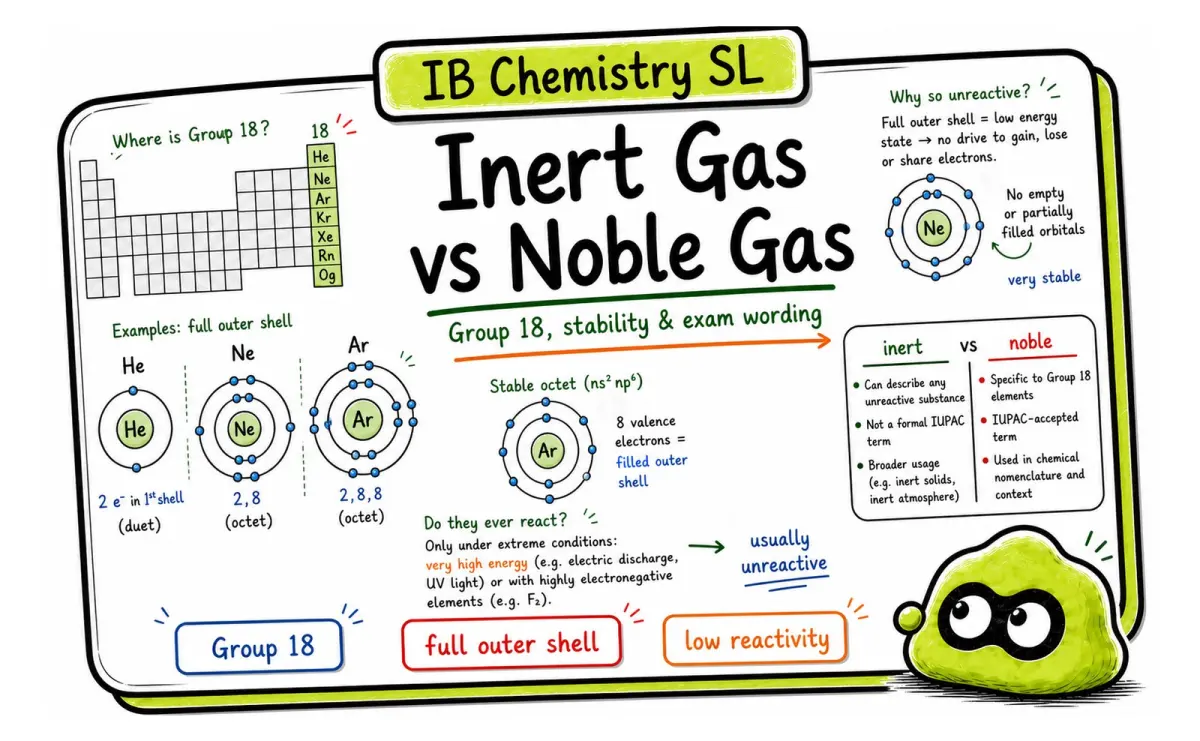
Students often use inert gas and noble gas as if they mean exactly the same thing. In many school chemistry questions, that shortcut works, but it can also make your exam wording vague.
In IB Chemistry, the safest way to think about it is simple: noble gases are the Group 18 elements, while inert describes a substance or atmosphere that is not reacting under the conditions being discussed.
Quick Answer
- Noble gases are the Group 18 elements: helium, neon, argon, krypton, xenon, radon and oganesson.
- They are often described as inert because they usually have very low reactivity.
- Their low reactivity is linked to full outer electron shells.
- Inert gas can also describe an unreactive gas used to stop another substance reacting, such as argon used as a protective atmosphere.
- Do not write that noble gases can never react. Some heavier noble gases can form compounds under special conditions.
- In exam answers, use noble gas when naming the group and inert when explaining low reactivity or a protective atmosphere.
Noble Gas vs Inert Gas: The Short Version
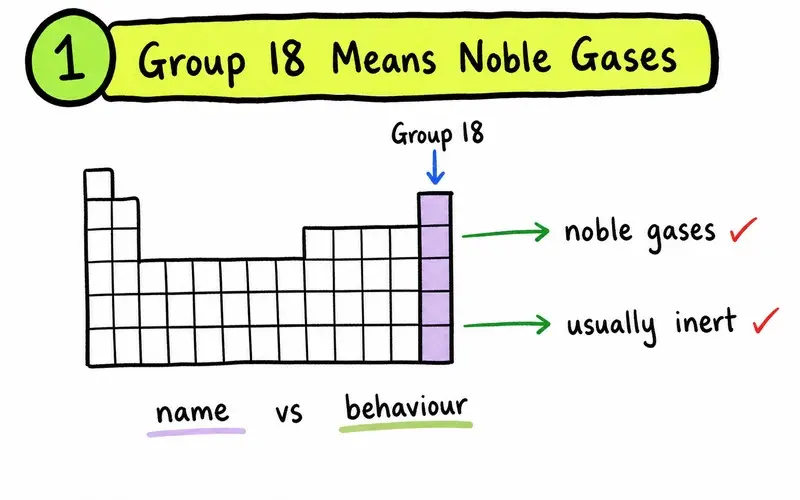
A noble gas is a member of Group 18 of the periodic table. That is a classification by position in the periodic table.
An inert gas is a gas that does not react, or reacts very little, under the conditions in the question. That is a description of behaviour.
| Term | Best meaning in IB Chemistry | Example wording |
|---|---|---|
| Noble gas | Group 18 element | Argon is a noble gas. |
| Inert gas | Unreactive gas or atmosphere | Argon provides an inert atmosphere. |
| Inert | Low tendency to react | The gas is inert under these conditions. |
The overlap is why students get confused. Noble gases are usually inert, but the words are not identical in every sentence.
Why Noble Gases Are Usually Unreactive
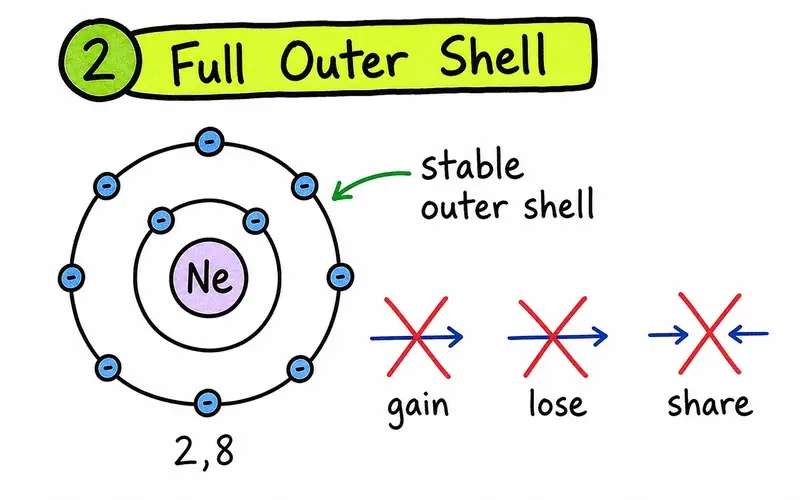
Noble gases have full outer electron shells. Helium has a full first shell, while neon and argon have full outer shells with stable electron arrangements.
Because of this, noble gas atoms have little tendency to:
- lose electrons
- gain electrons
- share electrons in covalent bonds
That is why they are usually unreactive compared with many other elements. The exam point is not just "they are stable". You need to connect stability to the full outer shell and the lack of drive to change electron arrangement.
Better wording:
Noble gases have full outer electron shells, so they have little tendency to gain, lose or share electrons.
Weak wording:
Noble gases do not want to react.
Atoms do not "want" anything. Keep the answer chemical.
Where Group 18 Fits in the Periodic Table
Group 18 is the far-right group of the periodic table. It includes helium at the top and then neon, argon, krypton, xenon, radon and oganesson below it.
In school-level chemistry, the most common examples are helium, neon and argon:
| Element | Simple electron arrangement | Why it matters |
|---|---|---|
| Helium | 2 | Full first shell |
| Neon | 2,8 | Full outer shell |
| Argon | 2,8,8 | Full outer shell |
This is why noble gases are often used when questions ask about stable electron configurations. For example, ions are often described as having the same electron configuration as a noble gas.
When to Use "Inert Gas" in Answers
Use inert gas when the question is about preventing reaction with air, oxygen, water vapour or another reactive substance.
Common examples include:
- argon used in a light bulb to reduce reaction with the hot filament
- nitrogen or argon used as an inert atmosphere in some reactions
- argon used when a sample must be protected from oxygen or moisture
In those answers, the point is not just that argon is in Group 18. The point is that the atmosphere is unreactive under the conditions, so it prevents unwanted reactions.
Good wording:
Argon is used because it is inert, so it prevents the hot metal from reacting with oxygen.
Can Noble Gases React?
For most IB Chemistry SL questions, it is safe to treat noble gases as very unreactive. But it is better not to write "noble gases never react."
The heavier noble gases, especially xenon, can form compounds under special conditions. That does not mean you need to memorise a long list of noble gas compounds for every basic question. It means your wording should be careful:
- say usually unreactive
- say low reactivity
- say full outer shell
- avoid never reacts
This is a small wording difference, but it makes your answer sound more precise.
Common Exam Wording Mistakes
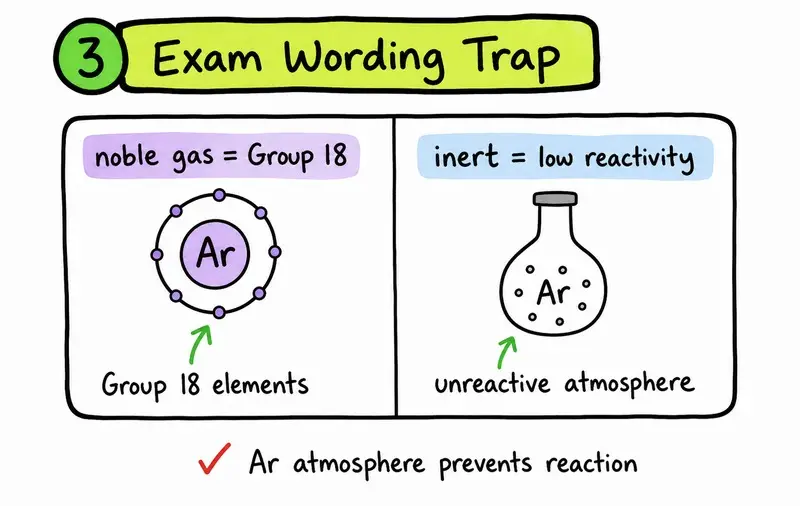
Here are the mistakes that lose clarity:
| Mistake | Why it is weak | Better version |
|---|---|---|
| "Inert gases are Group 18." | Inert describes behaviour, not only a group. | Noble gases are Group 18 and are usually inert. |
| "Noble gases never react." | Too absolute. | Noble gases have very low reactivity. |
| "They are stable." | Not enough chemistry. | They have full outer electron shells. |
| "Argon is noble, so it stops reaction." | The link is unclear. | Argon is inert, so it prevents reaction with oxygen. |
If the markscheme asks why a noble gas is unreactive, mention the full outer shell. If it asks why an inert atmosphere is used, mention that it prevents unwanted reactions.
How to Answer Typical IB Chemistry Questions
Use this answer pattern:
- Name the gas or group.
- State the electron-structure reason if the question is about noble gases.
- State the prevention-of-reaction reason if the question is about inert atmosphere.
- Avoid absolute wording like "never".
Worked example:
Question: Explain why argon can be used in a lamp.
Mark-worthy answer: Argon is used because it is inert under these conditions. It does not react with the hot filament, so it helps prevent the filament from oxidising or burning.
Why this works: The answer links argon to low reactivity and to the purpose of the inert atmosphere.
How EduNinja Helps with This Topic
This is a small topic, but it connects to periodicity, electron configuration and bonding. Use the IB Chemistry periodic table questions to practise Group 18 wording, then use IB Chemistry electron configuration questions if the shell explanation feels weak.
If you want a broader mixed set, open the IB Chemistry SL Question Bank and practise short-response questions where the markscheme rewards precise wording.
Practice This Topic
Try this exam-style question:
Explain why noble gases are usually described as unreactive, and state why the phrase inert gas is not always exactly the same as noble gas.
Answer guide:
- Noble gases are Group 18 elements with full outer electron shells.
- A full outer shell makes them stable, so they have little tendency to gain, lose or share electrons.
- Inert means unreactive under the conditions being discussed.
- Noble gas names a group of elements, while inert gas describes low reactivity.
Practice this exact topic
Periodicity question bank
Some questions may require an EduNinja membership.
Browse broader practice
Browse the full IB Chemistry SL Question Bank
Use this if you want to explore more available practice by topic.
Related Study Links
- Review the complete syllabus Study Hub
- IB Chemistry Question Bank
- Electronegativity Trend Across a Period
- Arrhenius Equation Explained
FAQ
Is an inert gas the same as a noble gas?
Not exactly. A noble gas is a Group 18 element, while an inert gas is a gas that is unreactive under the conditions in the question. Noble gases are usually inert, so the terms overlap, but the exam wording is not always identical.
Why are noble gases unreactive?
Noble gases are usually unreactive because they have full outer electron shells. This means they have little tendency to gain, lose or share electrons, so they do not readily form ions or covalent bonds.
Is argon an inert gas or a noble gas?
Argon is both a noble gas and usually an inert gas. It is a noble gas because it is in Group 18, and it is often called inert because it has very low reactivity under normal school-lab conditions.
Can noble gases ever react?
Some heavier noble gases can react under special conditions, so "never react" is too absolute. For most IB Chemistry SL answers, say noble gases are very unreactive because they have full outer electron shells.
Final Takeaway
Use this memory line: noble gas names the group; inert gas describes the behaviour. If you connect Group 18, full outer shells and low reactivity clearly, this becomes a quick exam wording win.
Put noble gases back into your full IB Chemistry SL study plan.
Return to the complete course overview, or move directly into the most relevant study tool.
Related articles
More course notes, updates and study resources from the EduNinja blog.
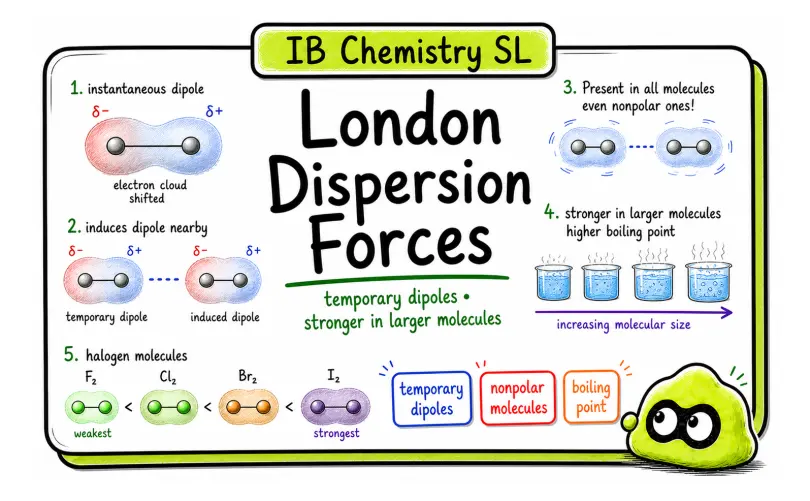
London Dispersion Forces Explained for IB Chemistry
Learn London dispersion forces for IB Chemistry with temporary dipoles, induced dipoles, molecular size, boiling point trends, examples and practice.
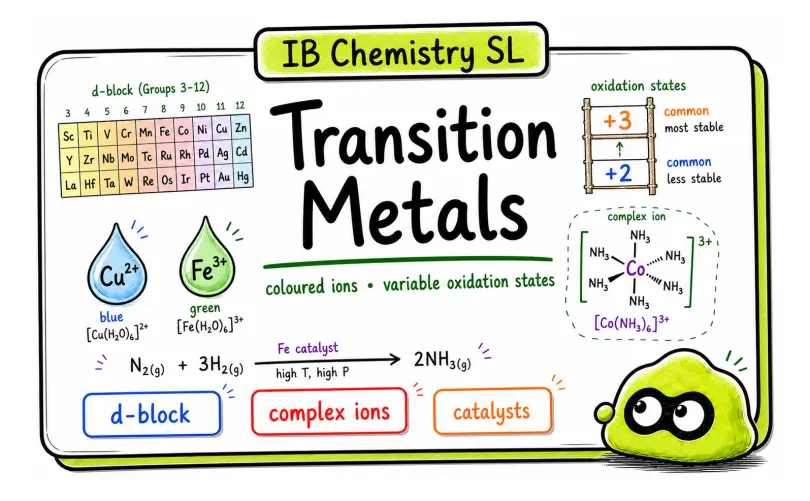
Transition Metals Explained for IB Chemistry
Revise transition metals in IB Chemistry, including coloured ions, variable oxidation states, complex ions, catalysts and common exam mistakes.
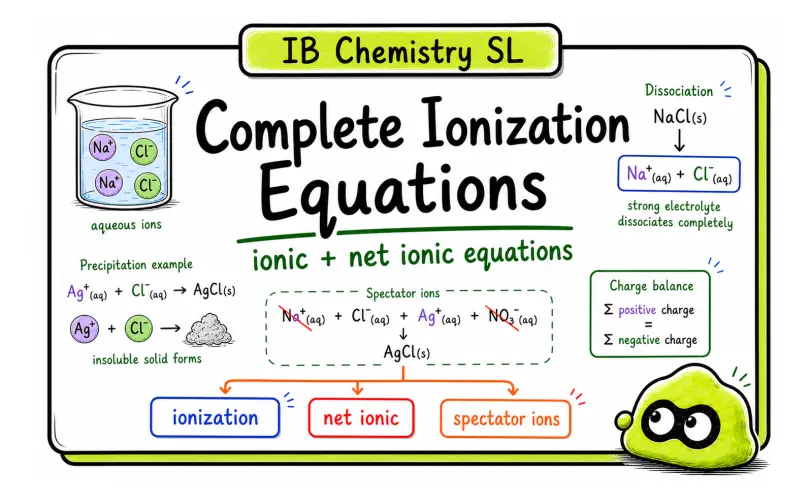
How to Complete Ionization and Net Ionic Equations
Learn complete ionization and net ionic equations for IB Chemistry, with ion charges, state symbols, spectator ions, worked examples and practice.