IB Biology A1/C1 Molecular Biology: Biomolecules, Enzymes and DNA
Revise IB Biology 2025 A1/C1 molecular-level topics with biomolecules, enzymes, DNA/RNA, respiration and photosynthesis answer chains.
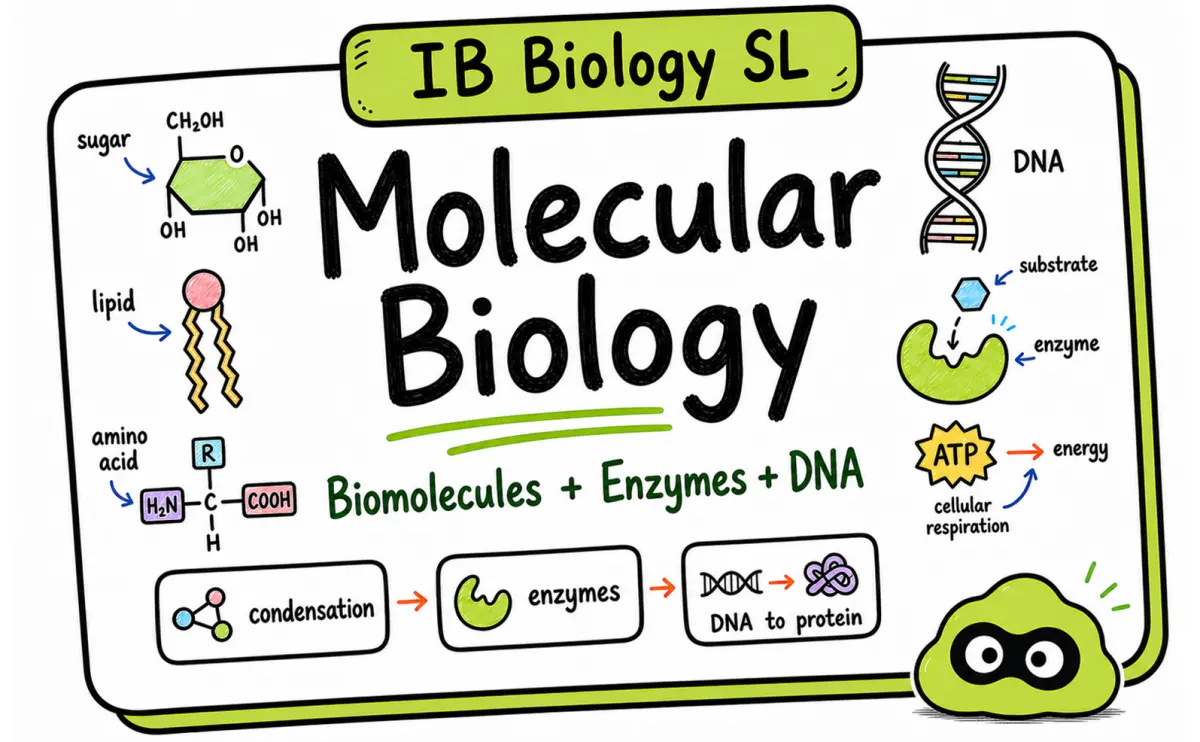
Molecular Biology is where students often know the vocabulary but lose the mechanism. You might remember "condensation", "active site", "semi-conservative replication", and "transcription", but IB Biology marks usually come from explaining what is joined, what is broken, what binds, or what sequence is copied.
Current syllabus map: This article is aligned to the IB Biology first assessment 2025 roadmap, especially A1/B1/C1/D1 molecule-level ideas, A1.2 nucleic acids, C1.1 enzymes, C1.2 respiration and C1.3 photosynthesis.
This guide turns the Chapter 2 notes into a revision path for biomolecules, enzymes, DNA, RNA, respiration, and photosynthesis.
Quick Answer
For IB Biology molecular biology revision, focus on these links:
- carbohydrates, lipids, proteins, and nucleic acids differ in elements, building blocks, bonds, and functions
- condensation joins molecules and releases water; hydrolysis breaks bonds using water
- protein shape controls function, and denaturation disrupts that shape
- enzymes lower activation energy by binding substrates at active sites
- DNA stores information; RNA helps transfer and express it
- DNA replication is semi-conservative because each new DNA molecule contains one original strand and one new strand
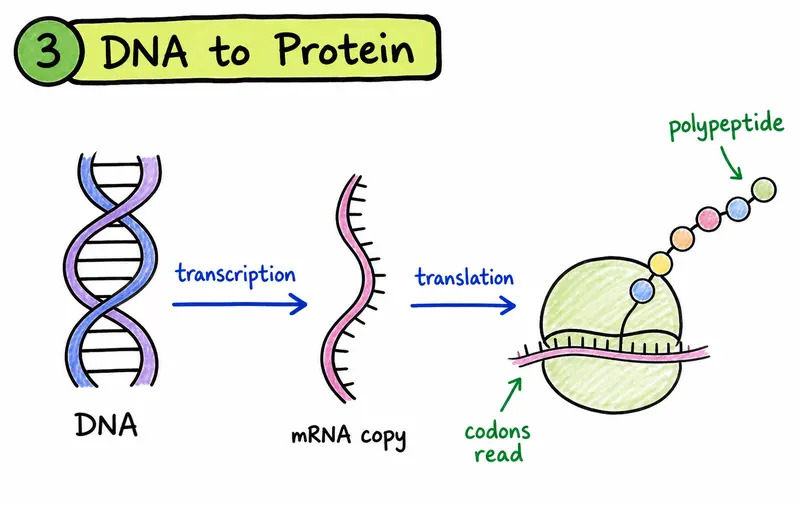
- transcription produces mRNA from DNA; translation uses mRNA to build a polypeptide
- respiration releases ATP from glucose; photosynthesis stores light energy in organic molecules
Use the relevant EduNinja course pages as your base:
Do not open every link at once. Start with the notes or topic page, then move into question practice and use any PDF resource only when it helps clarify the exact idea you are revising.
Core Concept That Gets Marks
Molecular Biology answers often need exact action verbs:
| Term | Action verb to use |
|---|---|
| Condensation | joins and releases water |
| Hydrolysis | breaks using water |
| Enzyme | lowers activation energy |
| Denaturation | changes active-site shape |
| Replication | copies DNA semi-conservatively |
| Transcription | makes mRNA from DNA |
| Translation | builds a polypeptide from mRNA codons |
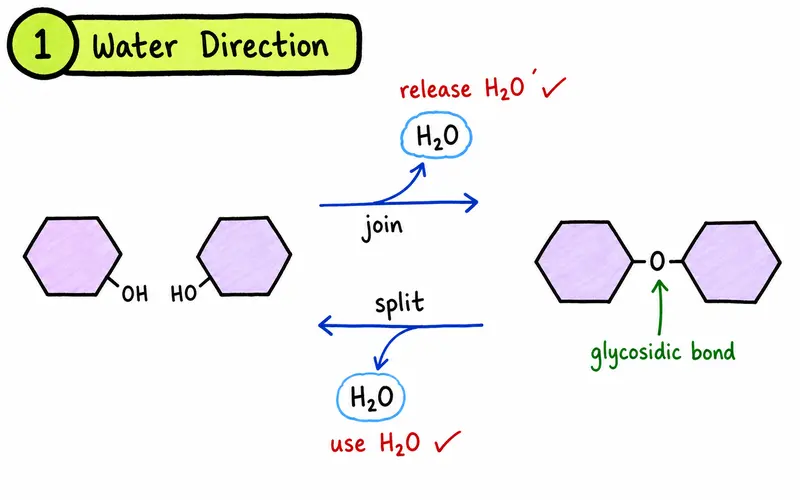
Condensation and Hydrolysis
Condensation and hydrolysis are opposite reaction types, but students often reverse water's role.
| Process | Direction | Exam wording |
|---|---|---|
| Condensation | monomers -> polymer | forms a covalent bond and releases water |
| Hydrolysis | polymer -> monomers | breaks a bond using water |
| Anabolism | builds larger molecules | usually requires energy |
| Catabolism | breaks molecules down | often releases energy |
Worked Example 1: Condensation vs Hydrolysis
Question: Explain how two monosaccharides can form a disaccharide and how the disaccharide can be broken down again.
Markscheme-style answer: Two monosaccharides join by a condensation reaction, forming a glycosidic bond and releasing water. The disaccharide can be broken by hydrolysis, where water is used to split the glycosidic bond.
Why this scores: It names the bond, the reaction type, and the role of water in both directions.
The Four Main Biomolecule Groups
| Molecule group | Key elements | Main roles |
|---|---|---|
| Carbohydrates | C, H, O | energy source and recognition molecules |
| Lipids | C, H, O | long-term energy storage, membranes, signalling |
| Proteins | C, H, O, N, sometimes S | enzymes, transport, structure, hormones |
| Nucleic acids | C, H, O, N, P | genetic information and information transfer |
For exam answers, add structure-function links. Lipids are often hydrophobic because they are mostly non-polar. Nucleic acids store information because base sequences can vary.
Weak Answer vs Mark-Worthy Answer
| Weak answer | Mark-worthy answer |
|---|---|
| Hydrolysis makes water. | Hydrolysis uses water to break covalent bonds in polymers. Condensation releases water when monomers join. |
| Enzymes speed reactions. | Enzymes lower activation energy by binding substrates at a specific active site, increasing reaction rate without being used up. |
| DNA turns into protein. | DNA is transcribed into mRNA, and mRNA is translated at a ribosome into a polypeptide sequence. |
| PCR copies DNA. | PCR amplifies a specific DNA segment through repeated denaturation, primer annealing, and extension by Taq polymerase. |
Proteins, Shape, and Enzymes
Proteins are chains of amino acids joined by peptide bonds. Their function depends on structure.
| Level | Meaning |
|---|---|
| Primary | amino acid sequence |
| Secondary | alpha helix, beta-pleated sheet, or random coil |
| Tertiary | overall 3D shape of one polypeptide |
| Quaternary | interaction of multiple polypeptide chains |
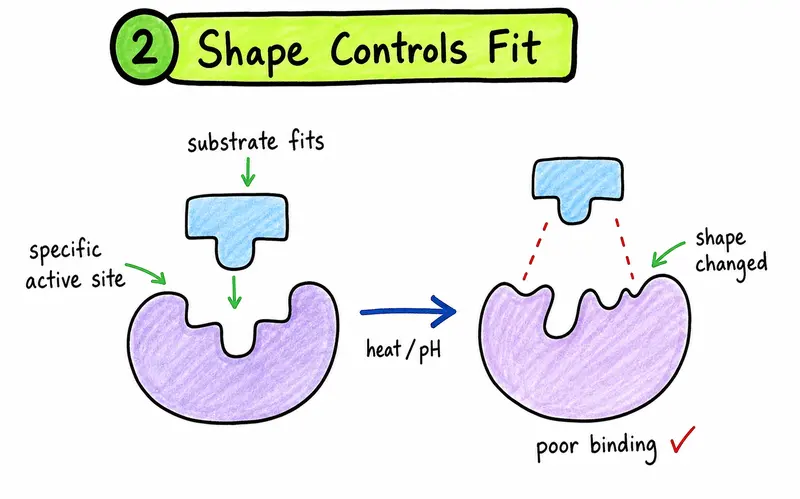
Enzymes are usually globular proteins that catalyse reactions by lowering activation energy. The active site is specific to the substrate. In induced fit, the enzyme changes shape slightly as the substrate binds.
Factors affecting enzyme activity:
- temperature increases kinetic energy until denaturation reduces activity
- pH changes can alter bonding and active-site shape
- substrate concentration increases rate until active sites are saturated
Worked Example 2: Enzyme Temperature Graph
Question: Explain why enzyme activity increases with temperature at first but decreases after the optimum.
Markscheme-style answer: At first, higher temperature gives enzyme and substrate molecules more kinetic energy, so collisions occur more often and more enzyme-substrate complexes form. Above the optimum, heat disrupts bonds maintaining the enzyme's tertiary structure, changing the active-site shape and reducing substrate binding.
Why this scores: It explains both sides of the graph and links denaturation to active-site shape.
DNA, RNA, and Protein Synthesis
DNA and RNA are nucleic acids made from nucleotides. Each nucleotide contains a base, sugar, and phosphate group. If you need more detail on bases, strands, and bonding, use the dedicated A1.2 nucleic acids revision page before doing mixed molecular-biology questions.
| Feature | DNA | RNA |
|---|---|---|
| Strands | usually double-stranded | usually single-stranded |
| Sugar | deoxyribose | ribose |
| Base | uses thymine | uses uracil instead of thymine |
| Role | stores genetic information | helps transfer and express information |
Transcription makes an mRNA copy from a DNA template. Translation uses the mRNA sequence at a ribosome to build a polypeptide.
DNA replication is semi-conservative. Each new DNA molecule contains one original strand and one newly synthesised strand. DNA helicase unwinds and separates strands; DNA polymerase adds complementary nucleotides.
PCR, Respiration, and Photosynthesis
PCR amplifies a specific DNA segment:
- Denaturation: heat separates DNA strands.
- Annealing: primers bind to target sequences.
- Extension: Taq polymerase builds new strands.
Cell respiration releases usable energy from glucose, usually as ATP. Photosynthesis stores light energy in organic molecules. Their summary equations are related, but do not write that photosynthesis is simply respiration in reverse; the pathways, locations, and enzyme-controlled steps differ.
Question-Type Breakdown
| Question type | What the examiner is testing | First move in your answer | Common trap |
|---|---|---|---|
| Biomolecule comparison | elements, monomers, bonds, functions | make a table by molecule group | saying lipids are simple polymers |
| Condensation/hydrolysis | role of water and bond direction | state whether water is released or used | reversing the reactions |
| Enzyme graph | active site and denaturation | explain low/high temperature separately | writing "enzyme dies" |
| DNA vs RNA | sugar/base/strand/role | compare specific features | drawing RNA as a double helix |
| Protein synthesis | sequence of information flow | DNA -> mRNA -> polypeptide | saying translation makes mRNA |
| PCR | three repeated stages | denaturation, annealing, extension | saying PCR copies the whole genome |
Exam-Ready Mini Checklist
Before moving on, check:
- Did I know which reaction releases water and which uses water?
- Did I link enzyme function to active-site shape and activation energy?
- Did I explain denaturation without saying enzymes "die"?
- Did I distinguish DNA from RNA using sugar, base, strand number, and role?
- Did I separate transcription from translation?
- Did I describe PCR as amplification of a specific DNA segment?
- Did I avoid saying photosynthesis is exactly respiration backwards?
Use A1.2 Nucleic acids questions for targeted DNA/RNA practice, then broaden into the IB Biology question bank. Put repeated mechanism errors, such as hydrolysis wording or enzyme graph wording, into flashcards.
Topic-Specific Revision Route
Use this route when the topic feels too wide:
- Group the topic into water, carbohydrates, lipids, proteins, enzymes, DNA/RNA, and energy processes.
- For each biomolecule, link structure to function in one sentence.
- Practise enzyme and DNA questions because they expose vague wording quickly.
- Use diagrams to track condensation, hydrolysis, replication, transcription, and translation.
- Finish with one mixed question that forces the ideas to connect.
Common Mistakes That Cost Marks
- Revising the notes without doing a topic-specific question.
- Writing a correct keyword but not linking it to the evidence in the question.
- Skipping the markscheme after a nearly correct answer.
- Letting one repeated mistake stay vague instead of turning it into a correction rule.
How EduNinja Helps
A clean revision loop is easier when the tools sit in one place. Rebuild the idea in EduNinja Notes, test it in the Questionbank, then turn every missed mark into a flashcard or a follow-up AI Tutor prompt. That keeps the article's method practical: learn the concept, answer a real question, mark it, and fix the exact weakness.
Related Study Links
- Review the full IB Biology SL syllabus
- IB Biology notes
- IB Biology question bank
- water revision guide
- DNA and RNA guide
Practice This Topic
Try an exam-style question on this exact topic, then check the worked guidance in the Question Bank.
Practice this topic: Practise IB Biology nucleic acids questions
FAQ
What is the hardest part of IB Biology molecular biology?
The hardest part is usually linking molecular structure to biological function. You need to connect polarity to water properties, protein shape to enzyme action, base sequence to protein synthesis, and energy transfer to respiration and photosynthesis.
What is the difference between condensation and hydrolysis?
Condensation joins molecules and releases water. Hydrolysis breaks bonds using water. A common exam mistake is reversing water's role, so practise writing both reactions with the bond formed or broken.
Why does enzyme activity fall after the optimum temperature?
After the optimum temperature, heat disrupts bonds that maintain the enzyme's tertiary structure. The active site changes shape, substrates bind less effectively, and the reaction rate falls.
What is the difference between transcription and translation?
Transcription makes mRNA from a DNA template. Translation uses mRNA codons at a ribosome to build a polypeptide. A simple exam chain is DNA -> mRNA -> amino acid sequence -> polypeptide.
Are respiration and photosynthesis exact opposites?
No. Their summary equations are related, but the pathways are not simply the same process in reverse. Treat them as linked energy-transfer processes with different locations, stages, and enzyme-controlled steps.
Put molecular biology back into your full IB Biology SL study plan.
Return to the complete course overview, or move directly into the most relevant study tool.
Related articles
More course notes, updates and study resources from the EduNinja blog.
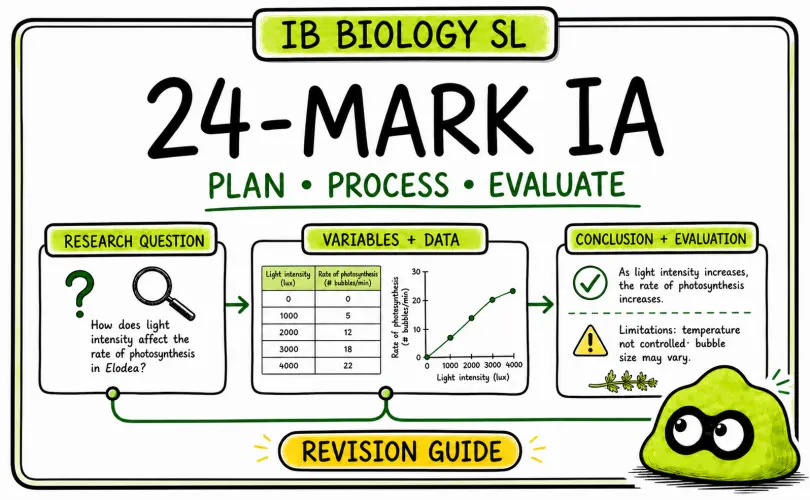
IB Biology Scientific Investigation Guide: How to Build a Strong 24-Mark IA
A practical IB Biology guide to the 24-mark Scientific Investigation: choose a workable research question, control variables, process data, draw a supported conclusion and evaluate limitations with specific improvements.
Abiotic Factors Explained | IB Biology SL
Revise IB Biology SL abiotic factors, tolerance ranges, limiting factors and how environmental variables affect distribution.
Active Transport vs Passive Transport | A-Level Biology
Revise A-Level Biology active and passive transport with concentration gradients, ATP, carrier proteins, examples, common mistakes and practice.