Spectator Ions in IB Chemistry: Net Ionic Equations
Revise spectator ions in IB Chemistry with net ionic equations, precipitation examples, common mistakes and targeted question practice.
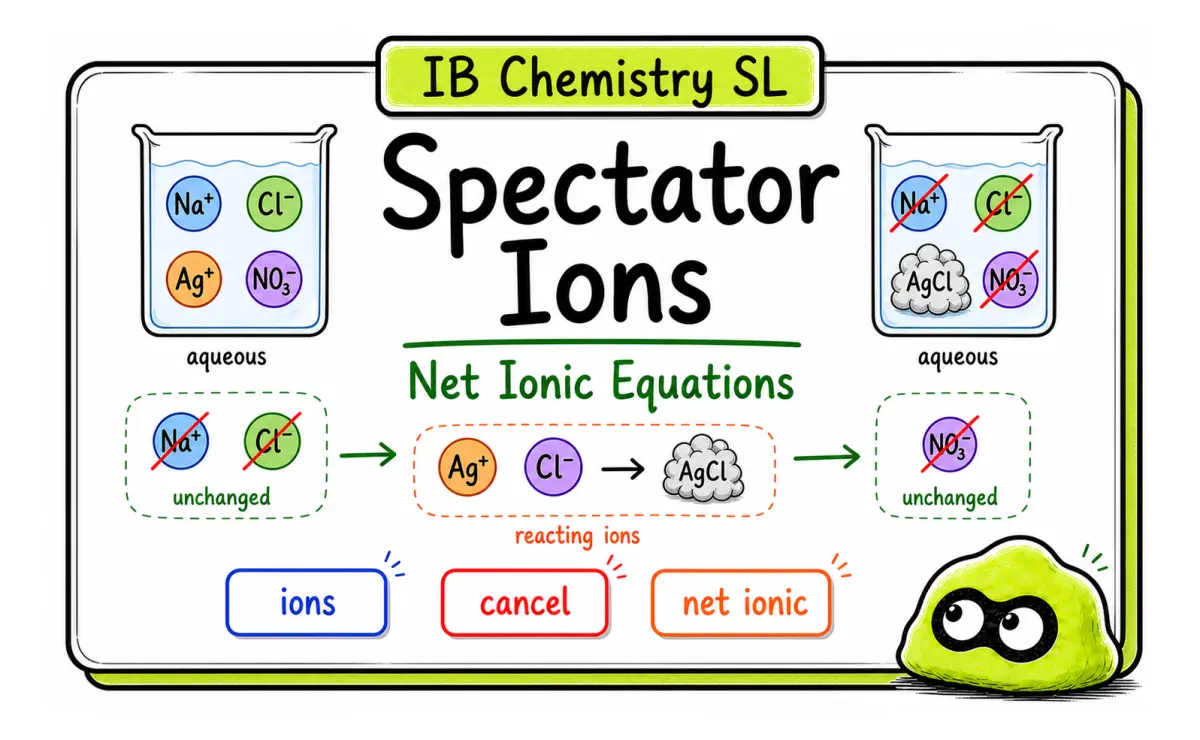
Spectator ions are ions that appear in an ionic equation but do not take part in the chemical change. In IB Chemistry, they matter because removing them helps you write the net ionic equation, which shows only the reacting particles.
This page targets the student search problem behind spectator ions and the common misspelling or word-order query "ion spectator". The useful exam skill is not memorising a definition; it is spotting unchanged aqueous ions and cancelling them safely.
Quick Answer
| Question | Exam-safe answer |
|---|---|
| What are spectator ions? | Ions that remain unchanged during a reaction |
| Where do they appear? | On both sides of the full ionic equation |
| What do you do with them? | Cancel them before writing the net ionic equation |
| Common examples | Na+, K+, NO3- in many precipitation or neutralisation equations |
| Main trap | Cancelling ions that actually form a precipitate, gas, or water |
What Spectator Ions Mean in IB Chemistry
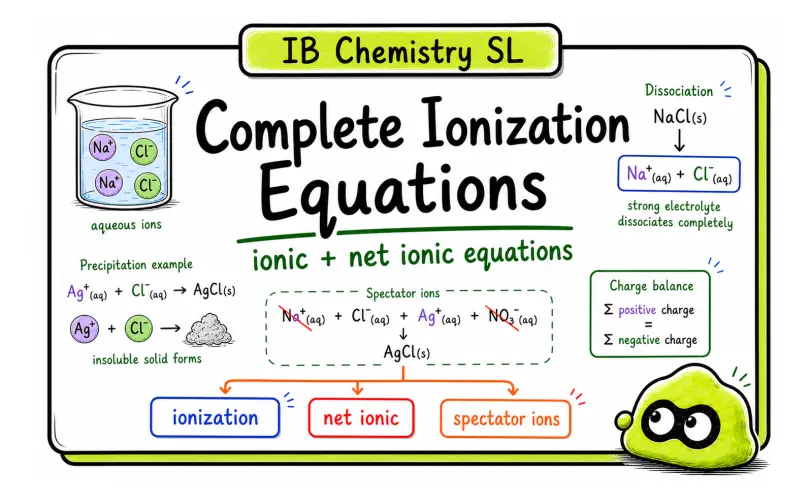
A spectator ion is present in the reaction mixture but does not undergo chemical change. It stays dissolved as an aqueous ion before and after the reaction. Because it is unchanged, it is not included in the net ionic equation.
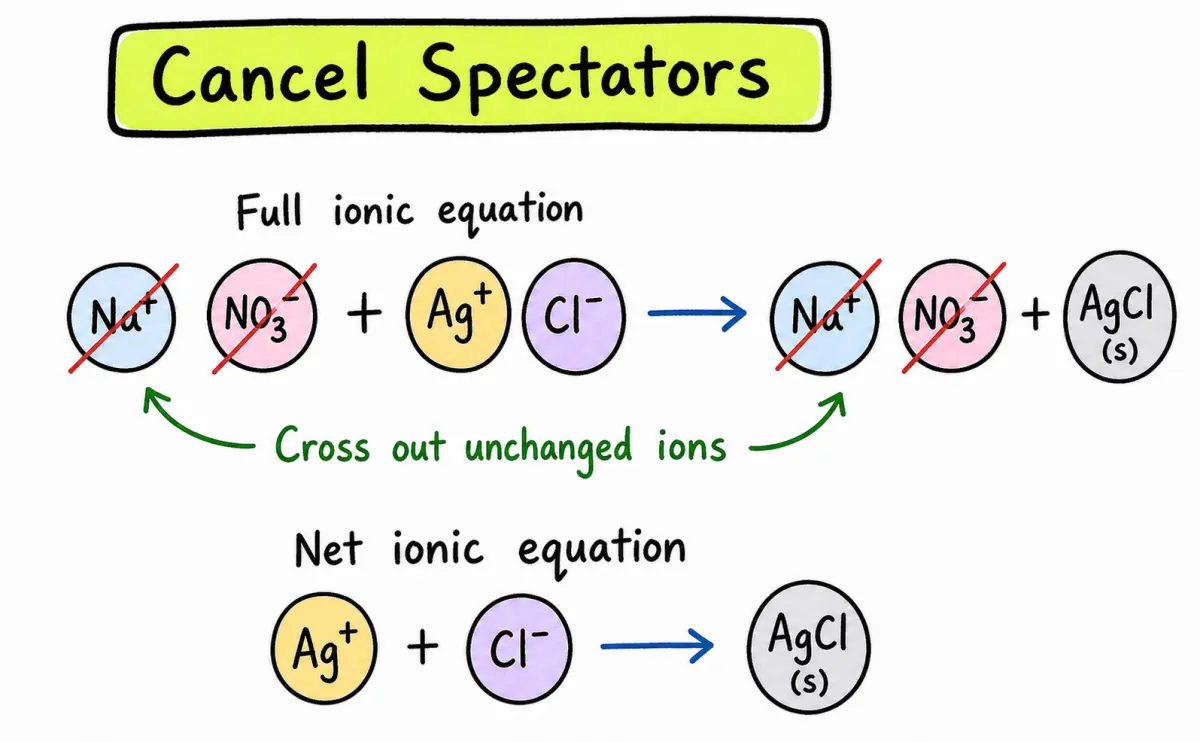
In a precipitation reaction, for example, two solutions may be mixed and a solid forms. The ions that make the solid are reacting ions. The ions that stay dissolved and unchanged are spectator ions.
Full Ionic Equation vs Net Ionic Equation
| Equation type | What it shows | What happens to spectator ions |
|---|---|---|
| Full equation | Compounds and states | Spectator ions may be hidden inside formulas |
| Full ionic equation | All dissolved ions separately | Spectator ions appear on both sides |
| Net ionic equation | Only the reacting species | Spectator ions are removed |
The net ionic equation is shorter because it shows the actual chemical change. This is why it is useful in acid-base and precipitation questions.
For IB Chemistry exam answers, always check that the net ionic equation is balanced for both atoms and charge after spectator ions are removed.
Worked Example
Question: Silver nitrate solution is mixed with sodium chloride solution. A white precipitate of silver chloride forms. Identify the spectator ions and write the net ionic equation.
Full ionic idea: Ag+ and NO3- are present from silver nitrate. Na+ and Cl- are present from sodium chloride.
Reacting ions: Ag+ and Cl- combine to form AgCl(s).
Spectator ions: Na+ and NO3- remain aqueous and unchanged.
Net ionic equation: Ag+ + Cl- -> AgCl(s)
Why this works: The answer checks which ions change state or form a product. Na+ and NO3- are present but do not take part in forming the precipitate.
Exam-Safe Wording
Use this definition:
Spectator ions are ions that remain unchanged in a reaction and appear on both sides of the full ionic equation.
For method questions, use this sequence:
- Split soluble ionic compounds into ions.
- Keep solids, liquids, gases, and weakly ionised species together where appropriate.
- Identify ions that appear unchanged on both sides.
- Cancel spectator ions.
- Write the net ionic equation with state symbols if required.
Common Mistakes
| Mistake | Why it loses marks | Better wording |
|---|---|---|
| Cancelling every repeated symbol | Some species change state or form products | Cancel only unchanged aqueous ions |
| Forgetting charges | Ionic equations must balance charge | Keep + and - signs visible |
| Removing the precipitate ions | They are reacting ions | Keep ions that form the solid |
| Calling spectator ions useless | They are present, just not chemically changed | Say they do not take part in the net ionic change |
Mini Practice Set
- Define spectator ion.
- Explain why Na+ is often a spectator ion in precipitation reactions.
- Identify the reacting ions when AgCl(s) forms from aqueous Ag+ and Cl-.
- Write the net ionic equation for H+ reacting with OH- to form water.
- State one reason why charge balance matters in ionic equations.
Practice This Topic
Try this exam-style question:
A student writes the net ionic equation for silver chloride precipitation as Na+ + NO3- + Ag+ + Cl- -> AgCl(s). Explain what is wrong and rewrite the equation correctly.
Answer guide:
- Na+ and NO3- are spectator ions because they remain aqueous and unchanged.
- The reacting ions are Ag+ and Cl-.
- The net ionic equation should show only the chemical change.
- Correct equation: Ag+ + Cl- -> AgCl(s).
- Charges and state symbols should be checked if required by the question.
Practice this exact skill
Practise IB Chemistry SL ionic model questions
Some questions may require an EduNinja membership.
Browse broader practice
Browse the full IB Chemistry SL Question Bank
Use this if you want to explore more available practice by topic.
Related Study Links
- Open the full revision Study Hub
- IB Chemistry Acids and Bases: pH, Neutralisation, and Common Mistakes
- IB Chemistry SL Strong and Weak Acids Guide
- Browse the full IB Chemistry Question Bank
FAQ
What is a spectator ion?
A spectator ion is an ion that remains unchanged during a chemical reaction. It appears on both sides of the full ionic equation, so it is cancelled when writing the net ionic equation. The word spectator means it is present but not directly involved in the chemical change.
How do you identify spectator ions?
Identify spectator ions by writing the full ionic equation and checking which aqueous ions appear unchanged on both sides. If an ion forms a solid, gas, water, or another product, it is not a spectator. Always check charges and state symbols before cancelling.
Are sodium and nitrate always spectator ions?
Sodium ions and nitrate ions are often spectator ions in school-level precipitation examples, but do not treat this as an automatic rule. You should still inspect the equation. An ion is a spectator only if it stays aqueous and unchanged on both sides of that specific reaction.
What is the difference between ionic and net ionic equations?
A full ionic equation shows all soluble ionic compounds as separate ions. A net ionic equation removes spectator ions and shows only the reacting particles. Net ionic equations are useful because they reveal the actual chemical change instead of listing ions that did not change.
Why are spectator ions removed?
Spectator ions are removed because they do not take part in the net chemical change. Keeping them can make the equation longer and hide the main reaction. Removing them helps you focus on the ions that form a precipitate, water, gas, or another product.
Final Takeaway
Spectator ions are present, but unchanged. If you can write the full ionic equation, cancel only the unchanged aqueous ions, and keep the reacting ions, your net ionic equation becomes much safer.
Put topic practice back into your full IB Chemistry SL study plan.
Return to the complete course overview, or move directly into the most relevant study tool.
Related articles
More course notes, updates and study resources from the EduNinja blog.
London Dispersion Forces Explained for IB Chemistry
Learn London dispersion forces for IB Chemistry with temporary dipoles, induced dipoles, molecular size, boiling point trends, examples and practice.
Transition Metals Explained for IB Chemistry
Revise transition metals in IB Chemistry, including coloured ions, variable oxidation states, complex ions, catalysts and common exam mistakes.
How to Complete Ionization and Net Ionic Equations
Learn complete ionization and net ionic equations for IB Chemistry, with ion charges, state symbols, spectator ions, worked examples and practice.