Transition Metals Explained for IB Chemistry
Revise transition metals in IB Chemistry, including coloured ions, variable oxidation states, complex ions, catalysts and common exam mistakes.
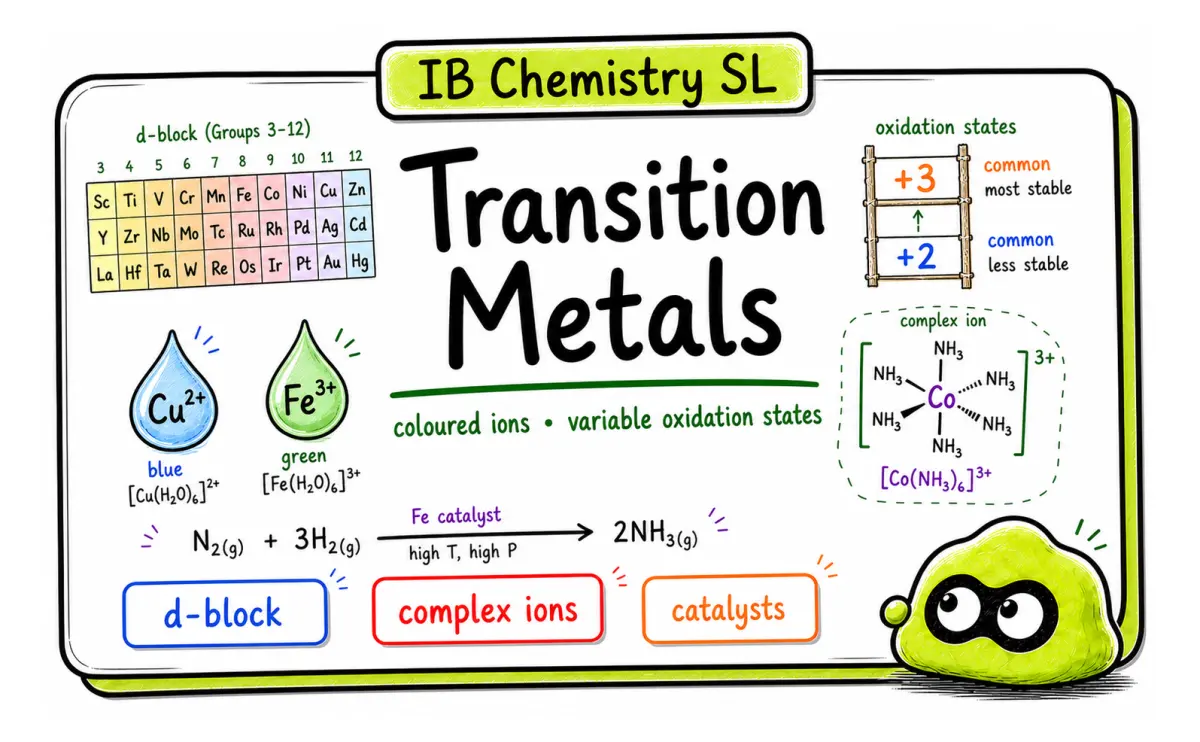
Transition metals are d-block elements that often form coloured ions, show variable oxidation states, form complex ions and act as catalysts. In IB Chemistry, the exam skill is to connect those properties to electron structure rather than memorising a list.
Students usually meet transition metals in questions about coloured solutions, redox changes, ligand bonding and industrial catalysts. The safest starting point is simple: transition metals have partially filled d orbitals in at least one of their common ions.
Quick Answer
| Feature | What it means |
|---|---|
| d-block position | Transition metals sit in the central block of the periodic table |
| Coloured ions | Many ions absorb visible light because of d-orbital energy gaps |
| Variable oxidation states | They can lose different numbers of electrons |
| Complex ions | Metal ions can bond to ligands using coordinate bonds |
| Catalysts | They can provide alternative reaction pathways |
What Transition Metals Are
A transition metal is usually described as a d-block element that forms at least one stable ion with an incomplete d subshell. This matters because the incomplete d subshell helps explain several important properties.
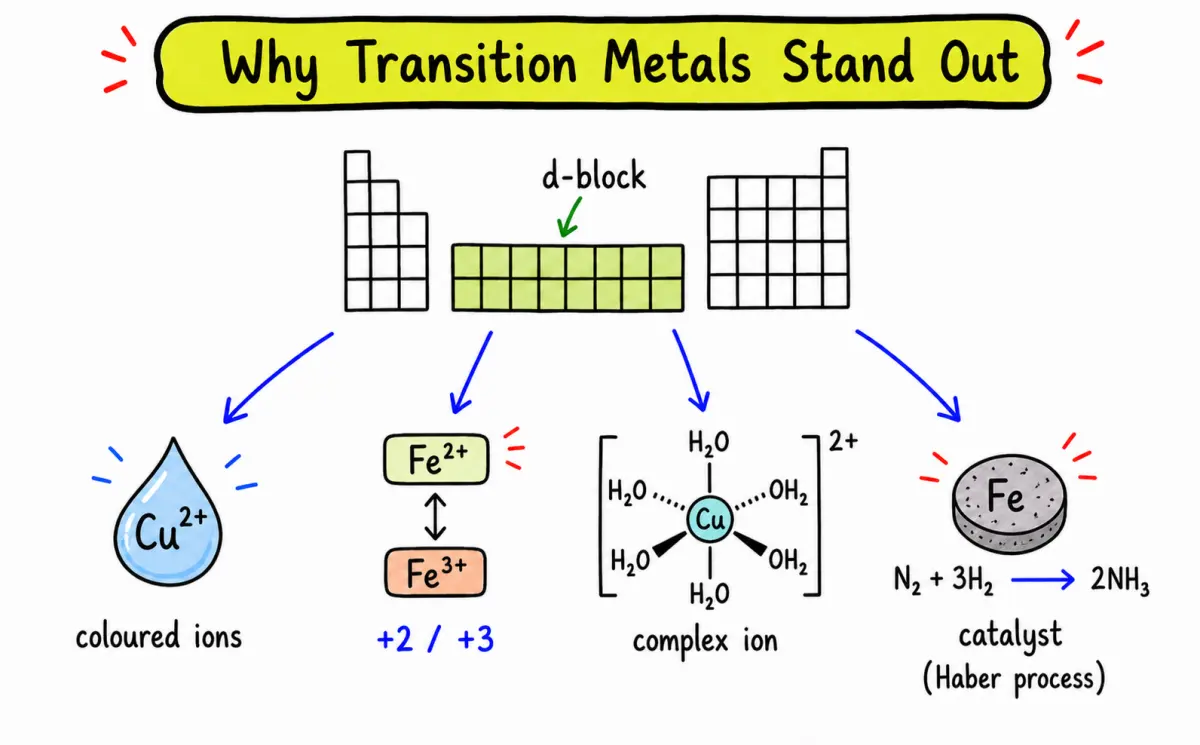
Zinc is a useful trap. Although Zn is in the d-block, Zn2+ has a full d10 arrangement, so it is often not treated as a transition metal in the stricter exam definition.
Why Transition Metal Ions Are Coloured
Many transition metal ions are coloured because their d orbitals split into different energy levels in a ligand field. Electrons can absorb visible light and move between these levels. The colour seen is related to the light not absorbed.
For example, copper(II) solutions are often blue, while some iron(III) compounds appear yellow, orange or brown depending on the ligand and conditions.
Variable Oxidation States
Transition metals can often form ions with different charges because the 4s and 3d electrons are close in energy. Iron commonly forms Fe2+ and Fe3+, while copper commonly forms Cu+ and Cu2+.
In redox questions, always track the oxidation number before and after the reaction. A change in oxidation number tells you that oxidation or reduction has happened.
Complex Ions and Ligands
A complex ion forms when ligands donate lone pairs to a central metal ion. The bond formed is a coordinate bond because both electrons in the shared pair come from the ligand.
Common ligand examples include H2O, NH3, Cl- and CN-. In exam answers, name the ligand, the central metal ion and the overall charge carefully.
Transition Metals as Catalysts
Transition metals and their compounds can act as catalysts because they can change oxidation state or provide a surface where reactants adsorb. Iron in the Haber process and vanadium(V) oxide in the Contact process are common school-level examples.
The key wording is that a catalyst provides an alternative pathway with lower activation energy. It is not used up overall.
Common Mistakes
| Mistake | Why it loses marks | Better habit |
|---|---|---|
| Calling every d-block element a transition metal | Zn can be an exception in strict definitions | Check the ion has an incomplete d subshell |
| Saying colour comes from the nucleus | Colour is linked to d-electron transitions | Mention split d orbitals and visible light absorption |
| Forgetting ligand charge | Complex ion charge depends on metal ion plus ligands | Add charges carefully |
| Treating catalysts as reactants | Catalysts are regenerated overall | Say alternative pathway and lower activation energy |
Mini Practice
- Explain why Fe2+ and Fe3+ show variable oxidation states.
- State why many transition metal ions are coloured.
- Identify the ligand in [Cu(H2O)6]2+.
- Explain why Zn2+ is often not counted as a transition metal ion.
- Give one industrial example of a transition metal catalyst.
Answers:
- Iron can lose different numbers of 4s and 3d electrons.
- Electrons absorb visible light when moving between split d-orbital energy levels.
- H2O is the ligand.
- Zn2+ has a full d10 subshell, not an incomplete d subshell.
- Iron in the Haber process, or V2O5 in the Contact process.
Practice This Topic
Try this exam-style task:
Explain why many transition metal compounds are coloured, and why zinc compounds are often colourless.
Answer guide:
Many transition metal ions have partially filled d orbitals. In a ligand field, these orbitals split into different energy levels, so electrons can absorb visible light. Zinc ions such as Zn2+ have a full d10 subshell, so d-d transitions are not possible in the same way.
Practice related Chemistry questions
Practice IB Chemistry SL periodic table questions
Some questions may require an EduNinja membership.
Browse broader practice
Browse the full IB Chemistry Question Bank
Related Study Links
- Review the complete syllabus Study Hub
- IB Chemistry Acids and Bases: pH, Neutralisation, and Common Mistakes
- Spectator Ions in IB Chemistry: Net Ionic Equations
- How to Complete Ionization and Net Ionic Equations
- Practice IB Chemistry SL periodic table questions
FAQ
What are transition metals in IB Chemistry?
Transition metals are usually d-block elements that form at least one stable ion with an incomplete d subshell. This stricter definition explains why zinc is often treated as an exception in school-level chemistry.
Why are transition metal ions coloured?
Many transition metal ions are coloured because ligands split the d orbitals into different energy levels. Electrons absorb visible light to move between these levels, and the remaining light gives the colour observed.
Why do transition metals have variable oxidation states?
Transition metals have variable oxidation states because their 4s and 3d electrons are close in energy. Different numbers of electrons can be removed, so ions such as Fe2+ and Fe3+ can both be stable.
What is a complex ion?
A complex ion contains a central metal ion surrounded by ligands. Ligands donate lone pairs to the metal ion, forming coordinate bonds. Water, ammonia and chloride ions are common ligand examples.
Final Takeaway
Transition metals are not just the middle of the periodic table. For exams, link their properties to incomplete d subshells, ligand bonding, variable oxidation states and catalysis.
Put topic practice back into your full IB Chemistry SL study plan.
Return to the complete course overview, or move directly into the most relevant study tool.
Related articles
More course notes, updates and study resources from the EduNinja blog.
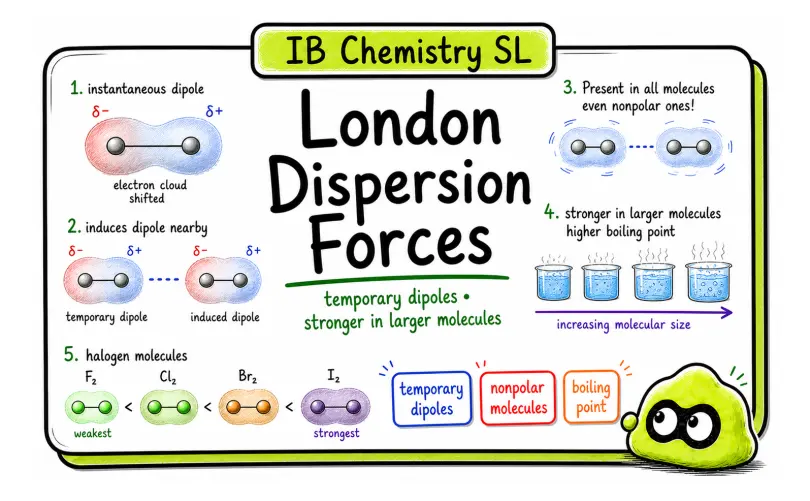
London Dispersion Forces Explained for IB Chemistry
Learn London dispersion forces for IB Chemistry with temporary dipoles, induced dipoles, molecular size, boiling point trends, examples and practice.
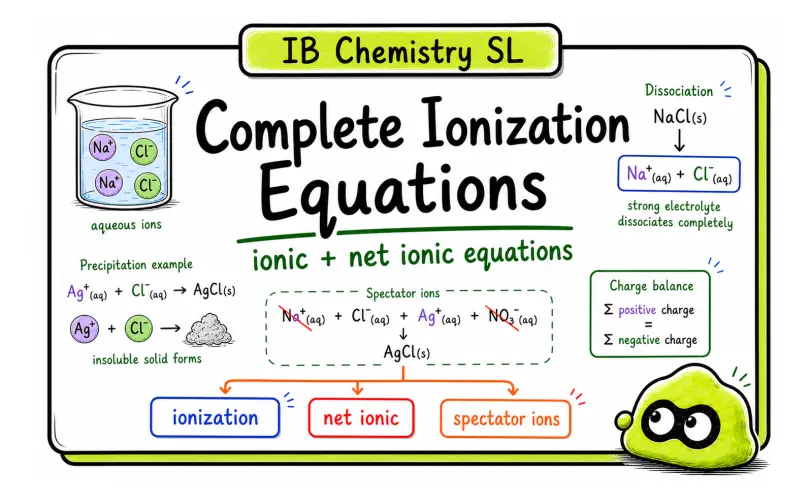
How to Complete Ionization and Net Ionic Equations
Learn complete ionization and net ionic equations for IB Chemistry, with ion charges, state symbols, spectator ions, worked examples and practice.
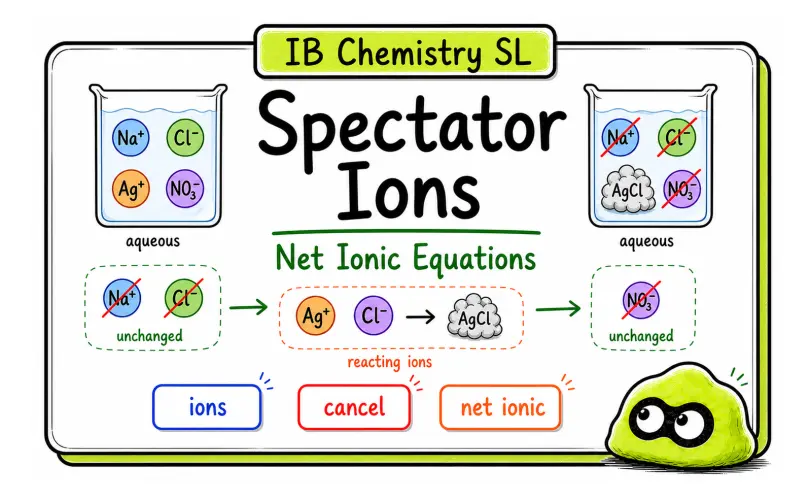
Spectator Ions in IB Chemistry: Net Ionic Equations
Revise spectator ions in IB Chemistry with net ionic equations, precipitation examples, common mistakes and targeted question practice.