How to Complete Ionization and Net Ionic Equations
Learn complete ionization and net ionic equations for IB Chemistry, with ion charges, state symbols, spectator ions, worked examples and practice.
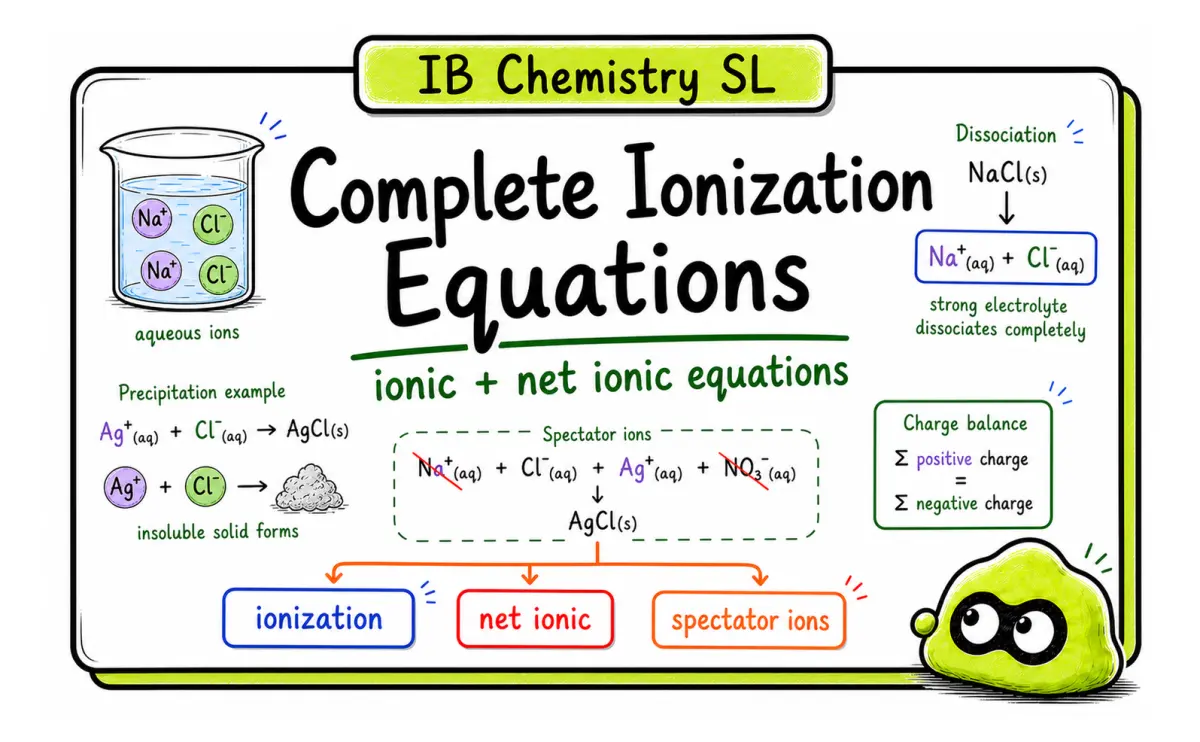
Complete ionization equations are a small skill with a big payoff: they force you to track ions, charges, coefficients and state symbols before you move into full ionic or net ionic equations.
Students often make this harder than it is. The question is usually asking: when this ionic substance dissolves or reacts in water, what ions should be shown, and in what ratio? Once that is clear, net ionic equations become much easier.
Quick Answer
| Skill | What to check |
|---|---|
| Ionization equation | Split an ionic compound into its ions |
| Charge balance | Total positive charge must equal total negative charge |
| Coefficients | Subscripts in the formula become ion coefficients |
| State symbols | Aqueous ions usually use (aq) |
| Net ionic equation | Remove spectator ions and keep only reacting species |
What Complete Ionization Equations Mean
An ionization equation shows the ions produced when an ionic compound separates into aqueous ions. For example:
NaCl(s) -> Na+(aq) + Cl-(aq)
For compounds with more than one ion of a type, the formula tells you the ratio:
CaCl2(s) -> Ca2+(aq) + 2Cl-(aq)
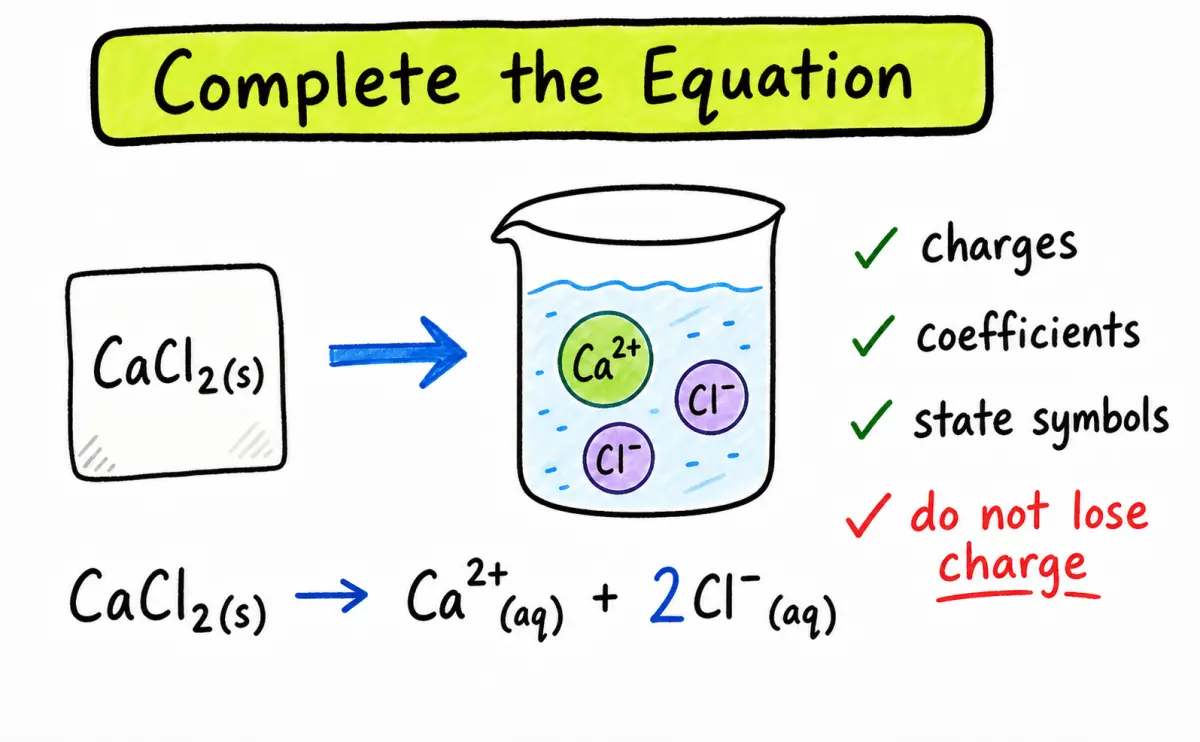
The safest method is to write the ion charges first, then add coefficients until the atoms and total charge balance.
How to Complete Each Ionization Equation
Use this sequence:
- Identify the cation and anion.
- Write their charges correctly.
- Use the formula subscripts to set ion ratios.
- Add state symbols if the question expects them.
- Check total charge on both sides.
For example, aluminium sulfate contains Al3+ and SO4^2-. The formula Al2(SO4)3 means:
Al2(SO4)3(s) -> 2Al3+(aq) + 3SO4^2-(aq)
Charge check: 2 x +3 = +6, and 3 x -2 = -6, so the total charge is 0.
From Ionization to Net Ionic Equations
Ionization equations help you write net ionic equations because they reveal which ions are actually present in solution.
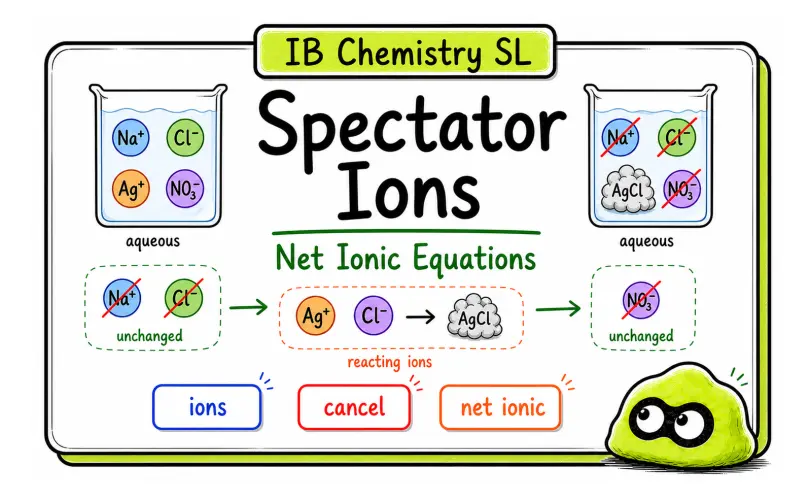
For silver nitrate and sodium chloride:
AgNO3(aq) + NaCl(aq) -> AgCl(s) + NaNO3(aq)
Full ionic idea:
Ag+(aq) + NO3-(aq) + Na+(aq) + Cl-(aq) -> AgCl(s) + Na+(aq) + NO3-(aq)
Spectator ions:
Na+ and NO3- are unchanged.
Net ionic equation:
Ag+(aq) + Cl-(aq) -> AgCl(s)
Complete Ionic vs Net Ionic Equations in IB Chemistry
A complete ionic equation shows all aqueous ions, including spectator ions. A net ionic equation removes spectator ions and shows only the species that take part in the chemical change.
For IB Chemistry, check three things before your final answer:
- correct ion charges
- correct state symbols
- balanced atoms and overall charge
For example, sodium ions and nitrate ions are often spectator ions in precipitation reactions because they remain aqueous and unchanged on both sides of the equation.
Common Mistakes
| Mistake | Why it loses marks | Better habit |
|---|---|---|
| Ignoring charges | The equation may not balance electrically | Write ion charges before coefficients |
| Turning subscripts into charges | CaCl2 does not mean Cl2- | Use known ion charges |
| Cancelling reacting ions | Precipitate-forming ions are not spectators | Cancel only unchanged aqueous ions |
| Forgetting state symbols | Some mark schemes require them | Add (aq), (s), (l), or (g) where needed |
Mini Practice
Complete these ionization equations:
- KBr(s) -> ?
- MgCl2(s) -> ?
- Na2SO4(s) -> ?
- AlCl3(s) -> ?
- Ba(NO3)2(s) -> ?
Answers:
- KBr(s) -> K+(aq) + Br-(aq)
- MgCl2(s) -> Mg2+(aq) + 2Cl-(aq)
- Na2SO4(s) -> 2Na+(aq) + SO4^2-(aq)
- AlCl3(s) -> Al3+(aq) + 3Cl-(aq)
- Ba(NO3)2(s) -> Ba2+(aq) + 2NO3-(aq)
Practice This Topic
Try this exam-style task:
A student writes: CaCl2(s) -> Ca+(aq) + Cl2-(aq). Explain the two mistakes and rewrite the equation correctly.
Answer guide:
Calcium forms Ca2+, chloride forms Cl-, and the subscript 2 means there are two chloride ions. The correct equation is:
CaCl2(s) -> Ca2+(aq) + 2Cl-(aq)
Practice related ionic model questions
Practise IB Chemistry SL ionic model questions
Some questions may require an EduNinja membership.
Browse broader practice
Browse the full IB Chemistry SL Question Bank
Related Study Links
- Explore the subject Study Hub
- Spectator Ions in IB Chemistry: Net Ionic Equations
- IB Chemistry Acids and Bases: pH, Neutralisation, and Common Mistakes
- Browse the full IB Chemistry Question Bank
- IB Chemistry SL Question Bank
FAQ
What does complete each ionization equation mean?
It means writing the ions produced when an ionic compound separates into solution. The answer should include correct ion charges, coefficients and state symbols when required.
How do you know the charges in an ionization equation?
Use the periodic table, common ion charges, or the formula of the compound. For example, CaCl2 contains Ca2+ and Cl- because two chloride ions are needed to balance one calcium ion.
Is an ionization equation the same as a net ionic equation?
No. An ionization equation shows ions produced from a compound. A net ionic equation shows only the species that take part in the chemical change after spectator ions are removed.
Final Takeaway
Complete the ions first, then check charges. If your ionization equation is balanced, your net ionic equation is much easier to trust.
Put topic practice back into your full IB Chemistry SL study plan.
Return to the complete course overview, or move directly into the most relevant study tool.
Related articles
More course notes, updates and study resources from the EduNinja blog.
London Dispersion Forces Explained for IB Chemistry
Learn London dispersion forces for IB Chemistry with temporary dipoles, induced dipoles, molecular size, boiling point trends, examples and practice.
Transition Metals Explained for IB Chemistry
Revise transition metals in IB Chemistry, including coloured ions, variable oxidation states, complex ions, catalysts and common exam mistakes.
Spectator Ions in IB Chemistry: Net Ionic Equations
Revise spectator ions in IB Chemistry with net ionic equations, precipitation examples, common mistakes and targeted question practice.