IB Chemistry Acids and Bases: pH, Neutralisation, and Common Mistakes
Revise IB Chemistry acids and bases with pH, strong vs weak acids, conjugate pairs, neutralisation, buffers, and markscheme wording. Includes examples and targeted FAQ.
Acids and bases are full of words students use too loosely: strong, weak, concentrated, dilute, acidic, alkaline, neutralised. The marks come from keeping those words separate.
This guide helps you revise pH and neutralisation by building exact contrast sentences, then applying them to equations and short explanations.
Current syllabus map: This article is aligned to the IB Chemistry first assessment 2025 syllabus through Structure and Reactivity, especially acid-base behaviour, equilibrium and reaction reasoning.
Quick Answer
For IB Chemistry acids and bases, separate the language:
- Strong acid means full ionisation in water.
- Weak acid means partial ionisation.
- Concentration means amount per unit volume, not acid strength.
- Neutralisation is the reaction between hydrogen ions and hydroxide ions to form water.
- pH is linked to hydrogen ion concentration.
- Always check whether the question wants an equation, calculation, or explanation.
Why Students Lose Marks on Acids and Bases
Most lost marks in this topic come from small gaps, not total misunderstanding. A student may know the rough idea but miss the exact relationship, the correct unit, the sequence of steps, or the wording that the markscheme expects.
That is why passive reading feels productive but does not always improve marks. You can spend an hour reading a clean note page and still lose marks if you have not practised retrieval, calculation setup, diagram interpretation, or explanation chains.
Use the relevant EduNinja course pages as your base:
Do not open every link at once. Start with the notes or topic page, then move into question practice and use any PDF resource only when it helps clarify the exact idea you are revising.
<!-- backend-minimal-fix-applied -->
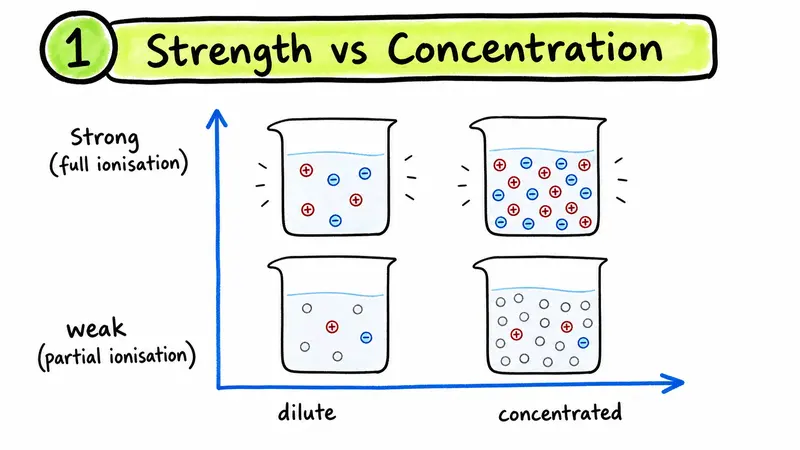
Strong, Weak, Concentrated, and Dilute
These words are not interchangeable.
| Term | Meaning | Common mistake |
|---|---|---|
| Strong acid | Fully ionises in water | Calling all low-pH acids strong |
| Weak acid | Partially ionises in water | Saying weak means harmless |
| Concentrated | Large amount per unit volume | Confusing concentration with strength |
| Dilute | Small amount per unit volume | Assuming dilute means weak |
For a fair comparison between a strong and weak acid, the concentration should be the same. Otherwise pH and reaction rate can be affected by amount as well as ionisation.
Neutralisation: The Core Ionic Idea
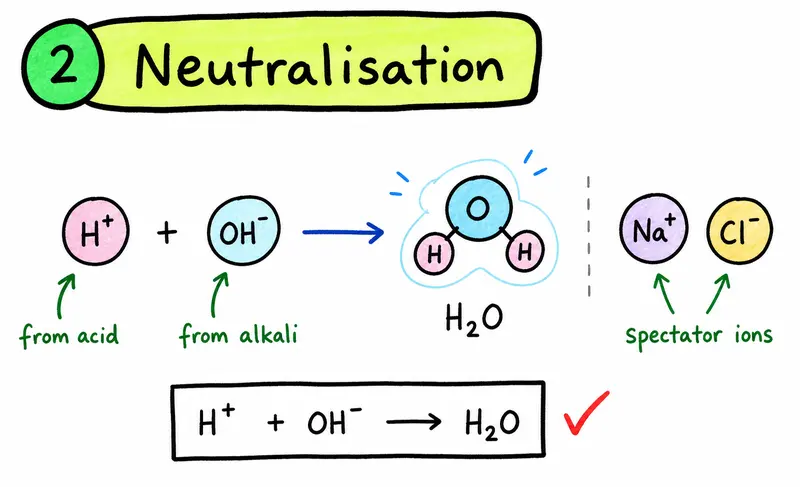
Neutralisation is the reaction between hydrogen ions and hydroxide ions to form water:
H+ + OH- -> H2O
In full equations, spectator ions may appear. The ionic equation helps you see the chemistry underneath: acid supplies H+, alkali supplies OH-, and water forms.
Worked Example: Compare Two Acids
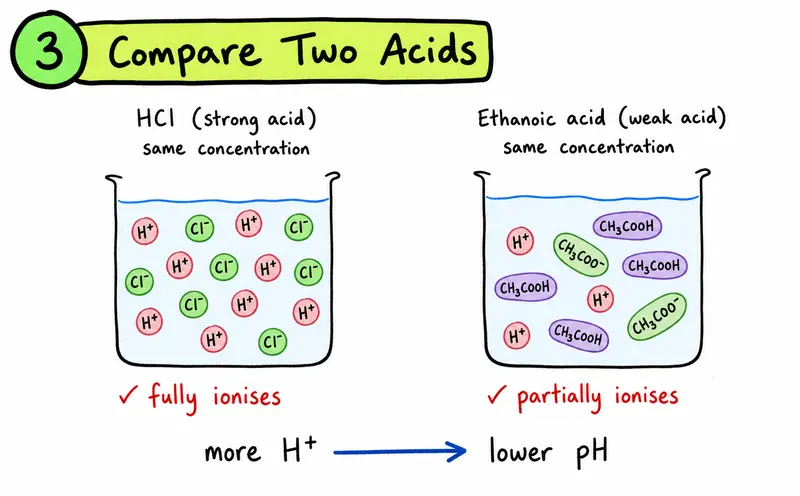
Question: Hydrochloric acid and ethanoic acid have the same concentration. Explain why hydrochloric acid has a lower pH.
Mark-worthy answer: Hydrochloric acid is a strong acid and fully ionises in water, producing a higher concentration of hydrogen ions. Ethanoic acid is a weak acid and only partially ionises, so fewer hydrogen ions are present. Therefore hydrochloric acid has the lower pH at the same concentration.
Why this scores: It controls concentration, uses ionisation language, and links pH to hydrogen ion concentration.
Exam Checklist for Acids and Bases
Before submitting an answer, check:
- Did I separate strength from concentration?
- Did I connect pH to hydrogen ion concentration?
- Did I use equilibrium language for weak acids?
- Did I include the ionic equation for neutralisation if needed?
- Did I avoid saying weak acids are not dangerous?
- Did I compare acids at the same concentration where relevant?
How EduNinja Helps with Acid-Base Questions
Use EduNinja Notes to rebuild the definitions, then practise short comparison and calculation questions in the Question Bank. For every mistake, write the exact missing contrast. For example: "weak acid means partial ionisation, not low concentration."
Practice This Topic
Try an exam-style acids and bases question, then check the worked guidance in the Question Bank.
Practice this topic: Practise IB Chemistry acids and bases questions
FAQ
Is a weak acid the same as a dilute acid?
No. Weak describes partial ionisation in water. Dilute describes low concentration. A weak acid can be concentrated, and a strong acid can be dilute.
Why does neutralisation form water?
Neutralisation forms water because hydrogen ions from the acid react with hydroxide ions from the alkali. The net ionic equation is H+ + OH- -> H2O.
Does low pH always mean a strong acid?
No. Low pH means high hydrogen ion concentration. To judge acid strength, you need to know the extent of ionisation and compare acids at the same concentration.
Related Study Links
- Explore the course Study Hub
- IB Chemistry Question Bank
- IB Chemistry Notes
- IB Chemistry Study Library
<!-- backend-minimal-top-up-applied -->
Worked Example: Neutralisation Calculation Logic
Question: A student adds acid to alkali until the solution is neutral. What has happened at particle level?
Mark-worthy answer: Hydrogen ions from the acid have reacted with hydroxide ions from the alkali to form water. When neutralisation is complete in a simple strong acid and strong alkali reaction, the amounts of H+ and OH- have reacted in the required ratio, so there is no excess acid or alkali.
Why this scores: It explains the particle change instead of only saying the solution becomes neutral.
What the Markscheme Wants
For pH and neutralisation questions, use the exact term first, then give the particle reason. "Strong" means full ionisation. "Weak" means partial ionisation. "Neutralisation" means H+ reacts with OH- to form H2O. If the question gives data, quote the pH or concentration before explaining it.
Put acids and bases back into your full IB Chemistry SL study plan.
Return to the complete course overview, or move directly into the most relevant study tool.
Related articles
More course notes, updates and study resources from the EduNinja blog.
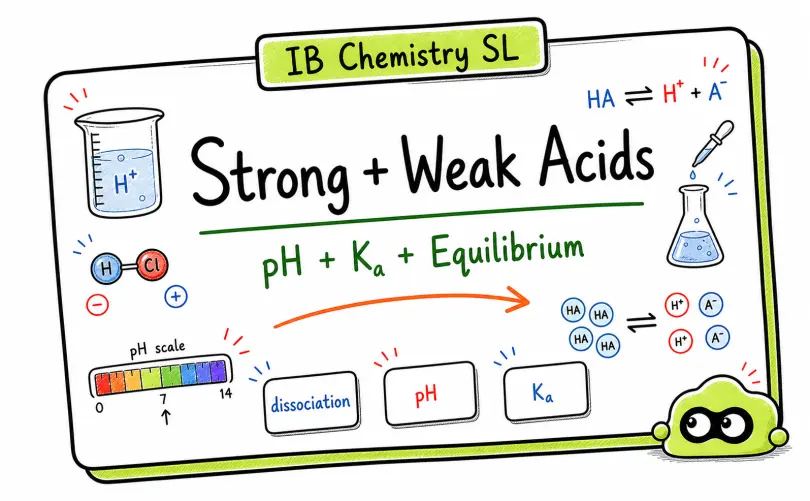
IB Chemistry SL Strong and Weak Acids: Exam Answer Guide
Revise IB Chemistry SL strong and weak acids with pH logic, equilibrium language, Ka, neutralisation, and mark-worthy answer patterns.
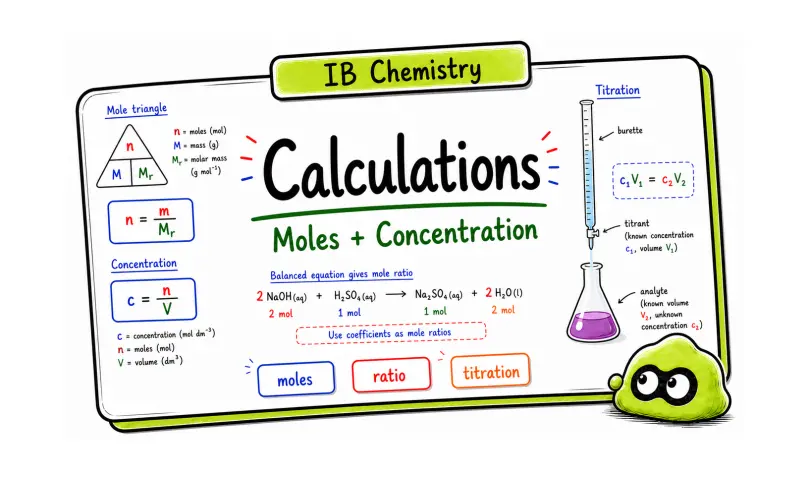
IB Chemistry Calculations: Mole Ratios, Concentration, and Titration Practice
A source-backed IB Chemistry guide for IB Chemistry calculations, using EduNinja PDF notes, worked examples, and markscheme-style answers.
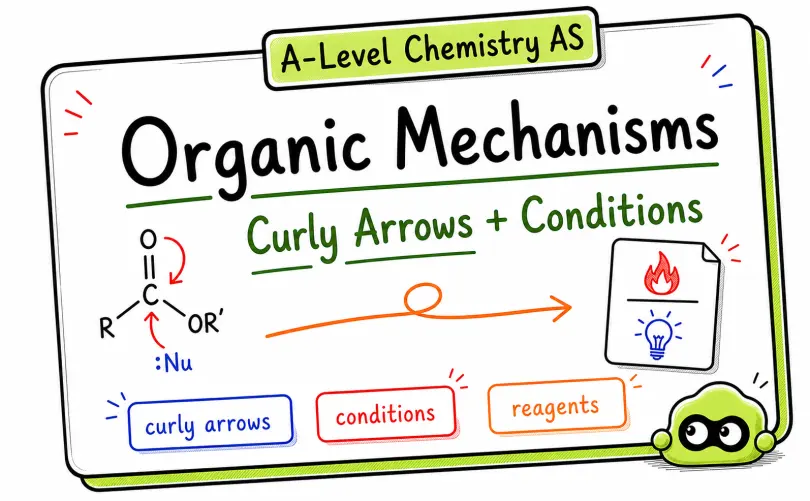
A-Level Chemistry Organic Mechanisms: Curly Arrows Guide
Revise A-Level Chemistry organic mechanisms with curly arrows, nucleophiles, electrophiles, substitution, addition, elimination, and common arrow errors.