London Dispersion Forces Explained for IB Chemistry
Learn London dispersion forces for IB Chemistry with temporary dipoles, induced dipoles, molecular size, boiling point trends, examples and practice.
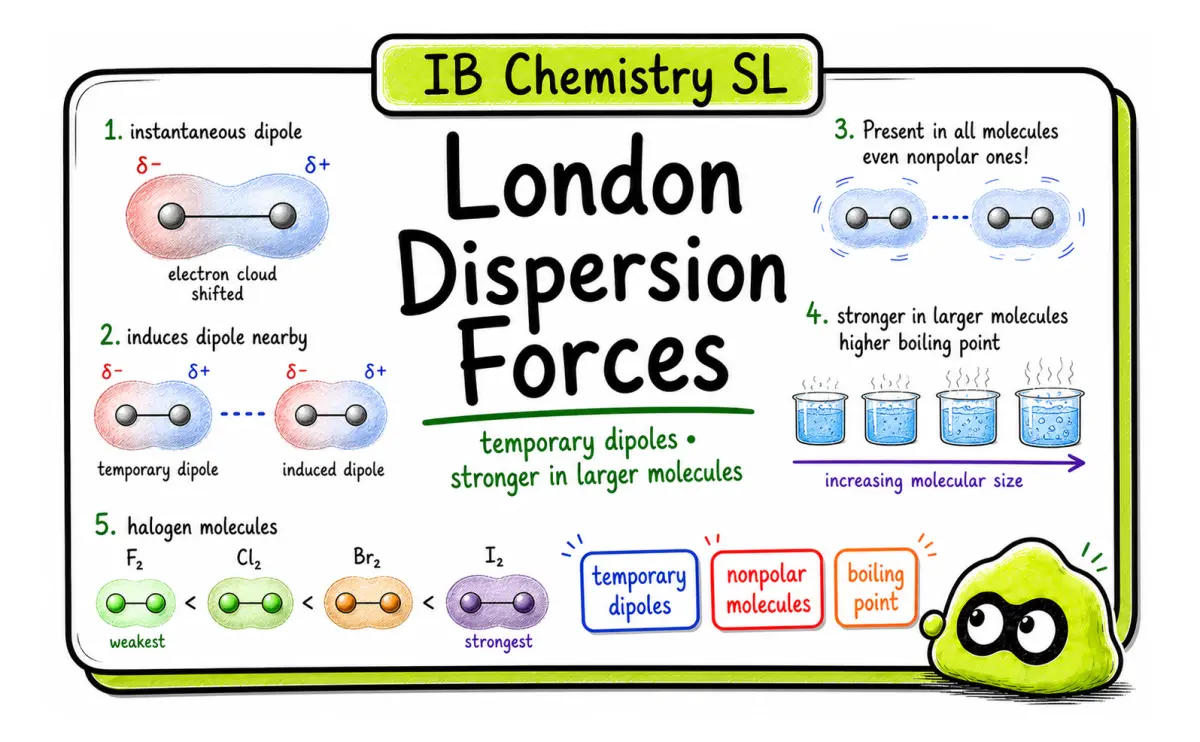
London dispersion forces are weak intermolecular attractions caused by temporary dipoles. They exist between all atoms and molecules, including nonpolar molecules, because electron clouds are constantly moving.
The exam skill is to explain the sequence clearly: an instantaneous dipole forms, it induces a dipole in a neighbouring particle, and the opposite partial charges attract. Larger electron clouds usually create stronger dispersion forces.
Quick Answer
| Idea | Exam-safe wording |
|---|---|
| Cause | Temporary uneven distribution of electrons |
| Also called | London forces or instantaneous dipole-induced dipole forces |
| Found in | All atoms and molecules, especially important in nonpolar substances |
| Stronger when | Molecules are larger, more polarisable or have more surface contact |
| Effect | Higher boiling point or melting point when other factors are similar |
What London Dispersion Forces Are
At any instant, electrons may be distributed slightly more on one side of a particle than the other. This creates a temporary dipole. That dipole can then induce a dipole in a nearby particle, causing a weak attraction.
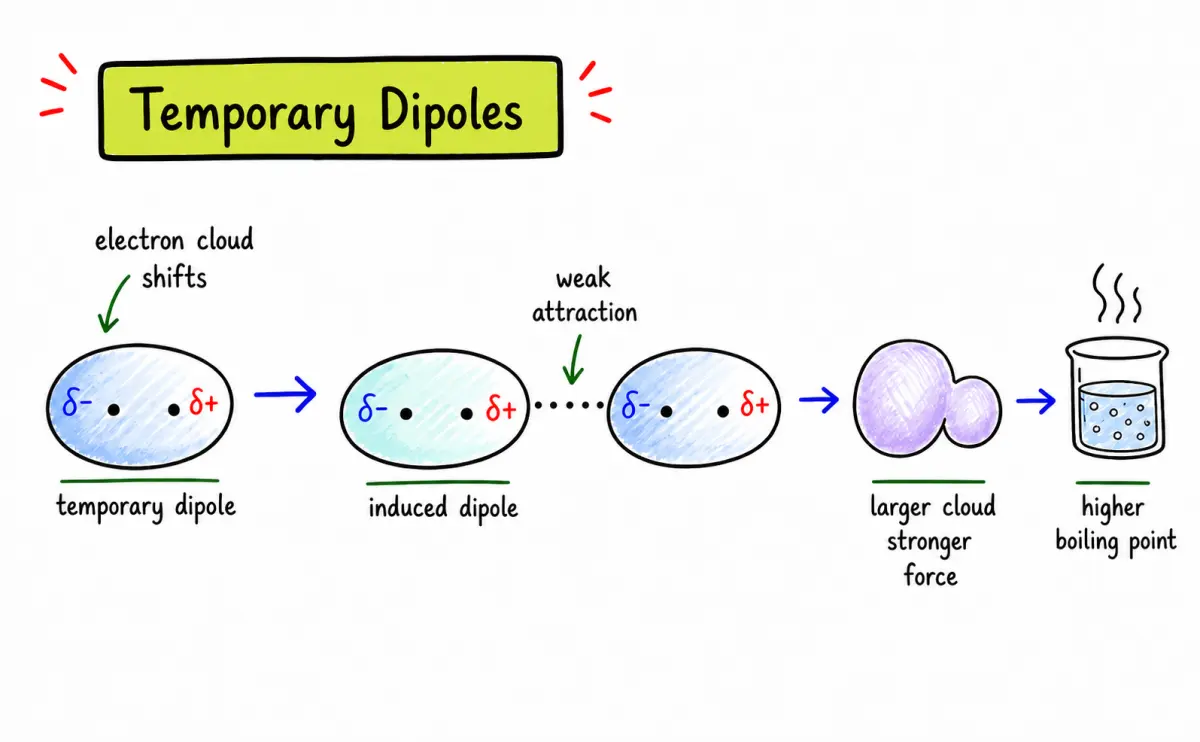
These attractions are temporary, but there are many of them. In larger molecules, the combined effect can become significant.
Why Dispersion Forces Exist in Nonpolar Molecules
Nonpolar molecules do not have permanent dipoles, but their electrons are still moving. A momentary shift in the electron cloud can create a temporary negative side and a temporary positive side.
This is why noble gases and nonpolar molecules can condense at low temperatures. They do not have permanent dipole-dipole forces, but they still have London dispersion forces.
Why Larger Molecules Have Stronger Dispersion Forces
Larger molecules usually have more electrons. Their electron clouds are easier to distort, which means they are more polarisable. More polarisable particles create stronger temporary and induced dipoles.
This explains the trend in halogens:
F2 < Cl2 < Br2 < I2
The boiling point increases down the group because dispersion forces become stronger as molecular size and electron number increase.
Shape and Surface Contact
Molecular shape can also matter. Long, straight-chain molecules can have more surface contact than compact branched molecules of similar mass. More contact can mean stronger dispersion forces and a higher boiling point.
When comparing molecules, check both size and shape before deciding which has stronger London dispersion forces.
Common Mistakes
| Mistake | Why it loses marks | Better habit |
|---|---|---|
| Saying nonpolar molecules have no intermolecular forces | They still have dispersion forces | Say no permanent dipole, but temporary dipoles occur |
| Calling the dipole permanent | The electron shift is momentary | Use temporary or instantaneous dipole |
| Comparing only mass | Shape and surface area can matter | Check size, polarisability and contact |
| Confusing bonds and forces | Dispersion forces act between particles | Do not call them covalent bonds |
Mini Practice
- Explain how a temporary dipole forms.
- State why I2 has stronger dispersion forces than F2.
- Explain why noble gases can liquefy at low temperatures.
- Compare a straight-chain alkane and a branched alkane of similar formula.
- State whether London dispersion forces are intra- or intermolecular.
Answers:
- Electrons momentarily shift to one side, creating partial charges.
- I2 has more electrons and a more polarisable electron cloud.
- Temporary dipoles create weak attractions between atoms.
- The straight-chain alkane may have stronger dispersion forces because of greater surface contact.
- They are intermolecular forces.
Practice This Topic
Try this exam-style task:
Explain why iodine has a higher boiling point than fluorine, even though both are nonpolar diatomic molecules.
Answer guide:
Both molecules have London dispersion forces. Iodine has more electrons and a larger, more polarisable electron cloud than fluorine. This creates stronger temporary dipoles and stronger induced dipoles, so more energy is needed to separate the molecules.
Practice related Chemistry questions
Practice IB Chemistry SL covalent model questions
Some questions may require an EduNinja membership.
Browse broader practice
Browse the full IB Chemistry Question Bank
Related Study Links
- Open the full revision Study Hub
- IB Chemistry Acids and Bases: pH, Neutralisation, and Common Mistakes
- How to Complete Ionization and Net Ionic Equations
- Spectator Ions in IB Chemistry: Net Ionic Equations
- Practice IB Chemistry SL covalent model questions
FAQ
What are London dispersion forces?
London dispersion forces are weak intermolecular attractions caused by temporary dipoles. A momentary uneven electron distribution creates an instantaneous dipole, which can induce a dipole in a nearby particle.
Are London dispersion forces present in all molecules?
Yes. London dispersion forces are present in all atoms and molecules because all electron clouds move and can become temporarily uneven. They are especially important in nonpolar molecules because other intermolecular forces may be absent.
Why do larger molecules have stronger dispersion forces?
Larger molecules usually have more electrons and more polarisable electron clouds. Their temporary dipoles can be stronger, so the induced dipole attractions between molecules are stronger.
Do London dispersion forces affect boiling point?
Yes. Stronger London dispersion forces mean more energy is needed to separate molecules, so boiling point usually increases when other factors are similar.
Final Takeaway
London dispersion forces come from moving electrons. For exam answers, use the chain: temporary dipole, induced dipole, attraction, stronger with larger and more polarisable electron clouds.
Put topic practice back into your full IB Chemistry SL study plan.
Return to the complete course overview, or move directly into the most relevant study tool.
Related articles
More course notes, updates and study resources from the EduNinja blog.
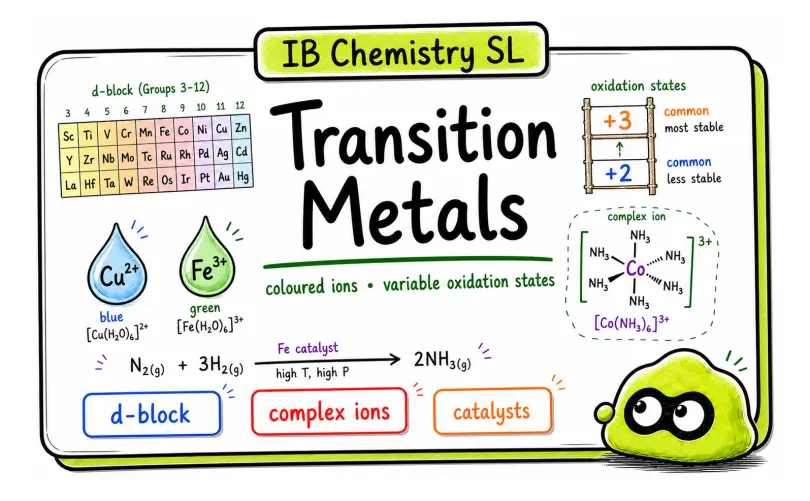
Transition Metals Explained for IB Chemistry
Revise transition metals in IB Chemistry, including coloured ions, variable oxidation states, complex ions, catalysts and common exam mistakes.
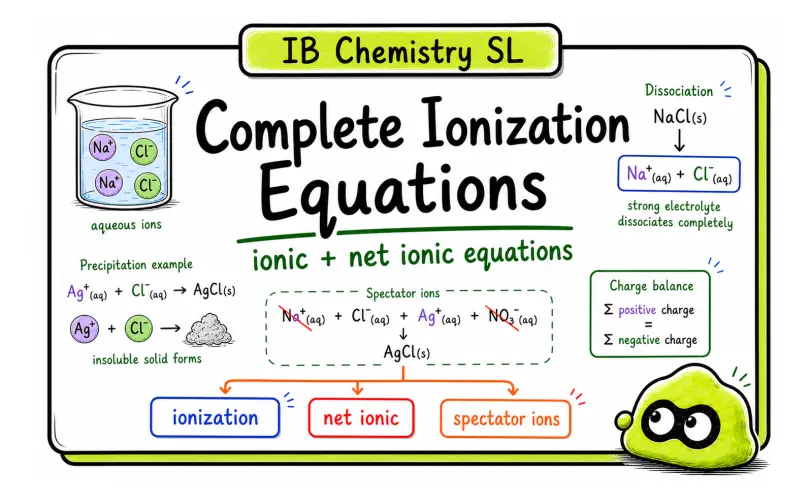
How to Complete Ionization and Net Ionic Equations
Learn complete ionization and net ionic equations for IB Chemistry, with ion charges, state symbols, spectator ions, worked examples and practice.
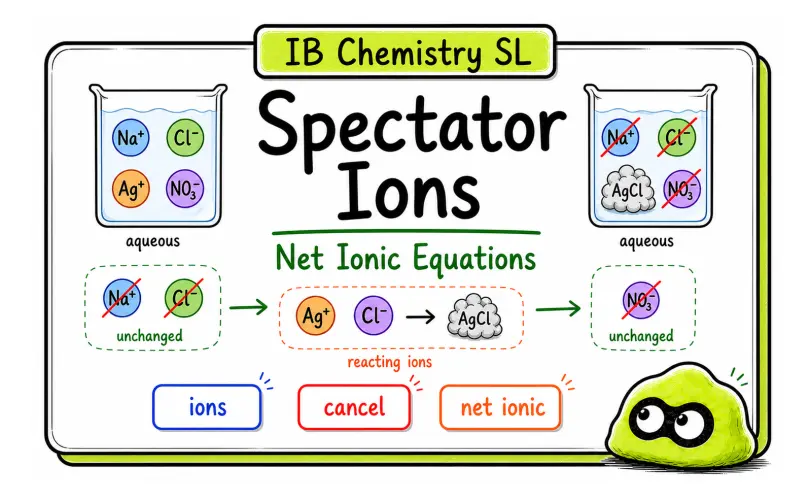
Spectator Ions in IB Chemistry: Net Ionic Equations
Revise spectator ions in IB Chemistry with net ionic equations, precipitation examples, common mistakes and targeted question practice.