Simple Harmonic Motion in A-Level Physics: Period and Graphs
Revise simple harmonic motion for CAIE A-Level Physics with period, frequency, displacement graphs, restoring force and practice questions.
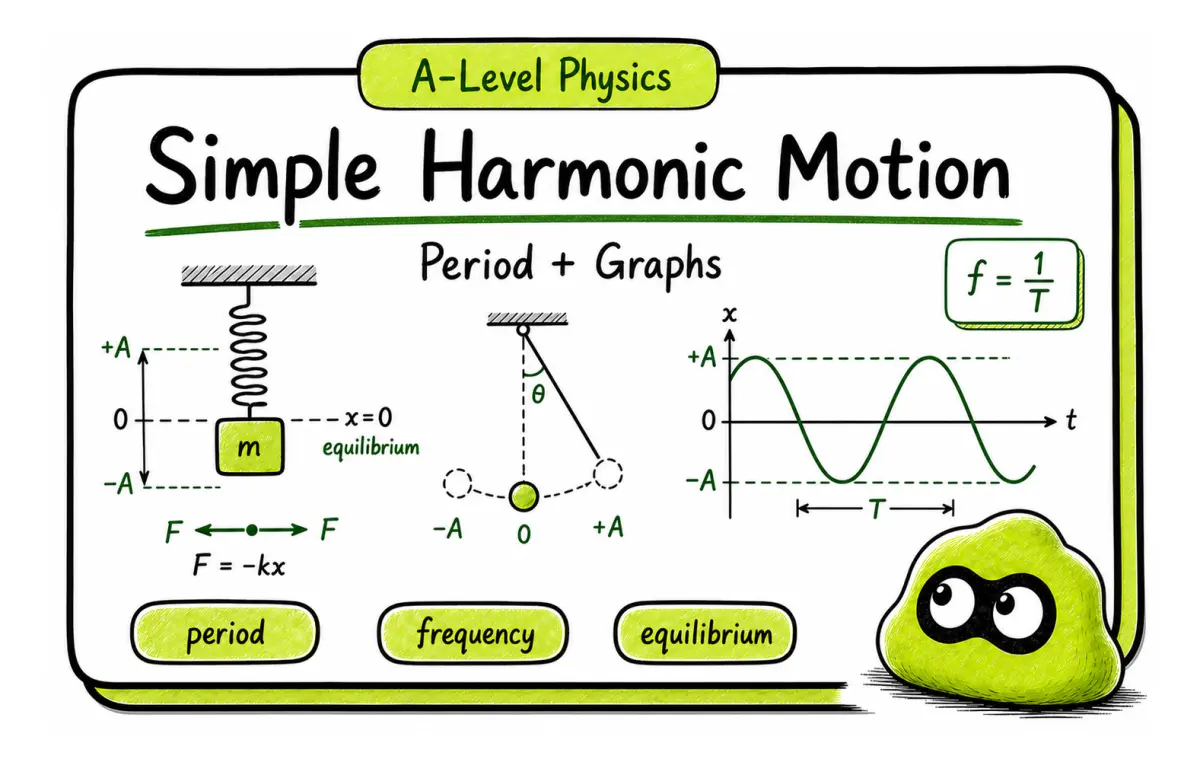
Simple harmonic motion in A-Level Physics is not just any repeated motion. The exam-safe idea is that acceleration, and therefore resultant force, is directly proportional to displacement from equilibrium and directed towards the equilibrium position.
This CAIE A-Level Physics bridge page focuses on the places students lose marks: period versus frequency, graph interpretation, restoring force wording, and when to use the SHM equations.
Quick Answer
| Idea | Exam-safe wording |
|---|---|
| SHM condition | Acceleration is proportional to displacement and opposite in direction |
| Equilibrium | The centre position where resultant force is zero |
| Period, T | Time for one complete oscillation |
| Frequency, f | Number of oscillations per second |
| Key link | f = 1 / T |
What Simple Harmonic Motion Means
Simple harmonic motion occurs when an object oscillates about an equilibrium position and the restoring acceleration is proportional to displacement. The restoring acceleration is always directed back towards equilibrium.
That direction is the part many students miss. If displacement is to the right, acceleration is to the left. If displacement is above equilibrium, acceleration is downward. The acceleration tries to return the object to equilibrium rather than push it further away.
Worked Example
Question: A mass on a spring completes 20 oscillations in 8.0 s. Calculate the period and frequency.
Method: The period is the time for one oscillation.
T = 8.0 / 20 = 0.40 s
Frequency is the number of oscillations per second, or f = 1 / T.
f = 1 / 0.40 = 2.5 Hz
Why this scores: The answer separates period from frequency and uses the correct unit. A common mistake is writing 20 / 8.0 as the period, when that is the frequency.
Graph Interpretation Trap
| Graph feature | What it tells you | Common trap |
|---|---|---|
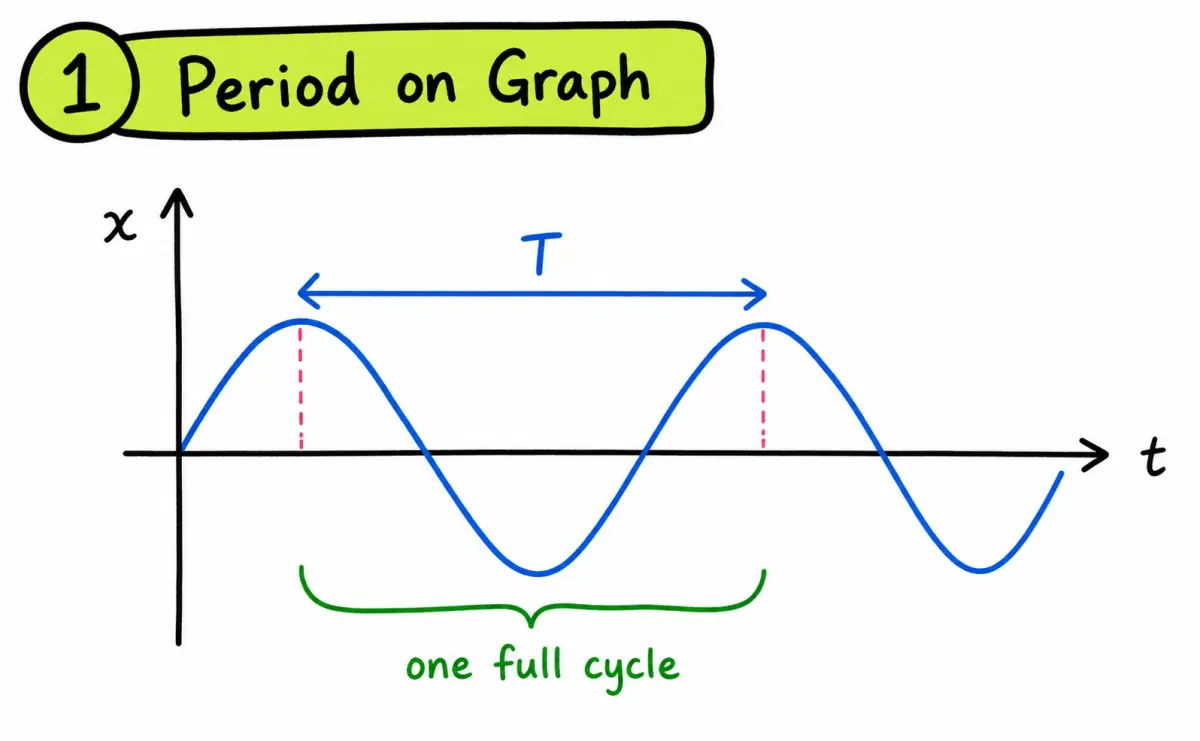
| One full cycle | One complete oscillation | Counting half a cycle as T |
| Maximum displacement | Amplitude | Confusing amplitude with period |
| Time between matching points | Period | Using neighbouring peak and trough |
| Steeper curve near equilibrium | Speed is greater | Assuming acceleration is greatest there |
For displacement-time graphs, measure period between matching points: peak to next peak, trough to next trough, or same-direction equilibrium crossing to the next same-direction crossing.
Exam-Safe Wording
For definition questions, write:
Simple harmonic motion occurs when acceleration is directly proportional to displacement from equilibrium and directed towards the equilibrium position.
For explanation questions, add:
- The force or acceleration is a restoring quantity.
- It acts in the opposite direction to displacement.
- The object oscillates about equilibrium.
- Period and frequency describe the timing of the oscillation.
This is safer than saying SHM is "back and forth motion." Repeated motion alone is not enough.
Common Mistakes
| Mistake | Why it loses marks | Better wording |
|---|---|---|
| Saying SHM is any oscillation | Not all oscillations meet the SHM condition | Acceleration is proportional to displacement |
| Forgetting direction | Proportionality alone is incomplete | Directed towards equilibrium |
| Mixing up T and f | Period and frequency are reciprocals | T is time per oscillation, f is oscillations per second |
| Misreading graphs | Half-cycles can look tempting | Measure one full cycle |
Mini Practice Set
- Define simple harmonic motion using acceleration and displacement.
- A pendulum makes 15 oscillations in 12 s. Calculate the period.
- Explain why the acceleration of an SHM object changes direction.
- State how to find period from a displacement-time graph.
Practice This Topic
Try this exam-style question:
A student says: "Simple harmonic motion is when something moves backwards and forwards." Improve this answer using acceleration, displacement and equilibrium.
Answer guide:
- State that acceleration is proportional to displacement from equilibrium.
- Mention that acceleration is directed towards the equilibrium position.
- Use the idea of a restoring force or restoring acceleration.
- Avoid defining SHM only as repeated back-and-forth motion.
Practice this exact topic
Practise A-Level Physics SHM questions
Some questions may require an EduNinja membership.
Browse broader practice
Browse the full CAIE A-Level Physics Question Bank
Use this if you want to explore more available practice by topic.
Related Study Links
- Explore the course Study Hub
- Simple Harmonic Motion Explained: IB Physics Revision Guide
- Frequency Symbol in IB Physics: f, Period and Hz
- IB Physics Data Booklet: Formula Use and Exam Mistakes
FAQ
What is simple harmonic motion in A-Level Physics?
Simple harmonic motion is oscillation where acceleration is directly proportional to displacement from equilibrium and directed towards equilibrium. This definition is more precise than saying an object moves back and forth. A-Level exam answers should include both proportionality and direction.
What is the difference between period and frequency?
Period is the time taken for one complete oscillation, while frequency is the number of oscillations per second. They are linked by f = 1 / T. A common calculation mistake is using total time divided by oscillations for frequency instead of period.
How do you find period from an SHM graph?
Find the time for one full cycle on the displacement-time graph. The safest method is to measure from one peak to the next peak, or one trough to the next trough. Do not use peak to trough, because that is only half a cycle.
Why is direction important in the SHM definition?
Direction is important because the acceleration or force must act towards equilibrium. If the object is displaced in one direction, the restoring acceleration acts in the opposite direction. Leaving out direction can make the answer incomplete even if you mention proportionality.
What is the common SHM exam mistake?
The common mistake is defining SHM as any repeated motion. Repetition alone is not enough. The answer must say that acceleration is proportional to displacement and directed towards equilibrium, then use period, frequency or graph evidence when the question requires it.
Final Takeaway
For simple harmonic motion, memorise the condition and practise applying it to graphs. The mark-winning wording is proportional acceleration, opposite direction, and equilibrium position.
Choose a course and continue studying.
Pick your curriculum and subject, then continue into the right question bank or notes.
Related articles
More course notes, updates and study resources from the EduNinja blog.

Transverse vs Longitudinal Waves
Compare transverse and longitudinal waves using particle motion, wave direction, compressions and rarefactions.
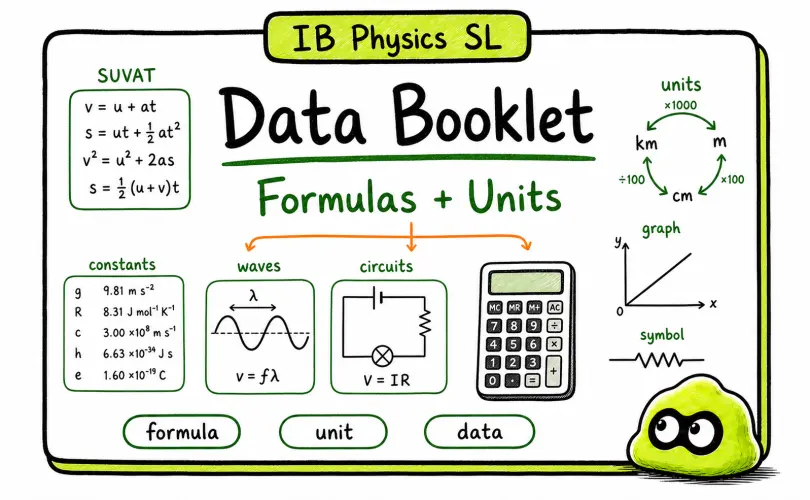
IB Physics Data Booklet: Formula Use and Exam Mistakes
Use the IB Physics data booklet better with formula choice, units, substitution, common exam mistakes and data-handling practice.
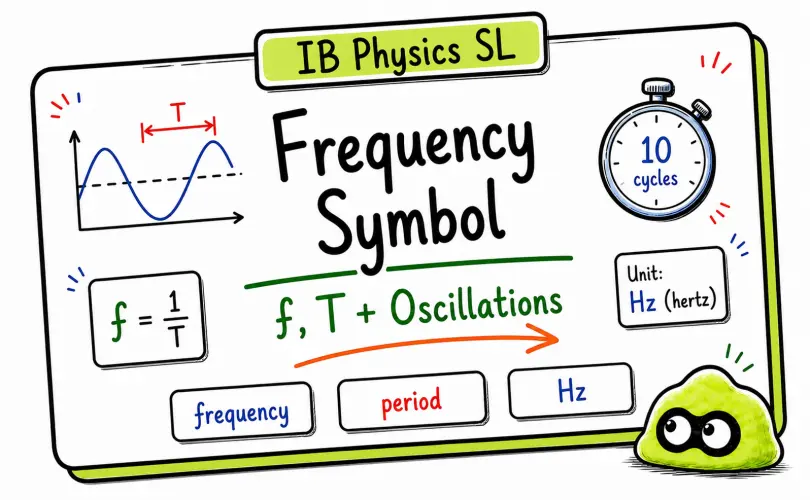
Frequency Symbol in IB Physics: f, Period and Hz
Revise the frequency symbol f in IB Physics, including hertz, period links, wave graph wording and exam-style practice.