Transverse vs Longitudinal Waves
Compare transverse and longitudinal waves using particle motion, wave direction, compressions and rarefactions.

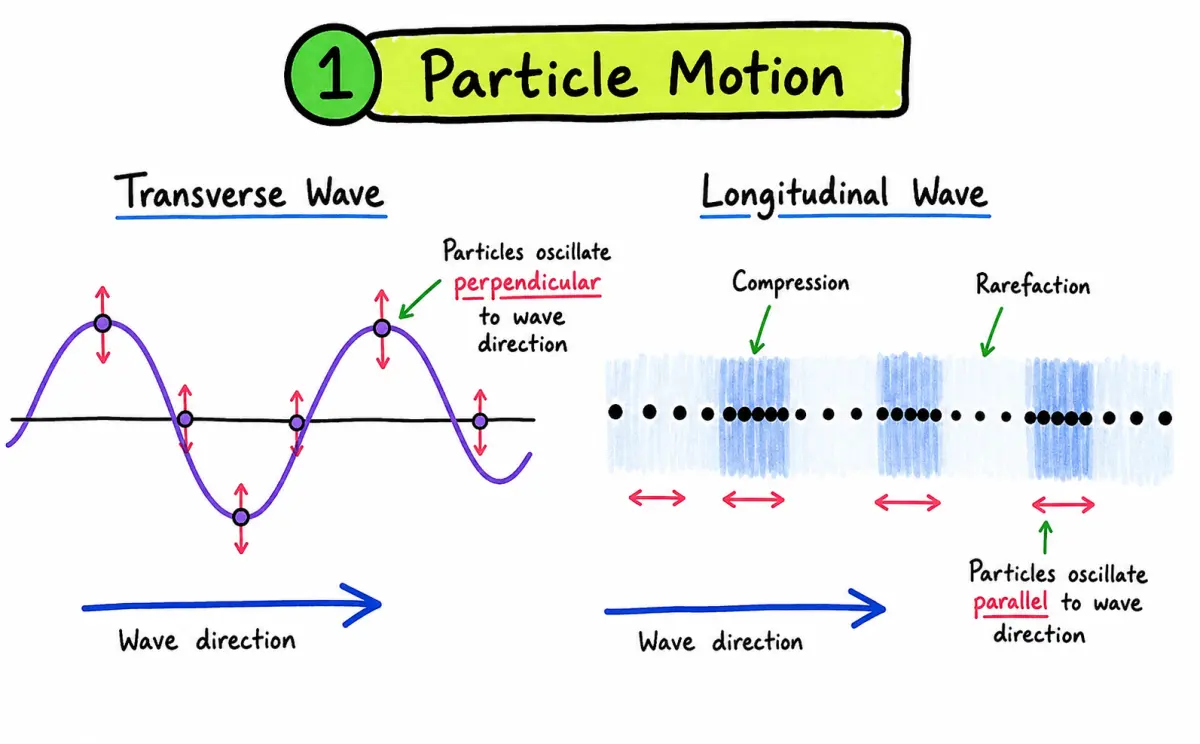
Transverse and longitudinal waves are distinguished by the direction in which particles oscillate compared with the direction in which the wave transfers energy. The wave moves forward, but the particles do not necessarily travel with it.
Quick Answer
| Wave type | Particle motion | Visible feature |
|---|---|---|
| Transverse | Perpendicular to wave direction | Crests and troughs |
| Longitudinal | Parallel to wave direction | Compressions and rarefactions |
Transverse Waves
In a transverse wave, particles oscillate at right angles to the direction of energy transfer. A rope wave is a useful model: the rope moves up and down while the disturbance travels along the rope. Light is also a transverse wave.
Longitudinal Waves
In a longitudinal wave, particles oscillate parallel to the direction of energy transfer. The particles move back and forth, producing regions where they are close together (compressions) and far apart (rarefactions). Sound in air is a common example.
How to Identify the Wave
Do not identify a wave only from its drawn shape. Instead, compare the particle-motion arrow with the wave-direction arrow. Perpendicular means transverse; parallel means longitudinal.
Common Mistakes
- The particles oscillate around equilibrium; they do not travel from the source to the observer with the wave.
- A transverse wave is not defined simply by having crests and troughs.
- Longitudinal waves can be drawn as a sine-like graph, but the physical particle motion remains parallel.
Practice This Topic
Try this exam-style task: Explain the difference between a transverse and a longitudinal wave using particle motion and wave direction.
Answer guide: In a transverse wave, particles oscillate perpendicular to the direction of energy transfer. In a longitudinal wave, particles oscillate parallel to it, creating compressions and rarefactions.
Practise IB Physics SL wave questions
Related Study Links
FAQ
What is a transverse wave?
A transverse wave has particle oscillations perpendicular to the direction of energy transfer.
What is a longitudinal wave?
A longitudinal wave has particle oscillations parallel to the direction of energy transfer, with compressions and rarefactions.
Is sound transverse or longitudinal?
Sound in air is usually modelled as a longitudinal wave because air particles oscillate parallel to the direction of travel.
Final Takeaway
Compare the two directions: perpendicular means transverse, while parallel means longitudinal.
Put topic practice back into your full IB Physics SL study plan.
Return to the complete course overview, or move directly into the most relevant study tool.
Related articles
More course notes, updates and study resources from the EduNinja blog.
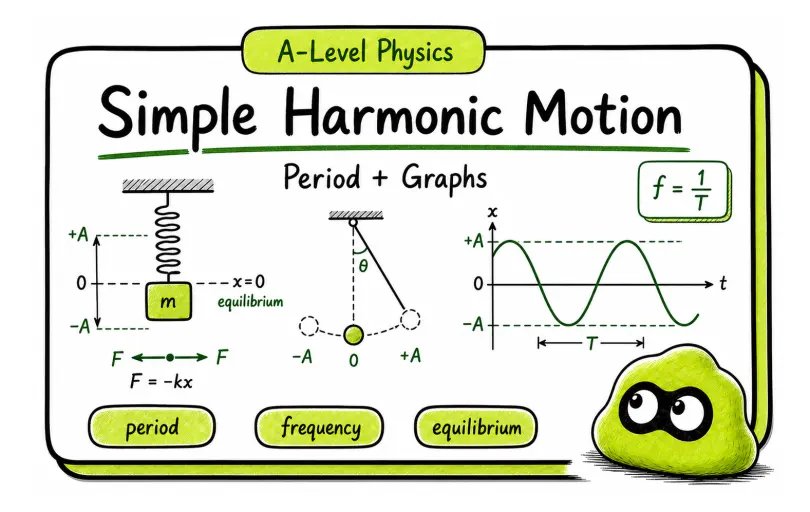
Simple Harmonic Motion in A-Level Physics: Period and Graphs
Revise simple harmonic motion for CAIE A-Level Physics with period, frequency, displacement graphs, restoring force and practice questions.

IB Physics Data Booklet: Formula Use and Exam Mistakes
Use the IB Physics data booklet better with formula choice, units, substitution, common exam mistakes and data-handling practice.
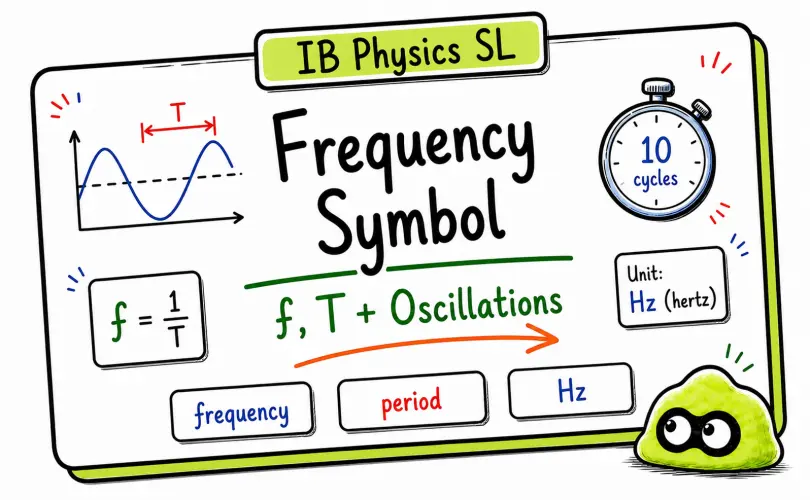
Frequency Symbol in IB Physics: f, Period and Hz
Revise the frequency symbol f in IB Physics, including hertz, period links, wave graph wording and exam-style practice.