Frequency Symbol in IB Physics: f, Period and Hz
Revise the frequency symbol f in IB Physics, including hertz, period links, wave graph wording and exam-style practice.
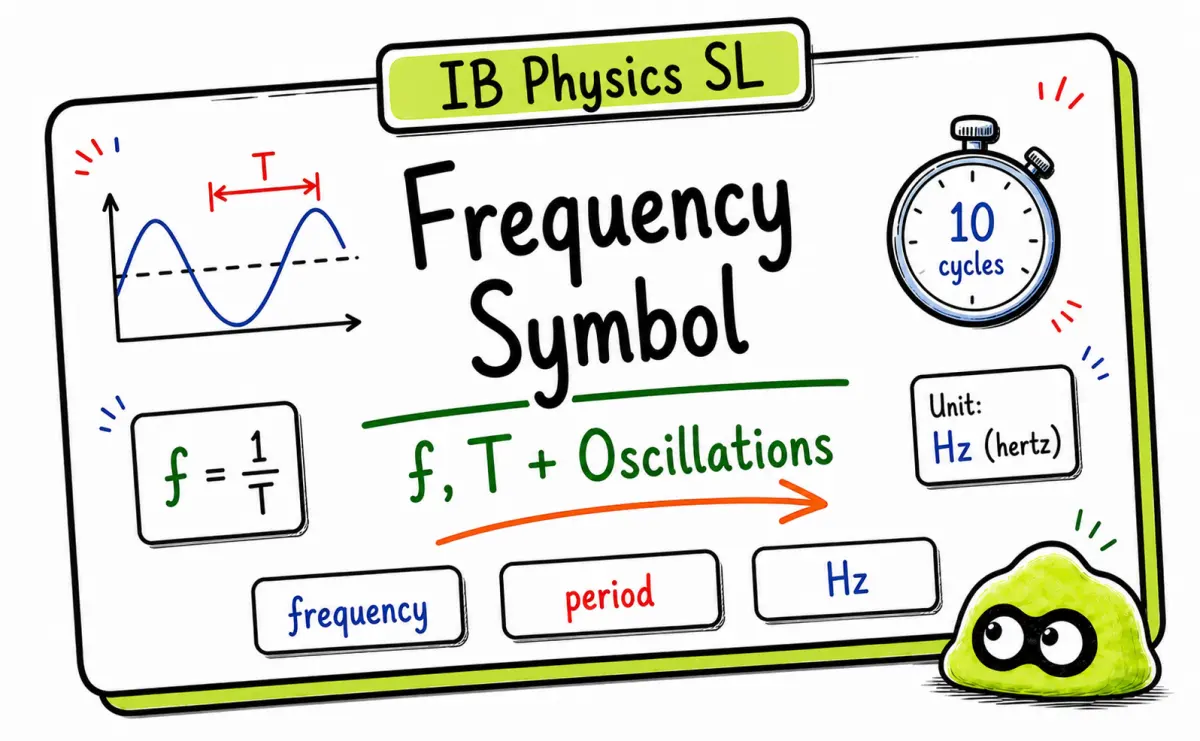
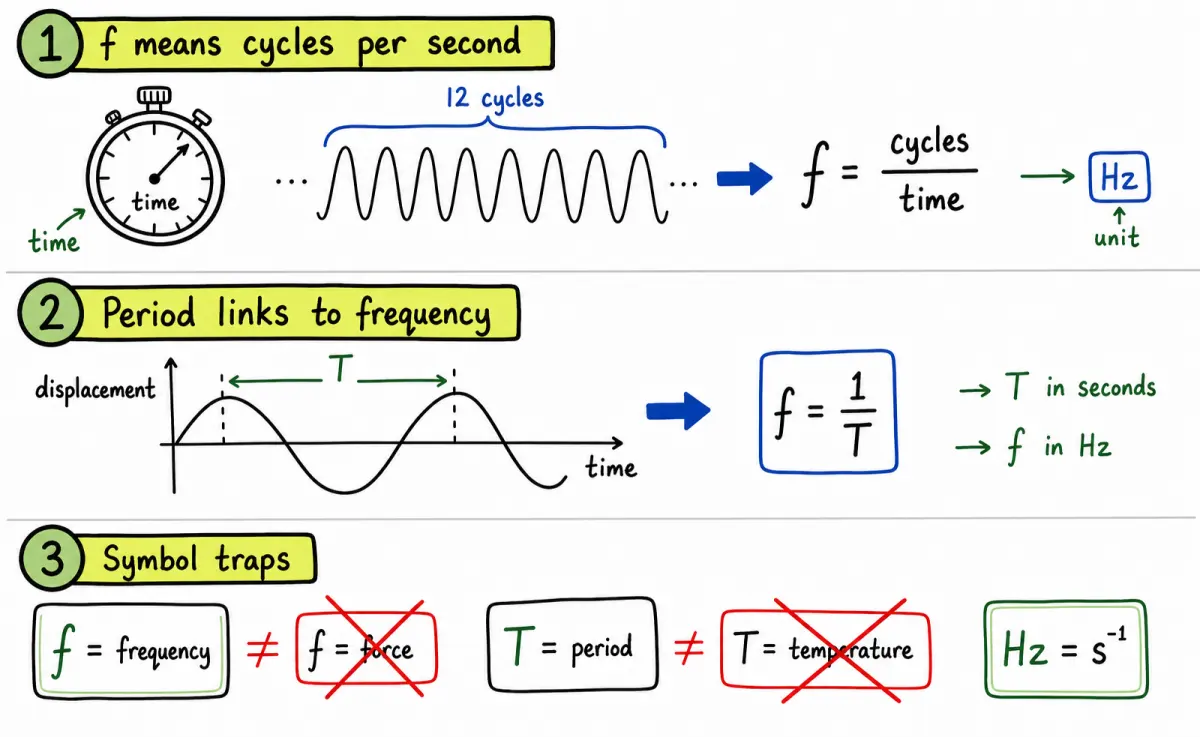
The frequency symbol in IB Physics is usually f. It tells you how many complete cycles, waves or oscillations happen every second, so its unit is hertz, Hz.
Students often lose marks because they know the idea but mix up the symbols. In oscillations and waves, f is frequency and T is period. They are linked by f = 1/T.
Quick Answer
| Idea | Meaning | Examiner wording |
|---|---|---|
| Frequency symbol | f | Number of complete cycles per second |
| Unit | Hz or s^-1 | Hertz is the same as per second |
| Period link | f = 1/T | Period must be in seconds before calculating frequency |
What Frequency Means
Frequency is a rate. If a source completes more cycles each second, the frequency is higher. In a graph question, one complete cycle may be shown as one full wave, one complete oscillation, or one repeating pattern.
Worked Example
A wave source makes 12 complete oscillations in 6.0 s. Calculate the frequency.
Use the definition:
f = number of oscillations / time = 12 / 6.0 = 2.0 Hz
The answer should include the unit. Writing only 2.0 is incomplete because frequency is a measured quantity.
Common Mistakes
| Mistake | Why it loses marks | Better wording |
|---|---|---|
| Using T as frequency | T means period in oscillations | Use f for frequency |
| Forgetting to convert time | Period must be in seconds | Convert ms or minutes first |
| Writing Hz as a force unit | Hz means per second | Use N for force, Hz for frequency |
Mini Practice Set
- A pendulum completes 20 oscillations in 10 s. Find its frequency.
- A wave has a period of 0.25 s. Find its frequency.
- Explain why a higher frequency means more cycles per second.
Practice This Topic
Try this exam-style question:
A wave source makes 12 complete oscillations in 6.0 s. State the symbol for frequency, calculate the frequency and give the unit.
Answer guide:
- The symbol for frequency is f.
- Use f = number of cycles / time.
- Calculate 12 / 6.0 = 2.0.
- Give the unit as Hz or s^-1.
Practice this exact topic
Practice frequency and SHM questions
Some questions may require an EduNinja membership.
Browse broader practice
Browse the full IB Physics SL Question Bank
Use this if you want to explore more available practice by topic.
Related Study Links
FAQ
What is the symbol for frequency in IB Physics?
The symbol for frequency is f. It means the number of complete cycles, waves or oscillations each second. In exam answers, be careful not to confuse f with force. Force is usually F and is measured in newtons, while frequency is measured in hertz.
Is Hz the same as s^-1?
Yes, hertz is equivalent to per second, or s^-1. This is because frequency counts how many complete cycles happen in one second. If a calculation gives 5 cycles per second, the frequency can be written as 5 Hz or 5 s^-1.
How are frequency and period linked?
Frequency and period are linked by f = 1/T. Period is the time for one complete cycle, while frequency is how many cycles happen each second. If the period gets smaller, more cycles fit into each second, so the frequency increases.
What mistake do students make with frequency graphs?
Students often measure only half a wave or choose two points that are not equivalent. For period, measure from crest to crest, trough to trough, or the same point in the repeating pattern. Once you have T, use f = 1/T.
Final Takeaway
For frequency symbol questions, write f, use seconds, and include Hz. The safest exam habit is to link the concept back to cycles per second before calculating.
Put topic practice back into your full IB Physics SL study plan.
Return to the complete course overview, or move directly into the most relevant study tool.
Related articles
More course notes, updates and study resources from the EduNinja blog.
Transverse vs Longitudinal Waves
Compare transverse and longitudinal waves using particle motion, wave direction, compressions and rarefactions.
Simple Harmonic Motion in A-Level Physics: Period and Graphs
Revise simple harmonic motion for CAIE A-Level Physics with period, frequency, displacement graphs, restoring force and practice questions.
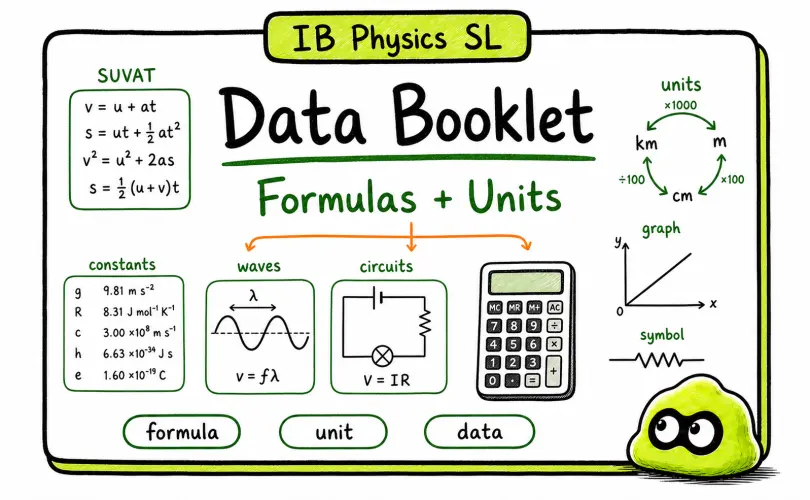
IB Physics Data Booklet: Formula Use and Exam Mistakes
Use the IB Physics data booklet better with formula choice, units, substitution, common exam mistakes and data-handling practice.