Chargaff's Rule in IB Biology: Base Pairing Practice
Revise Chargaff's rule, base pairing and DNA percentage calculations with worked examples and targeted IB Biology practice.
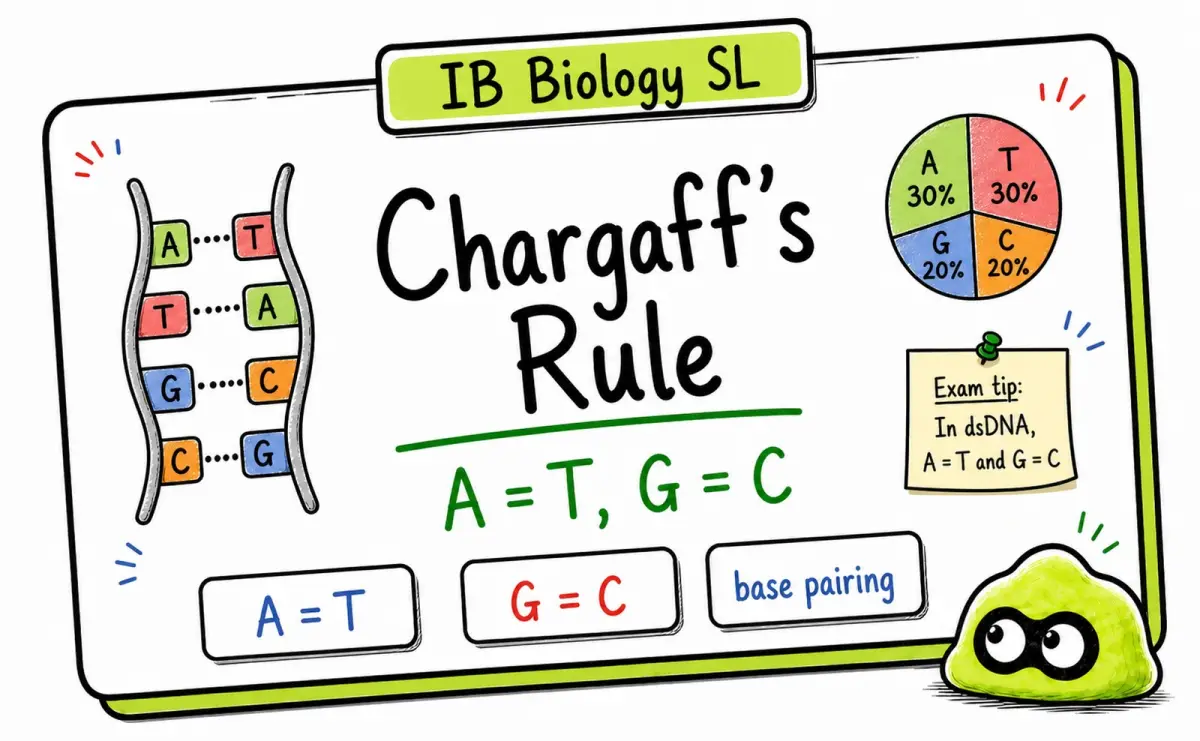
Chargaff's rule is the shortcut that helps you turn DNA base pairing into exam-ready calculations. In double-stranded DNA, adenine pairs with thymine and guanine pairs with cytosine, so %A = %T and %G = %C.
The student trap is treating this as a slogan instead of a calculation rule. In IB Biology, Chargaff's rule usually appears inside DNA structure, complementary base pairing, replication or data-style questions where you need to use the percentages carefully.
Quick Answer
| Rule | Meaning | Exam use |
|---|---|---|
| A pairs with T | Adenine and thymine are complementary bases | If A is 24%, T is 24% |
| G pairs with C | Guanine and cytosine are complementary bases | The remaining percentage is split equally |
| Total bases = 100% | A + T + G + C must add up to 100% | Use this to check your answer |
What Chargaff's Rule Means
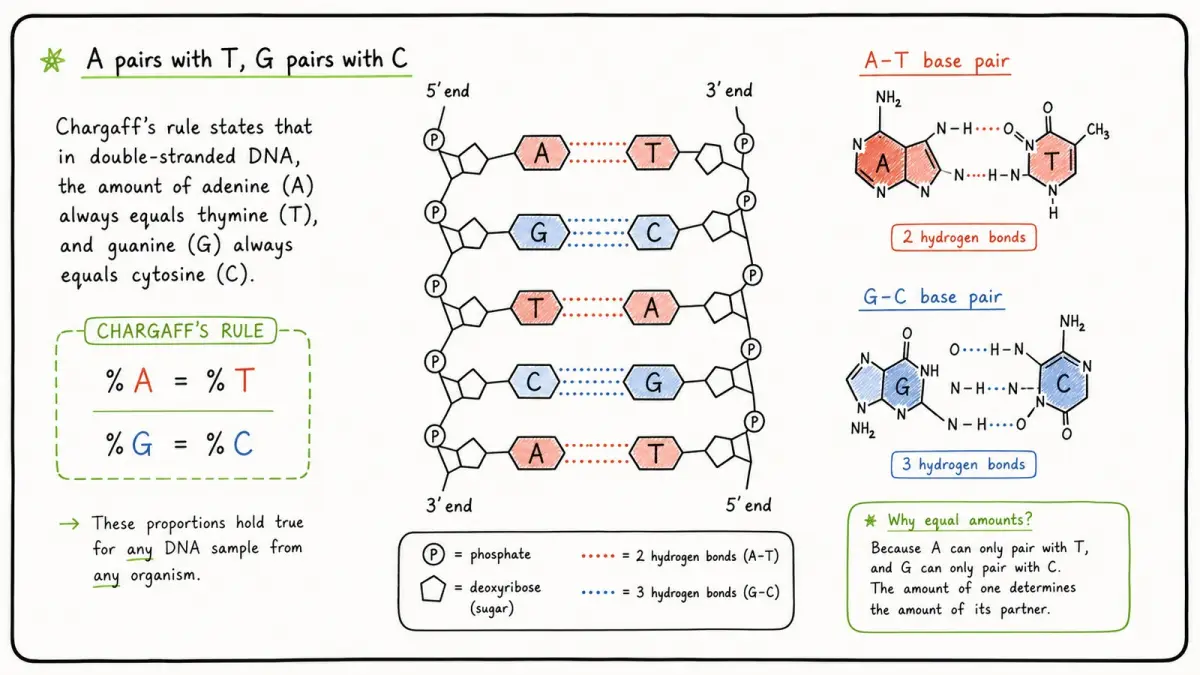
Chargaff's rule applies to double-stranded DNA because each base on one strand pairs with a complementary base on the other strand. That is why the amount of adenine matches thymine, and the amount of guanine matches cytosine.
The rule is about complementarity, not equal amounts of every base. A sample can be AT-rich or GC-rich, but A still matches T and G still matches C.
Exam-Style Worked Example
Question: In a double-stranded DNA sample, 18% of the bases are guanine. Calculate the percentages of cytosine, adenine and thymine.
Worked answer:
G pairs with C, so cytosine is also 18%. Together, G and C make 36%. That leaves 64% for A and T. Because A pairs with T, adenine is 32% and thymine is 32%.
How marks are awarded:
| Mark | What the examiner is looking for |
|---|---|
| 1 | Correct use of G = C |
| 1 | Correct subtraction from 100% |
| 1 | Correct split between A and T |
This is why you should not start by dividing 100 by 4. The given base percentage changes the whole calculation.
How Base Percentage Questions Work
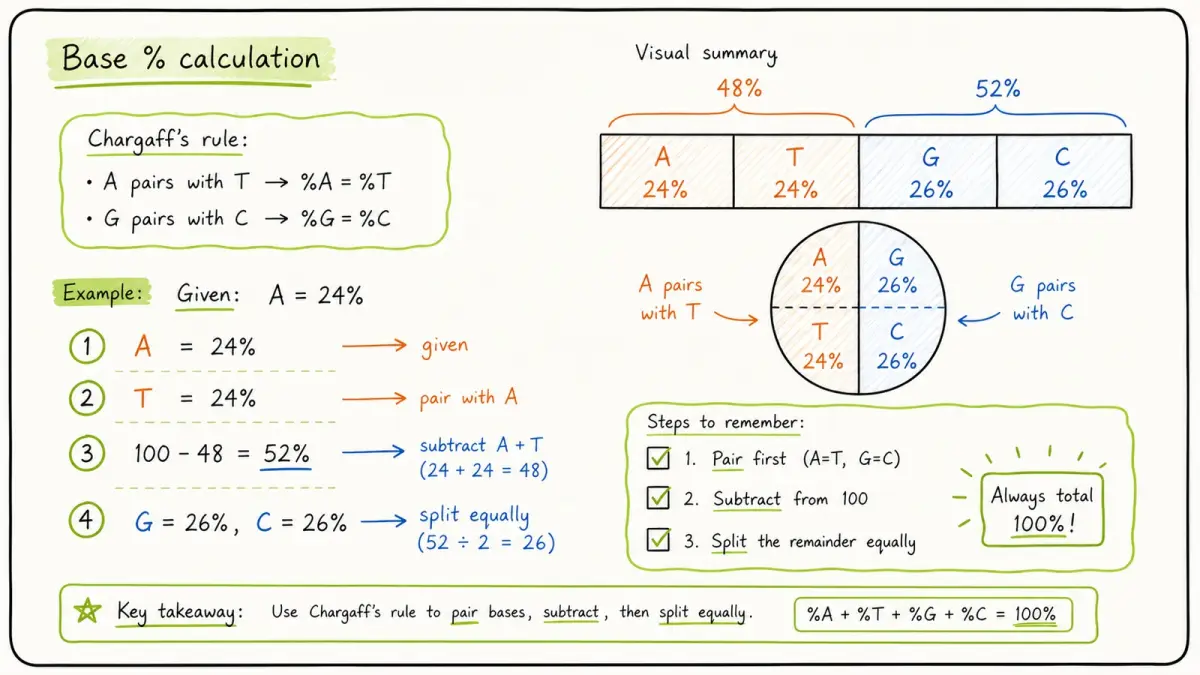
If a question says A = 24%, start with the pair. T must also be 24%. Together, A and T make 48%, so G and C must share the remaining 52%. That gives G = 26% and C = 26%.
Use this three-step method:
- Pair the given base first.
- Subtract the paired total from 100%.
- Split the remainder equally between the other pair.
Non-Example: Why 25% Each Is Usually Wrong
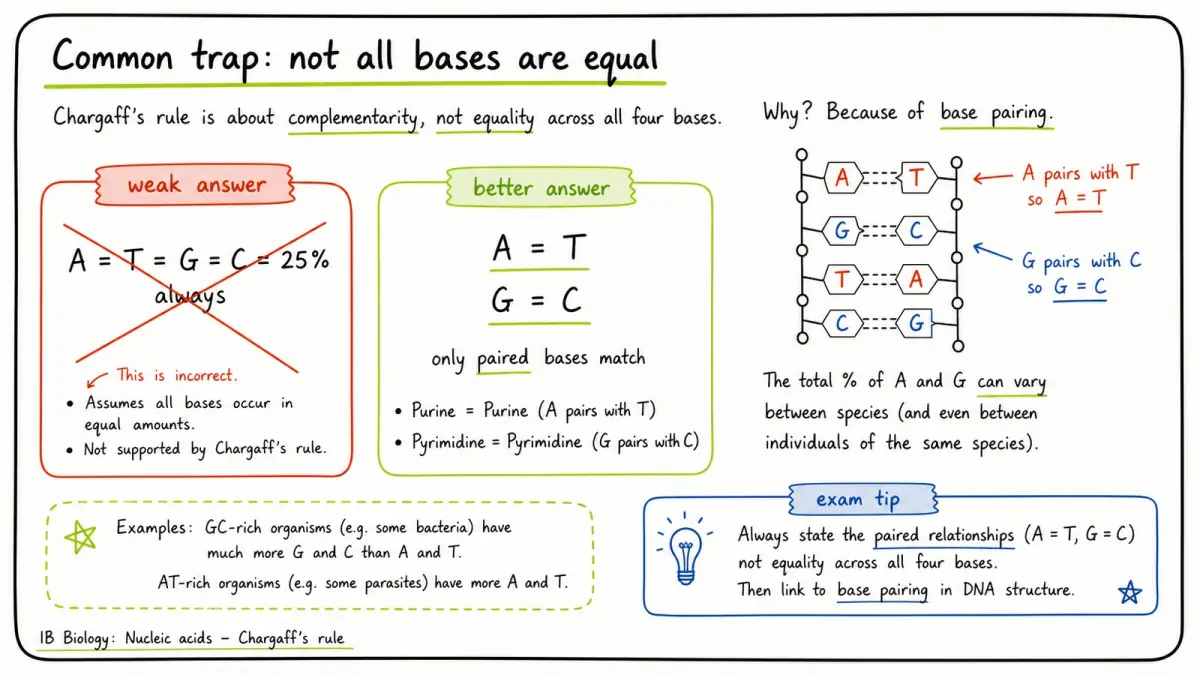
The answer A = T = G = C = 25% is only true in a special case where the DNA sample happens to contain equal amounts of all four bases. Chargaff's rule does not guarantee that.
Better exam wording:
In double-stranded DNA, A equals T and G equals C because of complementary base pairing. The total percentage of all four bases must equal 100%.
That sentence is safer than writing that all bases are equal.
Mini Practice Set
Try these before opening the question bank:
| Question | Quick check |
|---|---|
| If A = 31%, what is T? | T = 31% |
| If C = 22%, what are G, A and T? | G = 22%, A = 28%, T = 28% |
| Why is A = T = G = C not always correct? | Chargaff only matches paired bases |
Practice This Topic
Try this exam-style question:
In a double-stranded DNA sample, 24% of the bases are adenine. Calculate the percentages of thymine, guanine and cytosine.
Answer guide:
- A pairs with T, so thymine is 24%.
- A + T = 48%, leaving 52% for G and C.
- G pairs with C, so guanine and cytosine are each 26%.
- Check that all four percentages add to 100%.
Practice this exact topic
Practice Chargaff's rule questions
Some questions may require an EduNinja membership.
Browse broader practice
Browse the full IB Biology Question Bank
Use this if you want to explore more available practice by topic.
Related Study Links
- Review the full IB Biology SL syllabus
- IB Biology DNA and RNA Structure Revision Guide
- Topoisomerase vs Helicase: DNA Replication Guide
- IB Biology SL Nucleic Acids Revision Guide
- IB Biology nucleic acids questions
- IB Biology HL DNA replication questions
FAQ
What is Chargaff's rule in IB Biology?
Chargaff's rule says that in double-stranded DNA, adenine pairs with thymine and guanine pairs with cytosine. For exam answers, the useful part is the percentage relationship: %A = %T and %G = %C. A common mistake is to write that all four bases must be equal, which is not what the rule says.
How do you solve Chargaff's rule percentage questions?
To solve Chargaff's rule percentage questions, match the paired base first. If A is given, T has the same percentage; if G is given, C has the same percentage. Then subtract that paired total from 100% and split the remainder equally between the other complementary pair. Always check that all four bases total 100%.
Does Chargaff's rule mean all four bases are 25%?
No. Chargaff's rule does not mean A, T, G and C are each 25%. It only means A equals T and G equals C in double-stranded DNA. Some DNA samples are AT-rich or GC-rich, so the paired relationships stay true even when the four base percentages are not all equal.
Does Chargaff's rule apply to single-stranded DNA?
Chargaff's simple A = T and G = C relationship applies to double-stranded DNA because bases are paired across complementary strands. Single-stranded DNA does not necessarily show the same paired percentages. In exams, check whether the question is describing double-stranded DNA before using the percentage shortcut.
Is Chargaff's rule tested in IB Biology?
Yes. Chargaff's rule can be tested in IB Biology questions about DNA structure, complementary base pairing, replication and data interpretation. The mark usually comes from applying the base-pairing rule accurately, not just naming Chargaff. Percentage questions are especially likely to reward a clear step-by-step calculation.
Final Takeaway
Remember the exam-safe line: A = T and G = C, but all four bases do not have to be equal. Pair first, subtract second, split last.
Put DNA back into your full IB Biology SL study plan.
Return to the complete course overview, or move directly into the most relevant study tool.
Related articles
More course notes, updates and study resources from the EduNinja blog.

IB Biology SL Assessment and Grade Boundaries: How 55 + 50 + 24 Marks Become Your Final Grade
Learn how IB Biology SL Paper 1, Paper 2 and the scientific investigation combine through weighted assessment, how grade boundaries work and how to plan component-level revision.
Diploidy and Haploidy Explained
Revise diploid and haploid chromosome sets, meiosis, fertilisation and common IB Biology mistakes.
What Are Producers in an Ecosystem? IB Biology Guide
Learn what producers are in IB Biology ecosystems, how they start food chains, and how to use exam-safe trophic level wording.