Flaccid Cells in IB Biology: Osmosis and Water Potential
Revise flaccid cells in IB Biology, including osmosis, water potential gradients, turgid comparisons and exam wording.
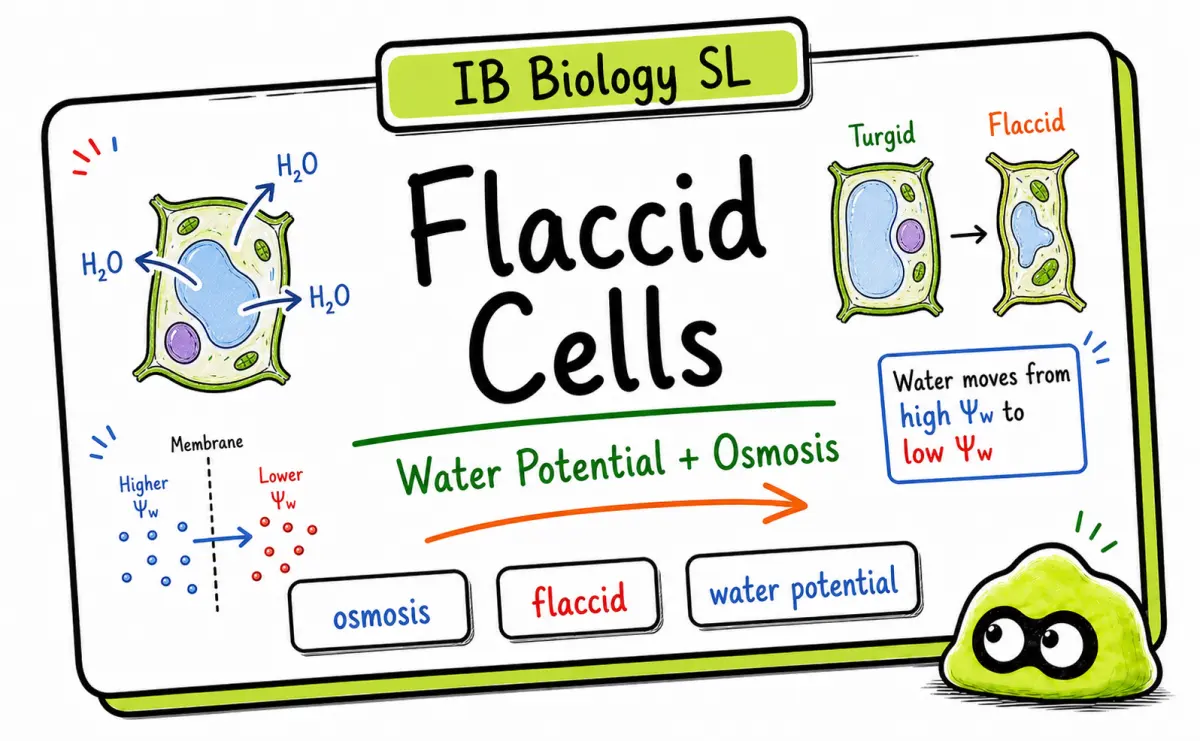
A flaccid plant cell has lost water by osmosis, so the vacuole is smaller and the cell is no longer pressing firmly against the cell wall. In IB Biology, the key idea is water potential.
If the solution outside the cell has a lower water potential than the cell sap, water moves out of the cell through a partially permeable membrane. The cell becomes flaccid because turgor pressure falls.
Quick Answer
| Term | Meaning | Examiner wording |
|---|---|---|
| Flaccid cell | Plant cell that has lost water | Less turgor pressure against the cell wall |
| Osmosis | Water movement across a partially permeable membrane | Down a water potential gradient |
| Turgid cell | Plant cell full of water | High turgor pressure keeps the cell firm |
What Makes a Cell Flaccid?
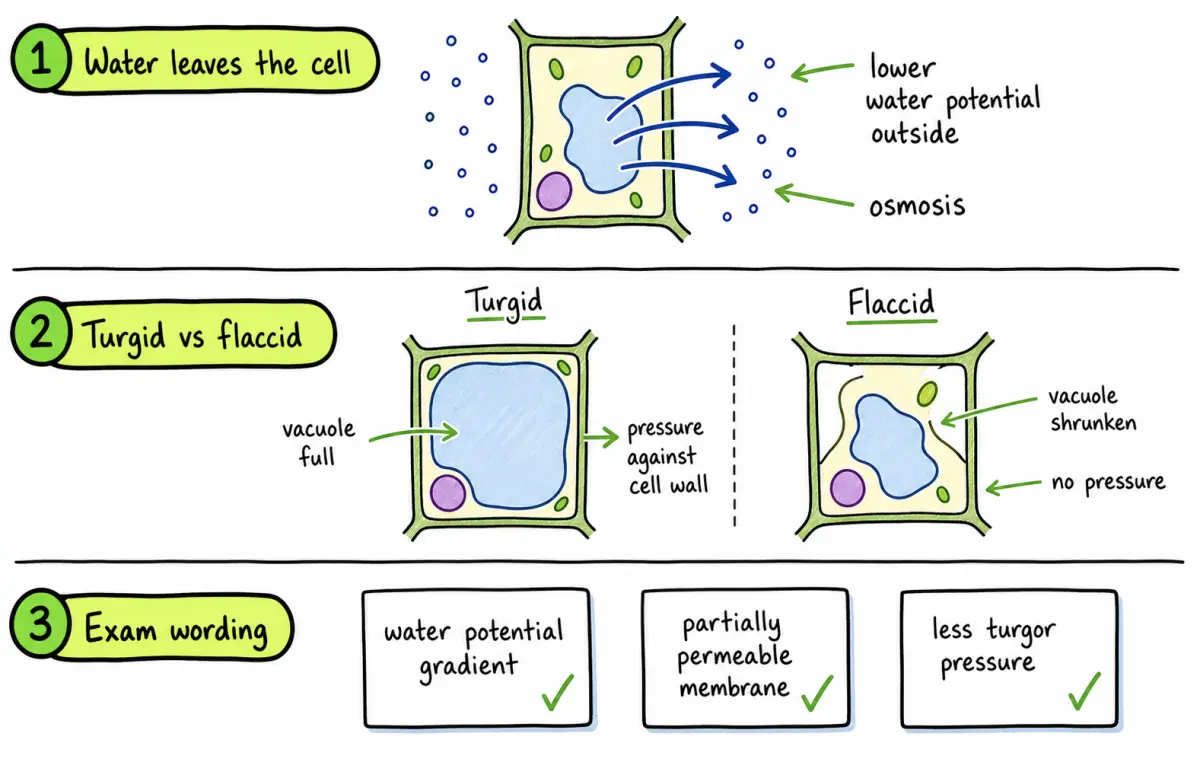
A plant cell becomes flaccid when water leaves the cell. The cell wall stays in place, but the membrane and vacuole are no longer pushed firmly against it. This is different from an animal cell because plant cells have a rigid cell wall.
Worked Example
A plant cell is placed in a solution with lower water potential than the cell sap. Explain why the cell becomes flaccid.
A strong answer should say that water moves out of the cell by osmosis, through a partially permeable membrane, down a water potential gradient. As water leaves, the vacuole shrinks and turgor pressure decreases.
Common Mistakes
| Mistake | Why it loses marks | Better wording |
|---|---|---|
| Saying solute moves out | Osmosis is water movement | Water moves out of the cell |
| Forgetting water potential | IB markschemes often expect this phrase | Down a water potential gradient |
| Saying the wall shrinks | The wall is rigid | The vacuole shrinks and pressure falls |
Mini Practice Set
- Describe what happens to a plant cell in a hypertonic solution.
- Explain why a flaccid cell has lower turgor pressure.
- Compare a turgid cell and a flaccid cell using water potential.
Practice This Topic
Try this exam-style question:
A plant cell is placed in a solution with lower water potential than the cell sap. Explain why the cell becomes flaccid.
Answer guide:
- Water moves out of the plant cell by osmosis.
- The movement is down a water potential gradient.
- Water passes through a partially permeable membrane.
- The vacuole shrinks, so turgor pressure decreases.
Practice this exact topic
Practice water potential and osmosis questions
Some questions may require an EduNinja membership.
Browse broader practice
Browse the full IB Biology SL membrane transport practice
Use this if you want to explore more available practice by topic.
Related Study Links
- Review the full IB Biology SL syllabus
- IB Biology SL Plant Biology Revision Guide
- IB Biology SL Transport Questions
FAQ
What does flaccid mean in biology?
Flaccid means a plant cell has lost water and is no longer firm. The vacuole contains less water, so the cytoplasm does not push strongly against the cell wall. In exam answers, connect this to osmosis and reduced turgor pressure rather than only saying the cell is soft.
Why does a plant cell become flaccid?
A plant cell becomes flaccid when water leaves the cell by osmosis. This happens when the surrounding solution has a lower water potential than the cell sap. Water moves through the partially permeable membrane, the vacuole shrinks, and the pressure against the cell wall decreases.
Is flaccid the same as plasmolysed?
Flaccid and plasmolysed are related but not always identical. A flaccid cell has lost enough water to reduce turgor pressure. A plasmolysed cell is more extreme, where the membrane pulls away from the cell wall. Use the term the question gives unless the separation is clear.
What wording does IB Biology expect for osmosis?
IB Biology answers usually need the phrases water potential gradient and partially permeable membrane. Saying water moves from high to low concentration can be too vague. A stronger answer says water moves from higher water potential to lower water potential by osmosis.
Final Takeaway
For flaccid cell questions, do not only describe the shape. Explain the water movement, the membrane, the water potential gradient and the loss of turgor pressure.
Put topic practice back into your full IB Biology SL study plan.
Return to the complete course overview, or move directly into the most relevant study tool.
Related articles
More course notes, updates and study resources from the EduNinja blog.

IB Biology SL Assessment and Grade Boundaries: How 55 + 50 + 24 Marks Become Your Final Grade
Learn how IB Biology SL Paper 1, Paper 2 and the scientific investigation combine through weighted assessment, how grade boundaries work and how to plan component-level revision.
Diploidy and Haploidy Explained
Revise diploid and haploid chromosome sets, meiosis, fertilisation and common IB Biology mistakes.
What Are Producers in an Ecosystem? IB Biology Guide
Learn what producers are in IB Biology ecosystems, how they start food chains, and how to use exam-safe trophic level wording.