EduNinja

IB Biology SLD2.3 Water potentialQuestion Bank

Question 1

Question 1(b)

(a)

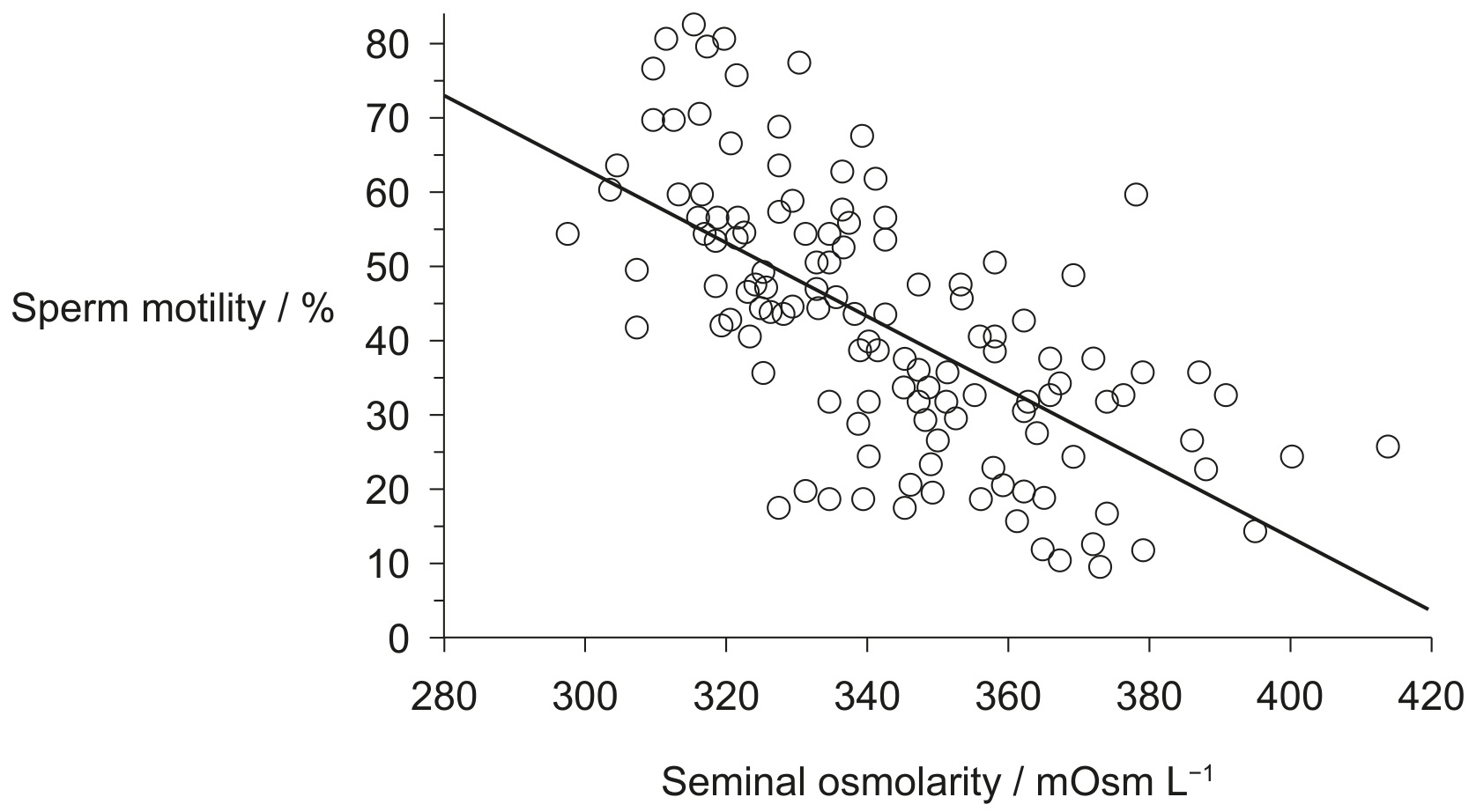
A study was done on the osmolarity of semen and sperm movement (motility).
Question image
[ 1 ]

Question 1(b)(ii)

(i)

The same study showed that blood plasma has a lower osmolarity than semen. Explain how that would affect the movement of water between blood plasma and semen.

[ 1 ]

Question 1(d)

(b)

Explain a change that would take place in sperm placed in a hypotonic solution.

[ 1 ]
Question 1

[Maximum number: 5]

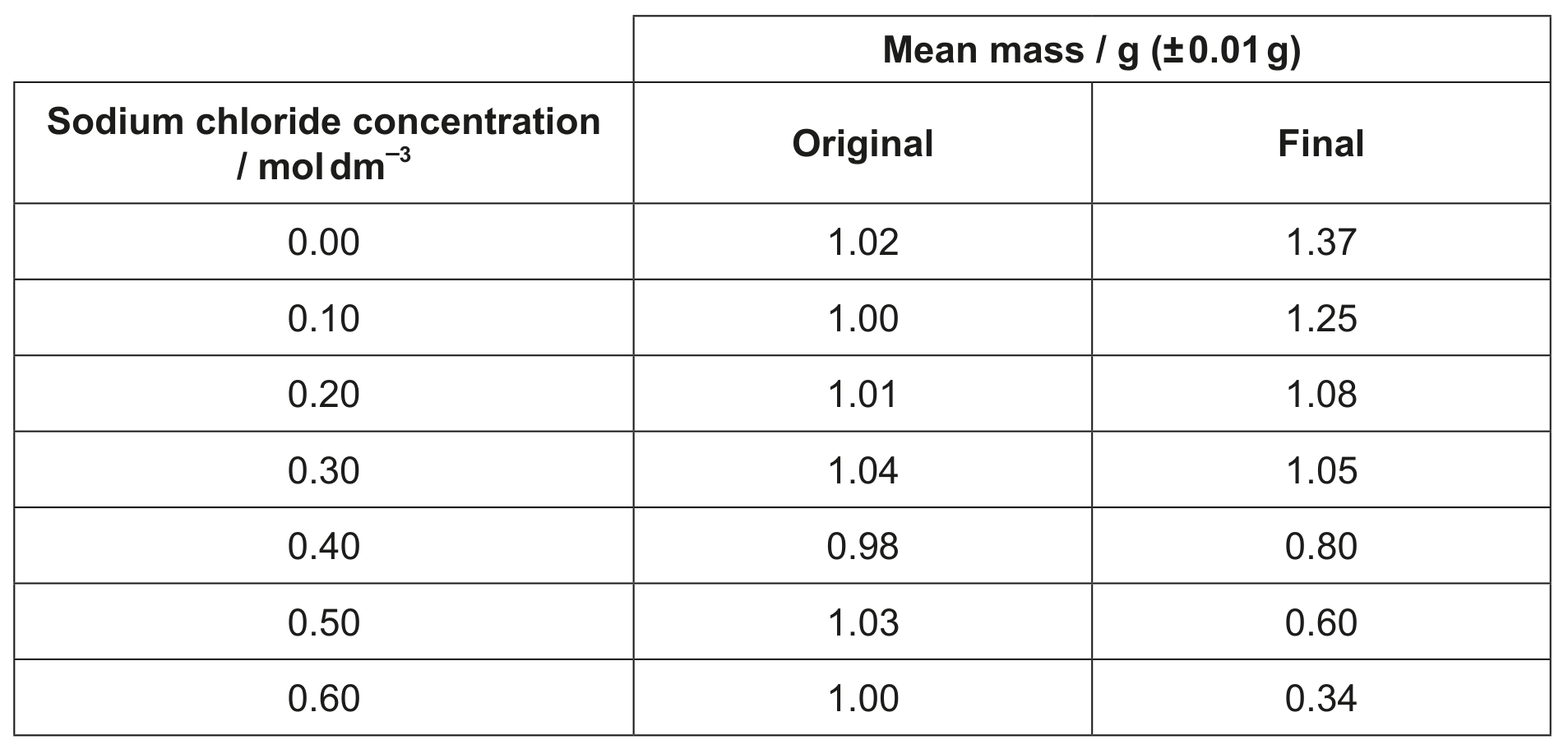
An experiment was carried out to determine the change in mass due to osmosis. Potato cubes were soaked in different concentrations of sodium chloride for 12 hours. The table shows the mean data for the mass of potato before and after the 12-hour period.

Table

Question 1(a)

(a)

Outline the conditions necessary for osmosis to occur.

[ 2 ]

Question 1(b)

(b)

Explain how the data may be used to determine the solute concentration of the potato tissue.

[ 2 ]

Question 1(c)

(c)

Estimate the solute concentration of the potato tissue.

[ 1 ]

Question 1

[Maximum number: 1]

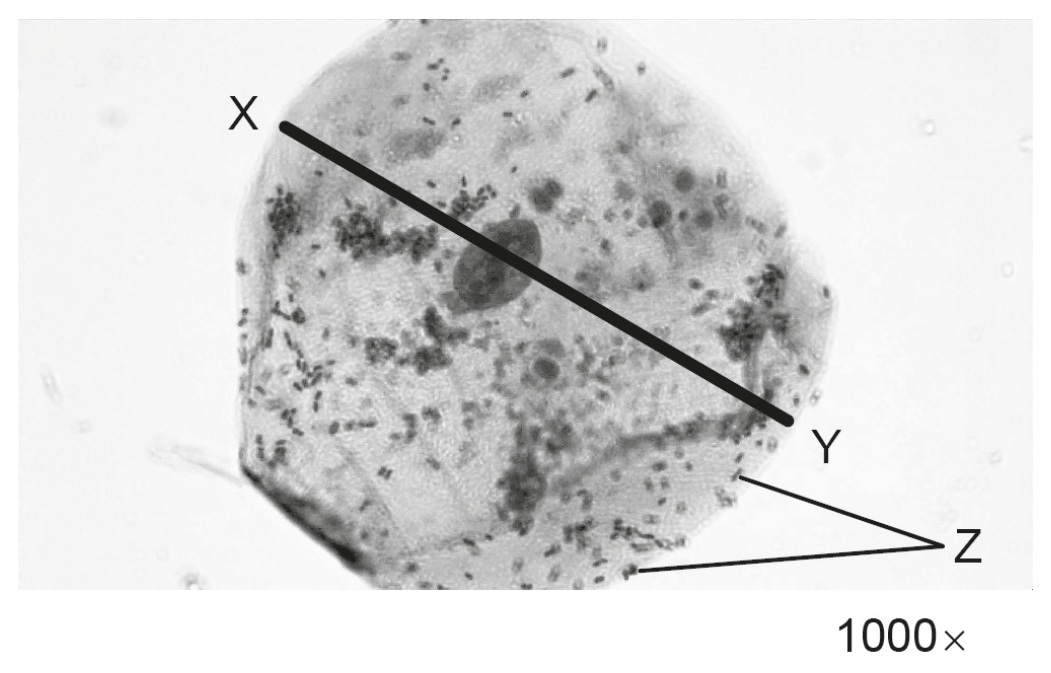
The micrograph shows a human cheek cell magnified with a light microscope.

Question image

Question 1(c)

(a)

Describe what would happen to the cheek cell if it was placed in a hypertonic salt solution.

[ 1 ]

Question 1

[Maximum number: 2]

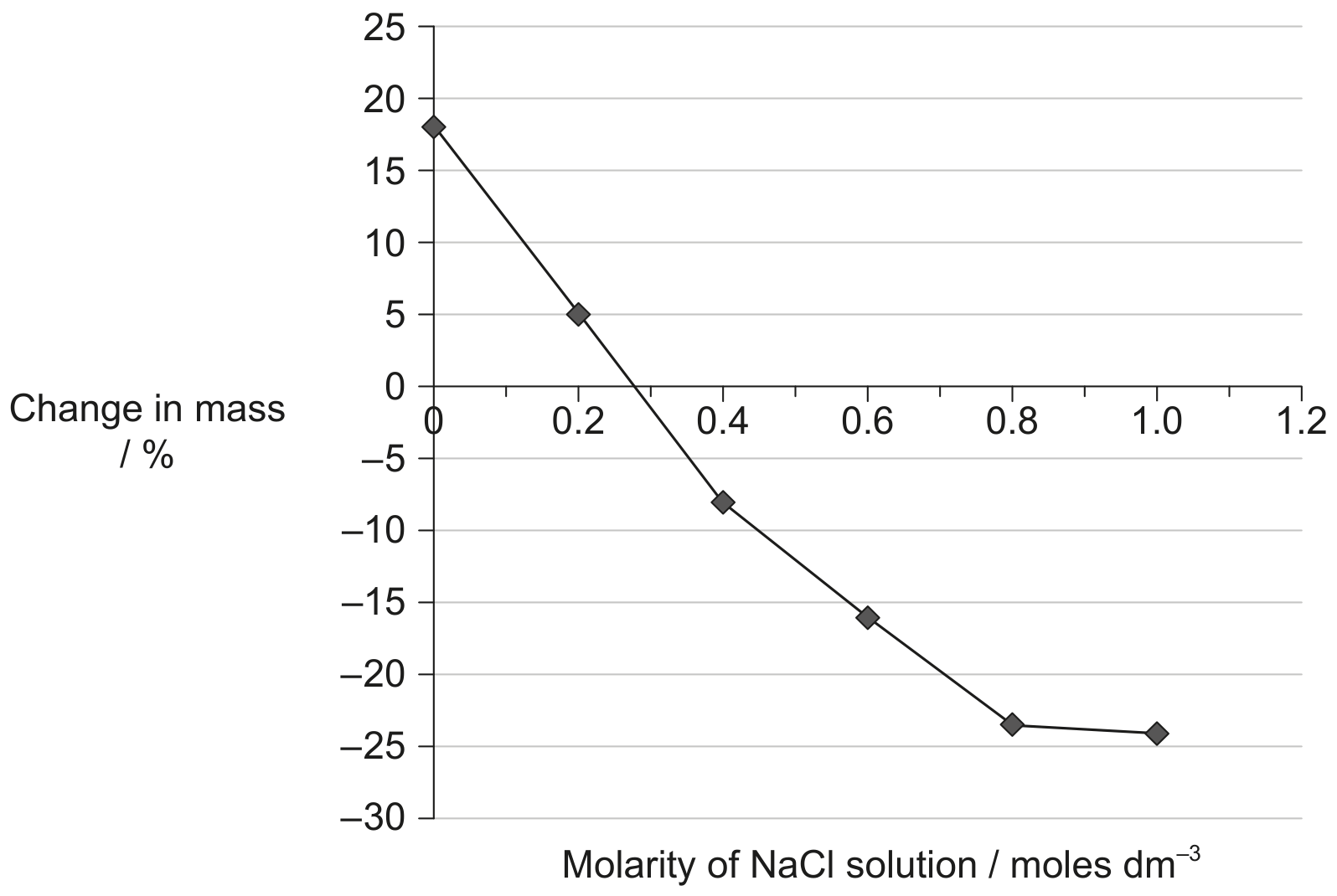
Solutions of ions, for example NaCl dissolved in water, can be used to investigate the concentration of solutes in plant tissues. After immersion in solutions of varying concentration, the percentage changes in mass of potato samples were measured. The graph shows the results.

Question image

Question 1(a)

Question 1(a)(i)

(a)
(i)

Estimate the osmolarity of the plant tissue.
moles dm3\mathrm{dm}^{-3}

[ 1 ]

Question 1(a)(ii)

(ii)

Identify which part of the graph represents samples measured in a hypotonic solution.

[ 1 ]
Question 1

[Maximum number: 7]

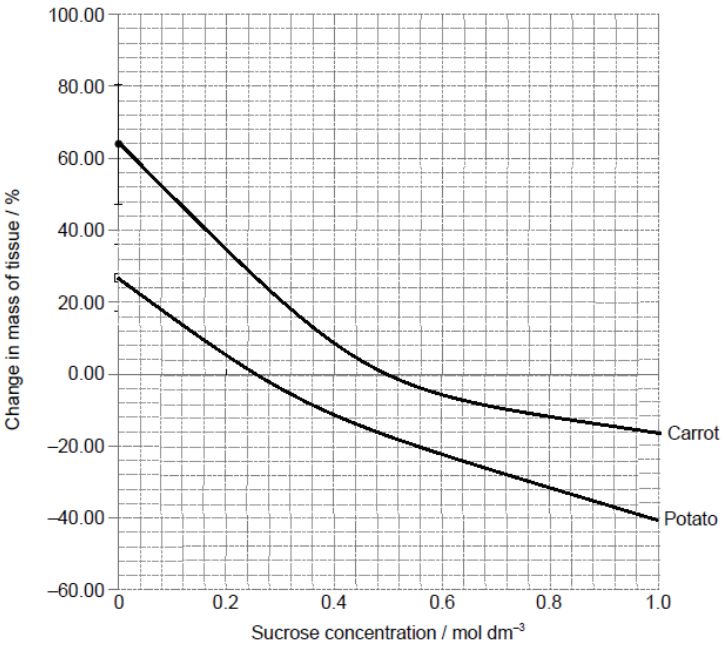
An experiment was carried out on osmosis in carrot (Daucus carota) root tissue and potato (Solanum tuberosum) tuber tissue. Similar sized pieces of tissue were cut and soaked in different sucrose solutions for 24 hours. The results are shown in the graph below.

Question image

Question 1(a)

(a)

Using the graph, estimate isotonic sucrose solutions for potato tissue and carrot tissue.

Potato:
Carrot:

[ 2 ]

Question 1(b)

(b)

Suggest a reason for the difference in the isotonic points for the potato and the carrot tissues.

[ 1 ]

Question 1(c)

(c)

From the evidence provided by the graph, evaluate the reliability of these data.

[ 2 ]

Question 1(d)

(d)

Explain one reason for calculating the percentage change in mass.

[ 2 ]

Question 1

[Maximum number: 2]

An experiment was carried out to measure the osmolarity of cantaloupe (fruit of Cucumis melo) tissue by placing pieces in salt solutions of different concentrations. The results are shown in the graph.

Removed for copyright reasons

Question 1(c)

(a)

Describe two factors that should be kept constant in this experiment in order to obtain an accurate measurement of the osmolarity of the cantaloupe tissue.

[ 2 ]

Question 3

[Maximum number: 1]

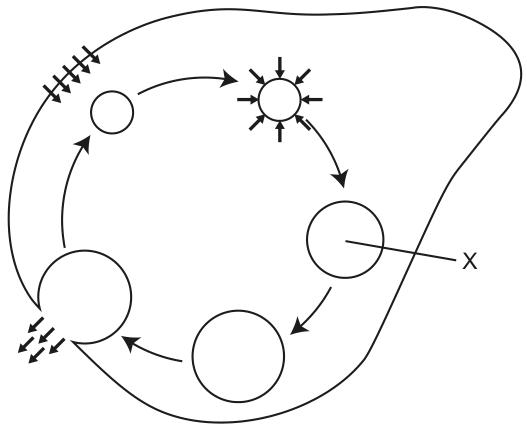
What would happen if the unicellular organism was placed in a solution slightly less concentrated than the cytoplasm of the cell, rather than in distilled water?

Question image
A

The cell would become larger.

B

More water would be expelled from the cell.

C

X would fill more slowly.

D

X would not appear.

Question 3

[Maximum number: 1]

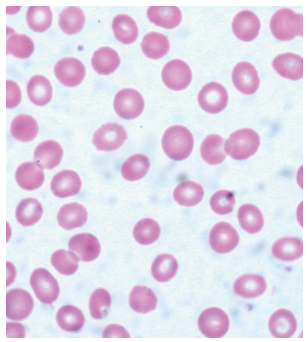
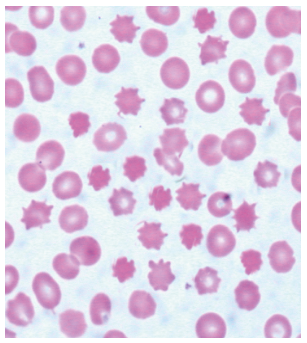
In an experiment on osmosis, red blood cells were immersed in a salt solution for two hours. The micrographs show the appearance of these cells before and after immersion in the salt solution.

before immersion

before immersion

after immersion

after immersion

What explains the observed changes?

A

The salt solution was hypertonic and entered the red blood cells.

B

The salt solution was hypotonic and disrupted the membranes of the red blood cells.

C

The salt solution was hypertonic and water moved into it from the red blood cells.

D

The salt solution was hypotonic and mineral salts were lost from the red blood cells.

Question 3

[Maximum number: 1]

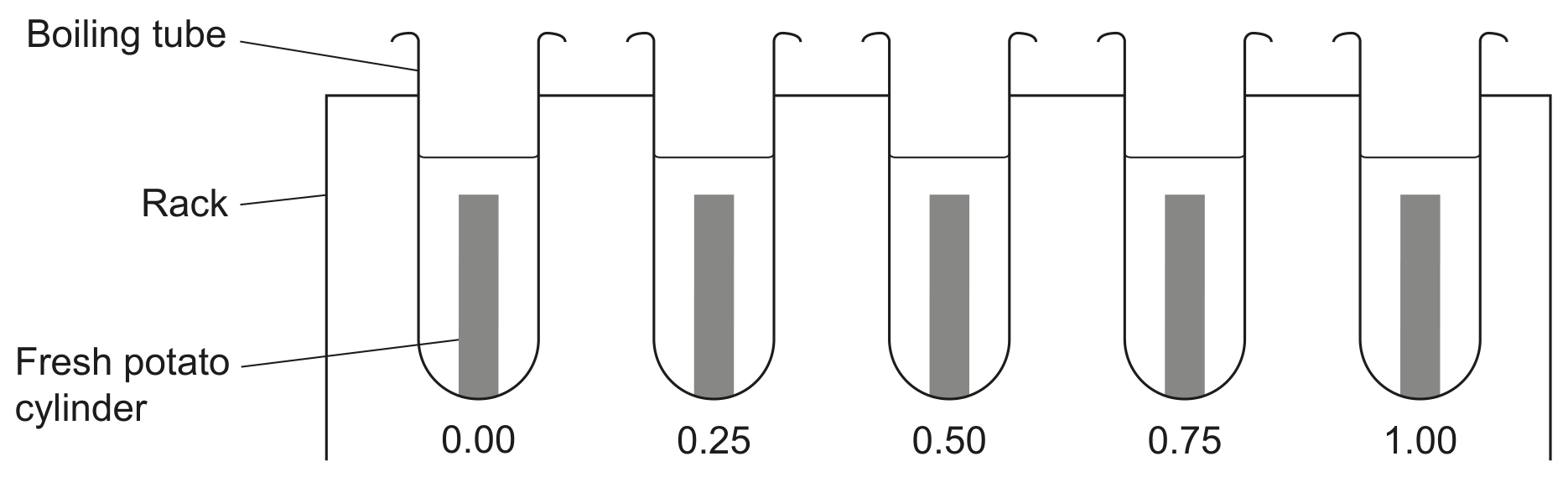
In an experiment, a student placed five fresh potato cylinders of equal size in solutions of varying sucrose concentrations.

Sucrose solution concentration / M

Sucrose solution concentration / M

On completion of the experiment, the student concluded that the concentration of sucrose isotonic with the potato was 0.30 M . In how many of the solutions did the potato cylinders lose mass?

A

1

B

2

C

3

D

4

Question 4

[Maximum number: 1]

Which process(es) occur(s) by osmosis?

I. Uptake of water by cells in the wall of the intestine
II. Loss of water from a plant cell in a hypertonic environment
III. Evaporation of water from sweat on the skin surface

A

I only

B

I and II only

C

II and III only

D

I, II and III

0 selected