Faraday Constant Explained | Chemistry
Learn what the Faraday constant means, how it relates charge to moles of electrons and how to use it in electrolysis calculations.

The Faraday constant links the amount of electrons transferred in an electrochemical process to the total charge. It is approximately 96485 C mol^-1, meaning that one mole of electrons carries about 96485 coulombs of charge. In electrolysis calculations, the key relationship is Q = nF, where Q is charge, n is the amount of electrons in moles and F is the Faraday constant.
Quick Answer
Use the Faraday constant when a question connects charge with moles of electrons:
Q = nF
If 0.25 mol of electrons are transferred, then Q = 0.25 x 96485 = 2.41 x 10^4 C. The most common mistake is using moles of the substance instead of moles of electrons.
What Is the Faraday Constant?
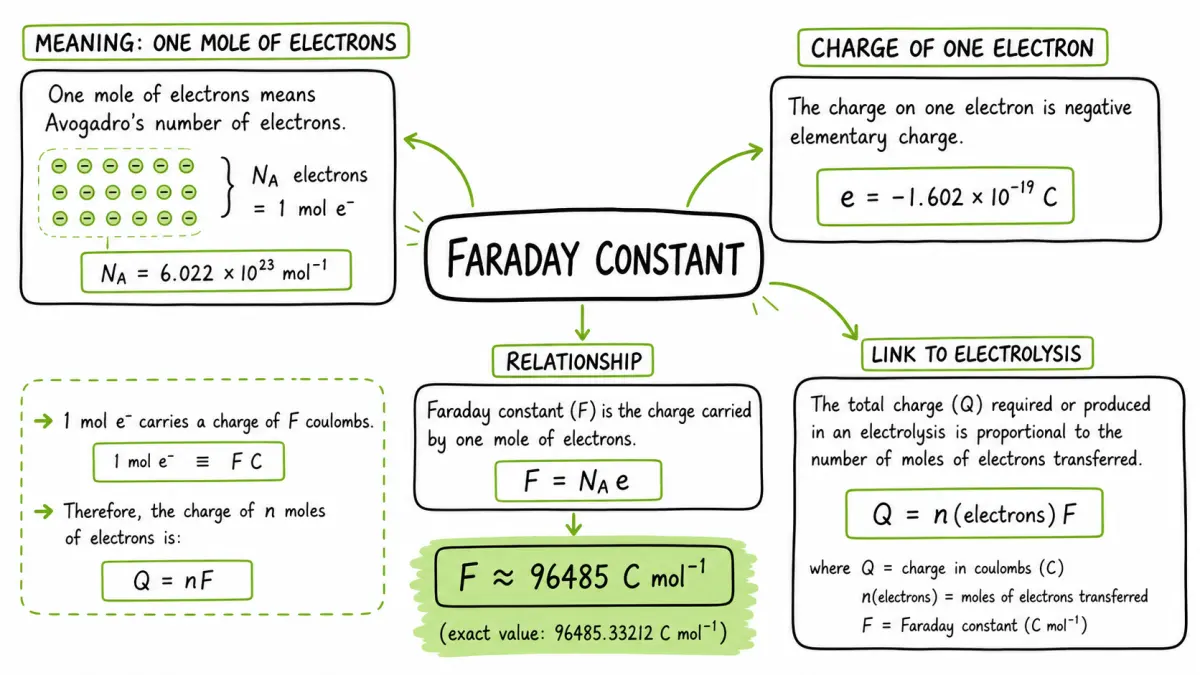
The Faraday constant, F, is the charge carried by one mole of electrons. It is related to the Avogadro constant and the magnitude of the charge on one electron:
F = N_A x e
Using N_A = 6.022 x 10^23 mol^-1 and e = 1.602 x 10^-19 C gives a value close to 96485 C mol^-1. The negative charge of an individual electron describes its sign; the Faraday constant is normally used as a positive magnitude in charge calculations.
The Link Between Charge and Electrons
The amount of charge depends on how many moles of electrons are transferred. One mole of electrons carries F coulombs, so n moles carry nF coulombs.
| Symbol | Meaning | Typical unit |
|---|---|---|
| Q | Total charge transferred | C |
| n | Amount of electrons transferred | mol e- |
| F | Faraday constant | C mol^-1 |
The units show why the formula works: mol e- x C mol e-^-1 = C.
Using the Faraday Constant in Electrolysis
In electrolysis, first use the half-equation to find how many electrons are involved per mole of the chemical species. Then convert the amount of substance into moles of electrons before applying Q = nF.
For example, the reduction half-equation Cu2+ + 2e- -> Cu shows that one mole of copper requires two moles of electrons. If 0.10 mol of copper is deposited, the amount of electrons is 0.20 mol, not 0.10 mol. The charge is therefore Q = 0.20F.
Worked Example
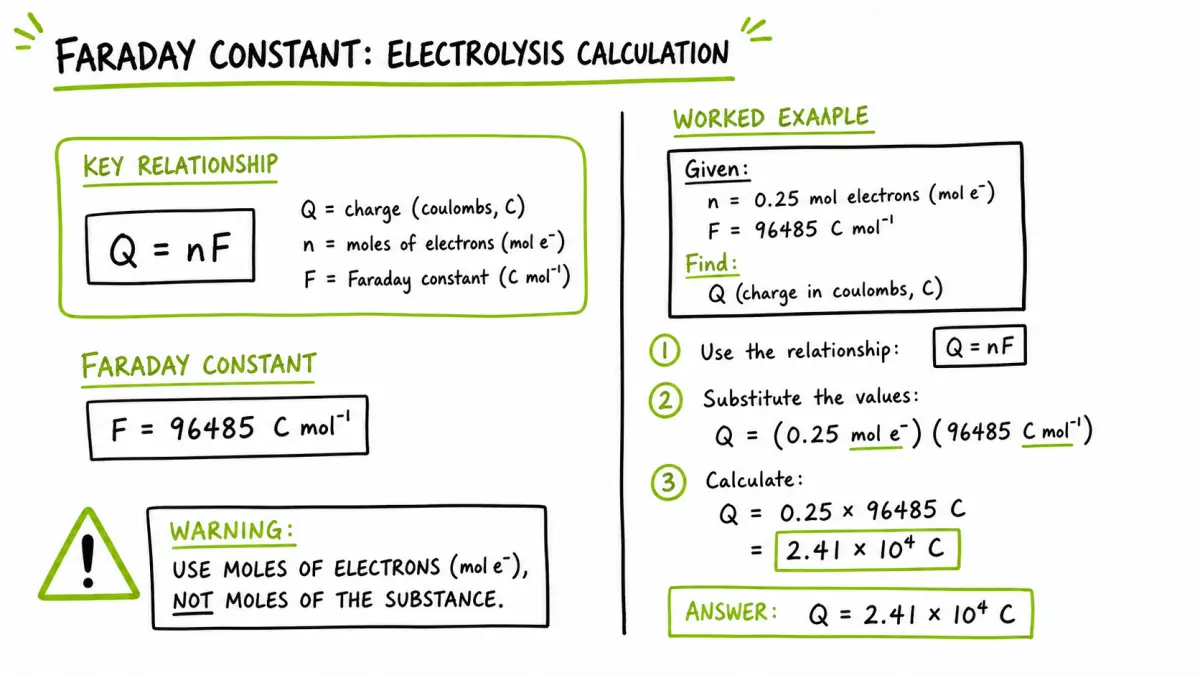
Question: Calculate the charge transferred when 0.25 mol of electrons pass through an electrolytic cell. Use F = 96485 C mol^-1.
Step 1: Write the relationship.
Q = nF
Step 2: Substitute the values.
Q = 0.25 x 96485 C
Step 3: Calculate and give the unit.
Q = 24121 C = 2.41 x 10^4 C to three significant figures.
Common Exam Mistakes
| Mistake | Correction |
|---|---|
| Using moles of the compound directly | Use the half-equation to find moles of electrons |
| Forgetting the factor in a half-equation | Balance charge and count electrons carefully |
| Giving the answer in mol C | Charge is measured in coulombs, C |
| Treating F as 96485 mol^-1 | Include the unit C mol^-1 |
| Rounding too early | Keep suitable working precision and round at the end |
Mini Practice
Calculate the charge transferred when 0.10 mol of electrons are moved. Use F = 96485 C mol^-1.
Answer guide: Q = nF = 0.10 x 96485 = 9648.5 C, or 9.65 x 10^3 C to three significant figures.
Practice This Topic
Practise A-Level Chemistry electrochemistry questions, especially questions requiring electron ratios from half-equations before using Q = nF.
FAQ
What is the value of the Faraday constant?
The Faraday constant is approximately 96485 C mol^-1. It represents the charge carried by one mole of electrons.
What does Q = nF mean?
Q is the total charge in coulombs, n is the amount of electrons in moles and F is the Faraday constant in C mol^-1.
Why do I need a half-equation?
The half-equation tells you how many electrons are transferred per mole of the chemical species. That electron ratio is needed before calculating charge.
Related Study Links
- A-Level Chemistry electrochemistry questions
- Arrhenius equation explained for IB Chemistry
- Transition metals explained for IB Chemistry
Final Takeaway
Use the half-equation to find moles of electrons, then apply Q = nF. Keep the units visible: charge is in coulombs and the Faraday constant is in C mol^-1.
Put faraday constant back into your full A-Level CAIE Chemistry AS study plan.
Return to the complete course overview, or move directly into the most relevant study tool.
Related articles
More course notes, updates and study resources from the EduNinja blog.

IB Chemistry SL 2025 Syllabus Changes: Assessment Guide
A practical IB Chemistry SL guide to the 2025 syllabus and assessment model: structure and reactivity, Paper 1A and 1B, Paper 2, scientific investigation and revision strategy.

Electron Domains and Molecular Geometry | A-Level Chemistry
Revise A-Level Chemistry electron domains, VSEPR shapes, lone pairs, bond angles, molecular geometry and common exam mistakes.

Salt Bridge Explained | A-Level Chemistry
Learn the function of a salt bridge in A-Level Chemistry, including ion movement, electrical neutrality, cell circuits and exam mistakes.