Covalent Bond in IGCSE Chemistry: Shared Pair Practice
Revise covalent bonds in Cambridge IGCSE Chemistry with shared electron pairs, simple molecules, dot-and-cross diagrams and practice questions.
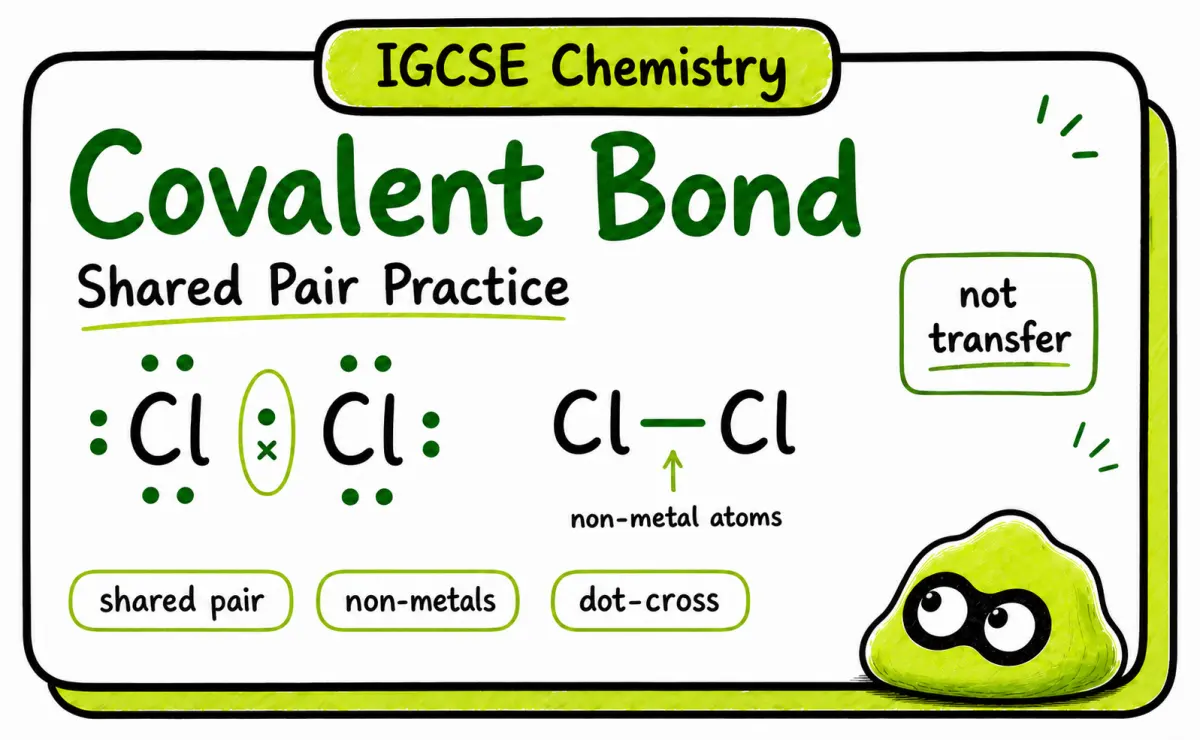
A covalent bond in IGCSE Chemistry is a shared pair of electrons between non-metal atoms. The exam trap is that students often say atoms "give" electrons or "swap" electrons, which sounds like ionic bonding instead of covalent bonding.
This bridge page focuses on Cambridge IGCSE Chemistry wording: shared electron pairs, simple molecules, dot-and-cross diagrams, and the difference between covalent bonding and ionic bonding.
Quick Answer
| Idea | Exam-safe wording |
|---|---|
| Covalent bond | A shared pair of electrons |
| Atoms involved | Usually non-metal atoms |
| Diagram skill | Show outer-shell electrons clearly |
| Common trap | Do not describe electron transfer |
| Simple molecule | Small group of atoms held by covalent bonds |
What a Covalent Bond Means
A covalent bond forms when two atoms share a pair of electrons. Each atom is attracted to the shared electrons, helping the atoms hold together in a molecule.
In Cambridge IGCSE Chemistry, this is often tested through simple molecules such as hydrogen, chlorine, water, methane or carbon dioxide. The exact molecule can change, but the exam logic stays the same: identify the shared pair and show the outer-shell electrons clearly.
Worked Example
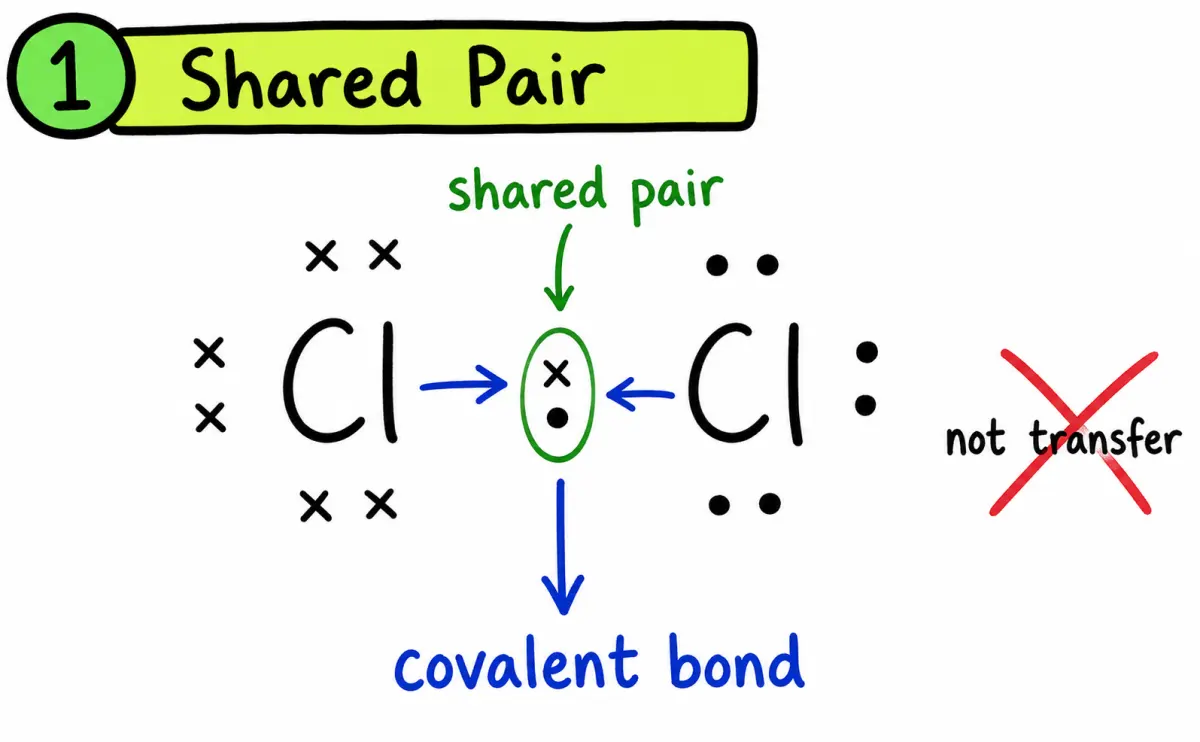
Question: Explain why chlorine gas, Cl2, contains a covalent bond.
Answer: Each chlorine atom has seven outer-shell electrons. The two chlorine atoms share one pair of electrons, so each atom has a full outer shell. This shared pair of electrons is a single covalent bond.
Why this scores: The answer names the shared pair and links it to the outer-shell arrangement. A weaker answer says that chlorine atoms "complete each other" without explaining how.
Dot-and-Cross Diagram Trap
| Diagram issue | Why it matters | Better habit |
|---|---|---|
| Missing outer electrons | The examiner cannot see the bond clearly | Show only outer-shell electrons |
| Using all dots | It may be hard to see which atom supplied which electron | Use dots and crosses consistently |
| Drawing electron transfer | That suggests ionic bonding | Show shared pairs between atoms |
| Forgetting lone pairs | The molecule may look incomplete | Include non-bonding outer electrons |
The most useful diagram habit is simple: draw the atoms, place one shared pair between bonded atoms, then check whether each non-metal has the correct outer-shell arrangement for the molecule.
Exam-Safe Wording
For definition questions, use:
A covalent bond is a shared pair of electrons between atoms.
For explanation questions, add:
- The atoms are non-metals.
- Outer-shell electrons are shared.
- Each shared pair forms one covalent bond.
- The dot-and-cross diagram should show the shared pair clearly.
This is stronger than saying covalent bonds are "strong because atoms want full shells." It is more specific and easier to match to a markscheme.
Common Mistakes
| Mistake | Why it loses marks | Better wording |
|---|---|---|
| Saying electrons are transferred | That describes ionic bonding | Electrons are shared |
| Forgetting the word pair | A covalent bond is one shared pair | Shared pair of electrons |
| Mixing up molecule and lattice | Simple covalent substances form molecules | Simple molecules have covalent bonds |
| Drawing inner-shell electrons | IGCSE diagrams usually focus on outer electrons | Show outer-shell electrons only |
Mini Practice Set
- Define a covalent bond.
- Explain why hydrogen chloride contains a covalent bond.
- State one difference between covalent bonding and ionic bonding.
- Describe one feature that must be clear in a dot-and-cross diagram.
Practice This Topic
Try this exam-style question:
A student says: "In a covalent bond, one atom gives an electron to another atom." Explain why this is wrong and rewrite the answer using correct IGCSE Chemistry wording.
Answer guide:
- Explain that electron transfer describes ionic bonding, not covalent bonding.
- State that a covalent bond is a shared pair of electrons.
- Mention that covalent bonds usually form between non-metal atoms.
- If using a diagram, show the shared pair between the atoms.
Practice this exact topic
Practise IGCSE Chemistry covalent bond questions
Some questions may require an EduNinja membership.
Browse broader practice
Browse the full Cambridge IGCSE Chemistry Question Bank
Use this if you want to explore more available practice by topic.
Related Study Links
- Cambridge IGCSE Chemistry Polymers: Repeat Units
- CAIE A-Level Chemistry Covalent Bonding: Definition
- Electron Affinity in IB Chemistry
FAQ
What is a covalent bond in IGCSE Chemistry?
A covalent bond is a shared pair of electrons between atoms. In IGCSE Chemistry, this usually means non-metal atoms sharing outer-shell electrons. If the question asks for a definition, the phrase "shared pair of electrons" is the part you should not miss.
Is covalent bonding the same as ionic bonding?
No, covalent bonding and ionic bonding are different. Covalent bonding involves sharing electrons, while ionic bonding involves electron transfer and attraction between oppositely charged ions. A common exam mistake is using transfer language when the question is asking about a simple molecule.
What should a dot-and-cross diagram show?
A dot-and-cross diagram should show outer-shell electrons and the shared electron pair or pairs between atoms. Dots and crosses help distinguish electrons from different atoms. The diagram should be clear enough that the examiner can see which electrons are bonded and which are lone pairs.
Do covalent bonds form between metals or non-metals?
Covalent bonds usually form between non-metal atoms. Metals more often form metallic bonding or ionic compounds with non-metals. For IGCSE exam answers, link covalent bonding to shared outer-shell electrons in simple molecules such as chlorine, water, methane or carbon dioxide.
What is the most common covalent bonding mistake?
The most common mistake is saying that one atom gives an electron to another. That describes ionic bonding, not covalent bonding. A better answer says that atoms share a pair of electrons, and that each shared pair forms one covalent bond.
Final Takeaway
For covalent bond questions, keep your wording clean: non-metal atoms share a pair of outer-shell electrons. If your diagram and sentence both show sharing, you are much less likely to drift into ionic bonding by accident.
Choose a course and continue studying.
Pick your curriculum and subject, then continue into the right question bank or notes.
Related articles
More course notes, updates and study resources from the EduNinja blog.
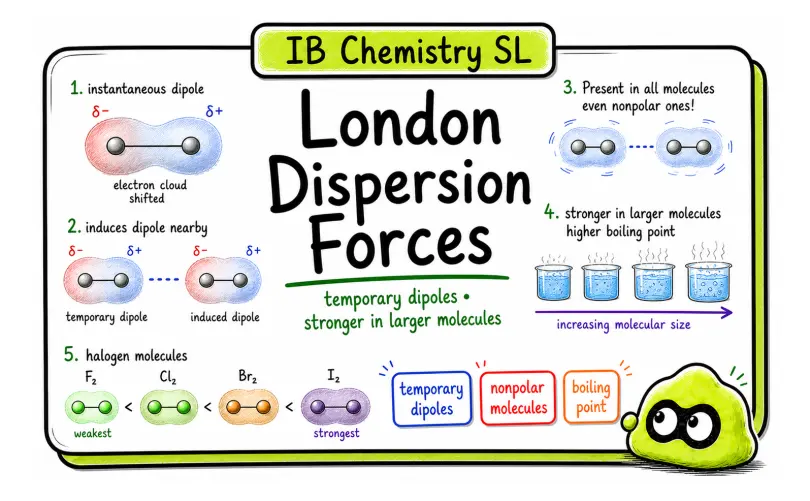
London Dispersion Forces Explained for IB Chemistry
Learn London dispersion forces for IB Chemistry with temporary dipoles, induced dipoles, molecular size, boiling point trends, examples and practice.
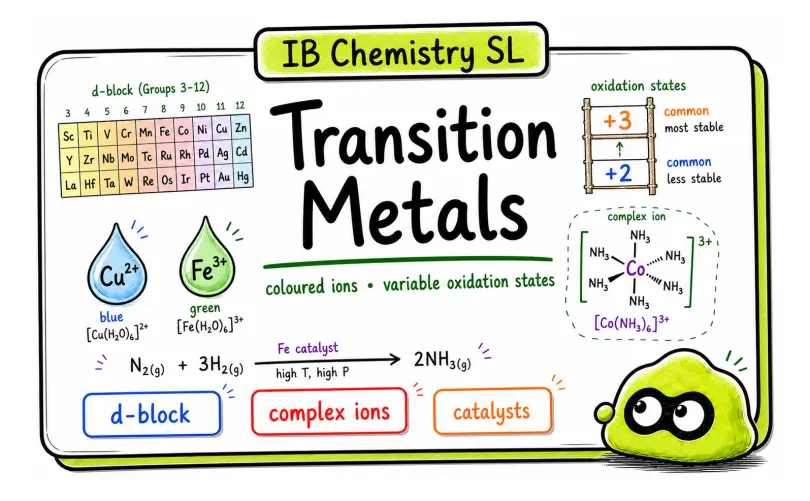
Transition Metals Explained for IB Chemistry
Revise transition metals in IB Chemistry, including coloured ions, variable oxidation states, complex ions, catalysts and common exam mistakes.
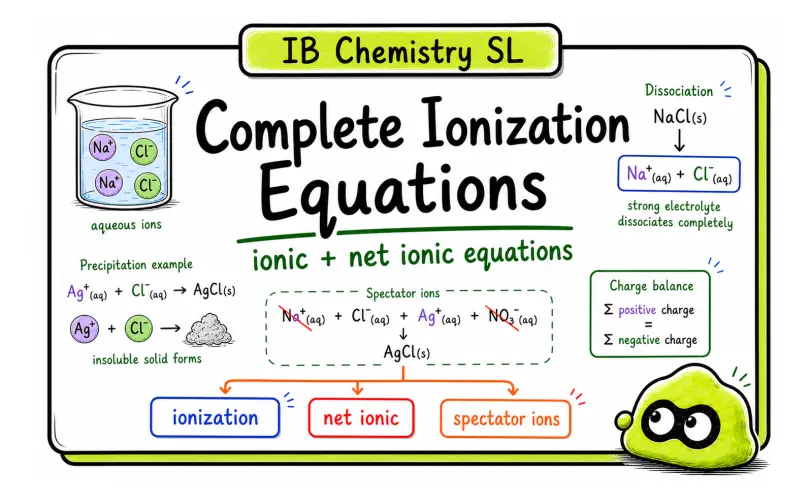
How to Complete Ionization and Net Ionic Equations
Learn complete ionization and net ionic equations for IB Chemistry, with ion charges, state symbols, spectator ions, worked examples and practice.