CAIE A-Level Chemistry Covalent Bonding: Definition
Revise CAIE A-Level Chemistry covalent bonding definitions, dot-and-cross diagrams and markscheme wording with targeted practice.
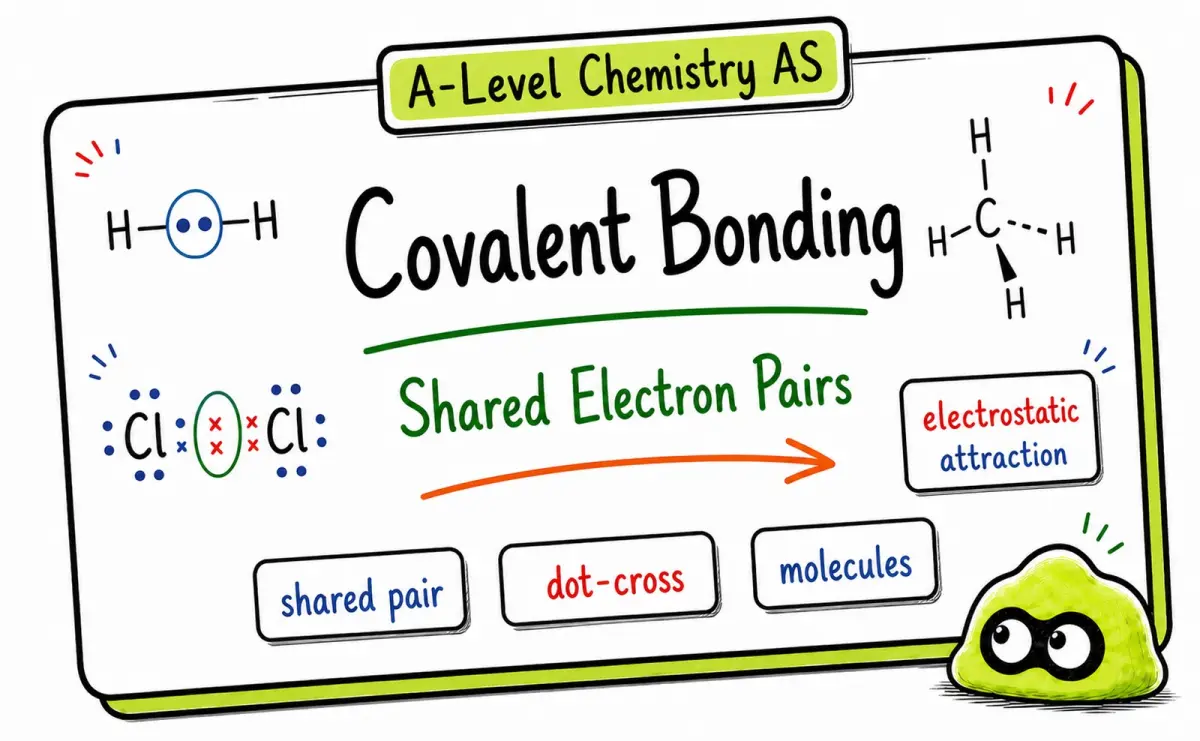
A covalent bond is a shared pair of electrons between atoms. For CAIE A-Level Chemistry, the stronger definition adds the reason the bond holds: electrostatic attraction between the shared pair of electrons and the nuclei of the bonded atoms.
That wording matters because exam questions often reward precision, not just the phrase "sharing electrons".
Quick Answer
| Idea | Exam-safe wording |
|---|---|
| Covalent bond | A shared pair of electrons between atoms |
| Why it holds | Electrostatic attraction between the shared pair and both nuclei |
| Diagram skill | Show shared pairs and lone pairs clearly in dot-and-cross diagrams |
What a Covalent Bond Means
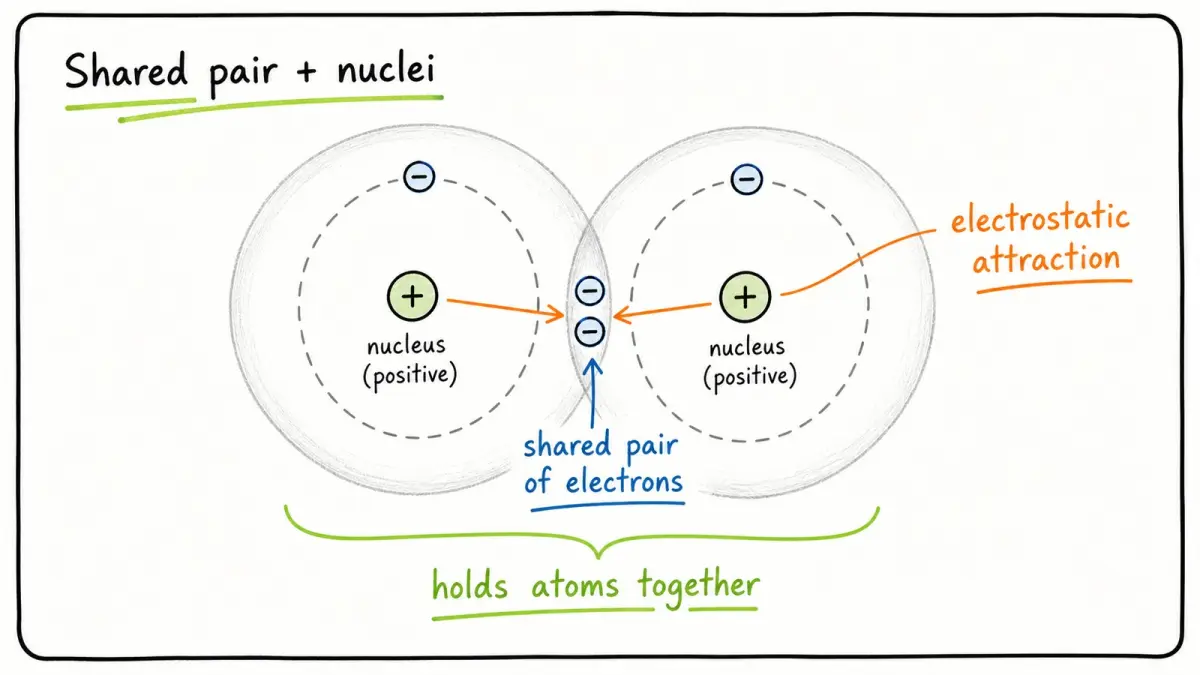
The shared pair of electrons is attracted to both positive nuclei. This attraction holds the atoms together. That is why a complete A-Level answer should mention the shared pair and the attraction to nuclei.
Weak wording:
A covalent bond is when atoms share electrons.
Stronger wording:
A covalent bond is the electrostatic attraction between a shared pair of electrons and the nuclei of the bonded atoms.
Markscheme Translation: How the Definition Gets Marks
For a 2-mark definition question, the marks often split like this:
| Mark | Student wording that earns it |
|---|---|
| 1 | A covalent bond is a shared pair of electrons |
| 1 | There is electrostatic attraction between the shared pair and the nuclei |
This is why the phrase "atoms share electrons" can be too loose. It may describe the idea, but it does not always include the attraction that holds the bond together.
Dot-and-Cross Diagrams
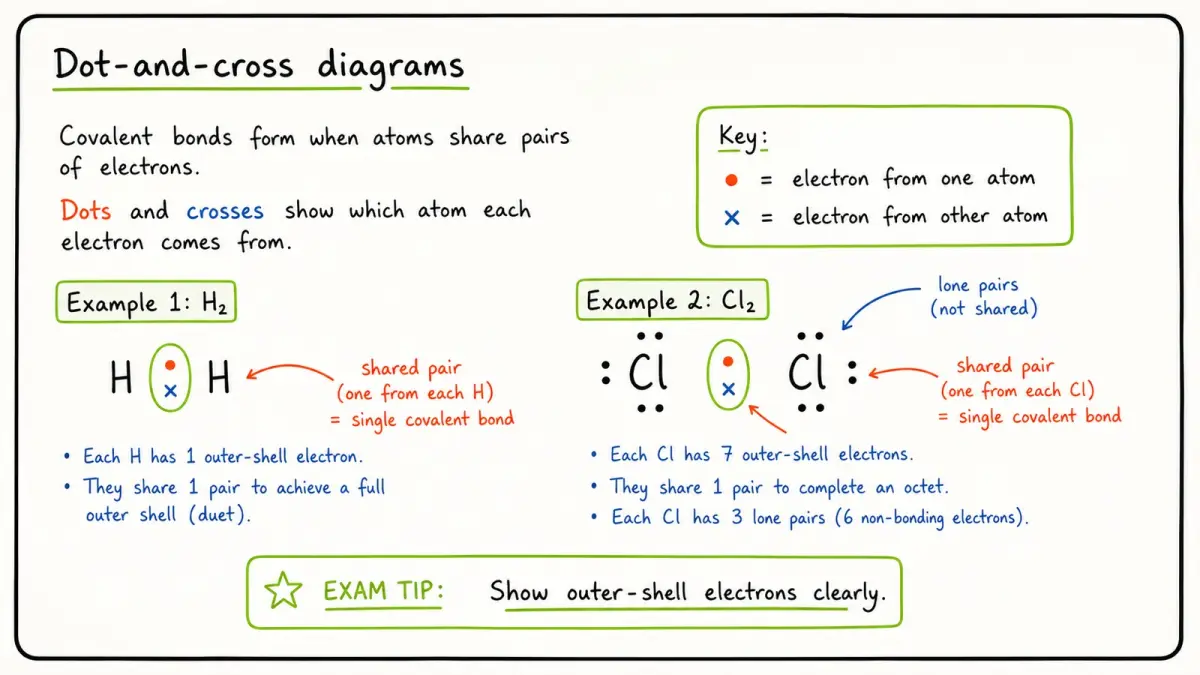
Dot-and-cross diagrams show which atom each outer-shell electron comes from. They do not mean the electrons stay different after bonding; they are a drawing convention to make the sharing visible.
For simple molecules, check:
- the number of outer-shell electrons
- which electrons are shared
- which electrons remain as lone pairs
- whether each atom has a stable outer shell where expected
Exam-Style Worked Example
Question: Define a covalent bond.
Worked answer:
A covalent bond is the electrostatic attraction between a shared pair of electrons and the nuclei of the bonded atoms.
Why this earns marks:
The answer includes the shared pair and the attraction to nuclei. It is more precise than saying "two atoms share electrons" because it explains what the bond is.
Common Mistakes
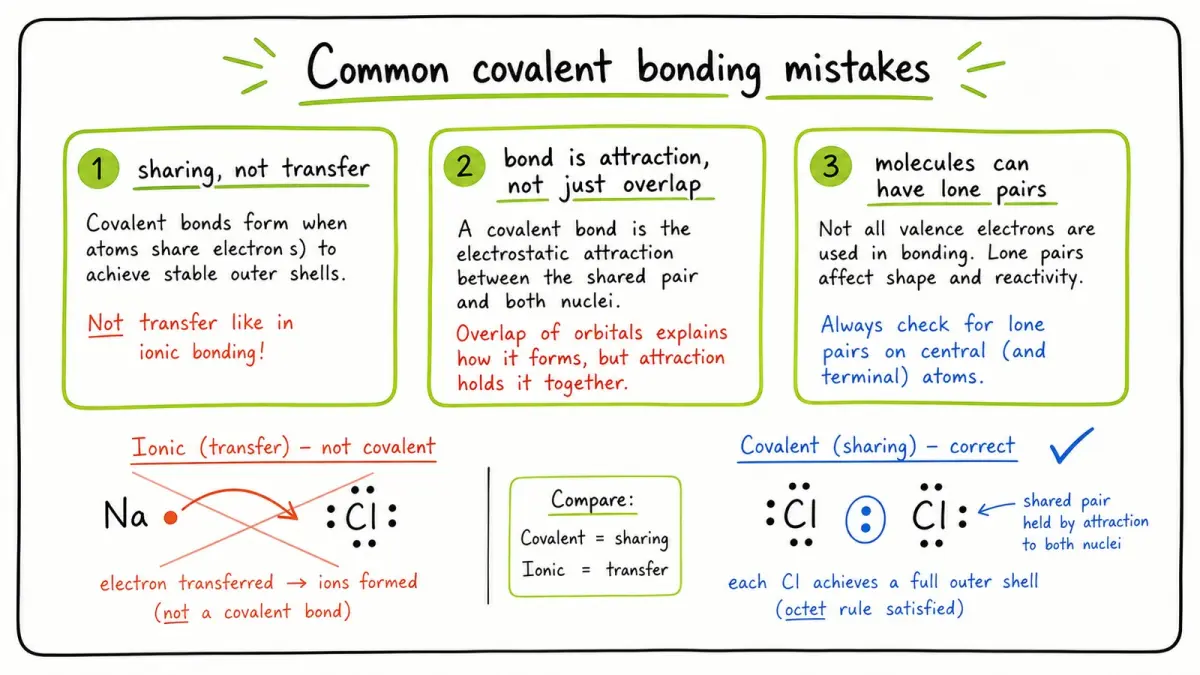
| Mistake | Why it loses marks | Better wording |
|---|---|---|
| Saying electrons are transferred | That describes ionic bonding | Covalent bonding involves sharing |
| Only writing "overlap" | The bond itself is an attraction | Mention attraction between shared pair and nuclei |
| Forgetting lone pairs | Diagrams become incomplete | Show non-bonding outer electrons clearly |
Mini Practice Set
| Question | Quick check |
|---|---|
| Define a covalent bond in markscheme wording. | Shared pair plus attraction to nuclei |
| What do dots and crosses show? | Which atom each outer electron came from |
| Is covalent bonding electron transfer? | No, it is sharing |
Practice This Topic
Try this exam-style question:
Define a covalent bond and explain why the shared pair of electrons is attracted to both nuclei.
Answer guide:
- A covalent bond involves a shared pair of electrons.
- The shared pair is attracted electrostatically to both positive nuclei.
- This attraction holds the atoms together.
- Use dot-and-cross diagrams to show which outer-shell electrons are shared.
Practice this exact topic
Practice covalent bonding questions
Some questions may require an EduNinja membership.
Browse broader practice
Browse the full CAIE A-Level Chemistry Question Bank
Use this if you want to explore more available practice by topic.
Related Study Links
- Explore the course Study Hub
- A-Level Chemistry Bonding: Covalent Bonds and Intermolecular Forces
- CAIE AS Chemistry Atomic Structure Guide
- CAIE AS Chemistry Group 2 Trends Guide
- A-Level Chemistry Organic Mechanisms Guide
- CAIE A-Level Chemistry AS Question Bank
FAQ
What is a covalent bond?
A covalent bond is a shared pair of electrons between atoms. For CAIE A-Level Chemistry, a stronger definition says it is the electrostatic attraction between the shared pair of electrons and the nuclei of the bonded atoms. This extra attraction wording is often what separates a vague answer from a mark-worthy one.
How many marks is a covalent bond definition usually worth?
A covalent bond definition can reward two separate ideas: the shared pair of electrons and the electrostatic attraction to the nuclei. If you only write that atoms share electrons, the answer may be incomplete. A safer 2-mark answer includes both the shared pair and the attraction holding the atoms together.
What is a dot-and-cross diagram?
A dot-and-cross diagram shows outer-shell electrons using different symbols for different atoms. It helps you show which electrons are shared in covalent bonds and which remain as lone pairs. The dots and crosses are a drawing convention, not a claim that the electrons behave differently after bonding.
Is covalent bonding electron transfer?
No. Covalent bonding is not electron transfer; it involves atoms sharing pairs of electrons. Electron transfer is associated with ionic bonding. In exam answers, keep these two models separate because mixing up transfer and sharing is one of the quickest ways to lose definition marks.
Why do covalent bonds hold atoms together?
Covalent bonds hold atoms together because the shared pair of electrons is attracted to the positive nuclei of both bonded atoms. This electrostatic attraction holds the atoms in the molecule. For A-Level wording, it is better to mention both the shared pair and the attraction to nuclei.
Final Takeaway
For CAIE A-Level answers, do not stop at "shared electrons". Add the markscheme idea: electrostatic attraction between the shared pair and both nuclei.
Put CAIE A-Level chemistry back into your full A-Level CAIE Chemistry AS study plan.
Return to the complete course overview, or move directly into the most relevant study tool.
Related articles
More course notes, updates and study resources from the EduNinja blog.
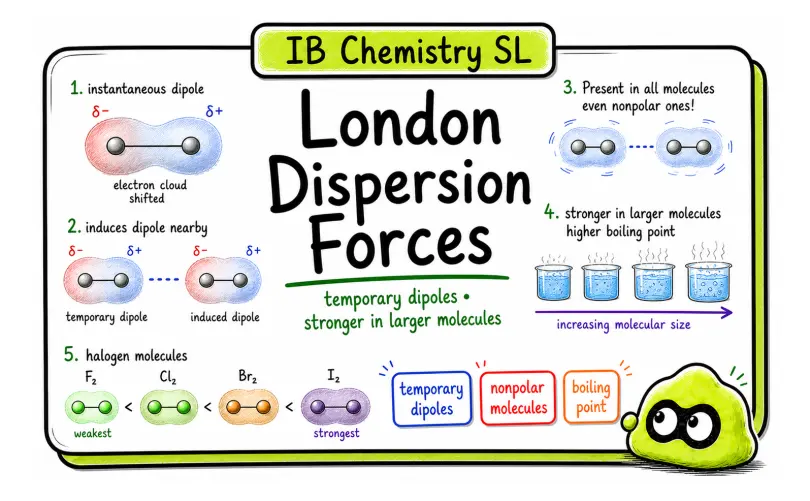
London Dispersion Forces Explained for IB Chemistry
Learn London dispersion forces for IB Chemistry with temporary dipoles, induced dipoles, molecular size, boiling point trends, examples and practice.
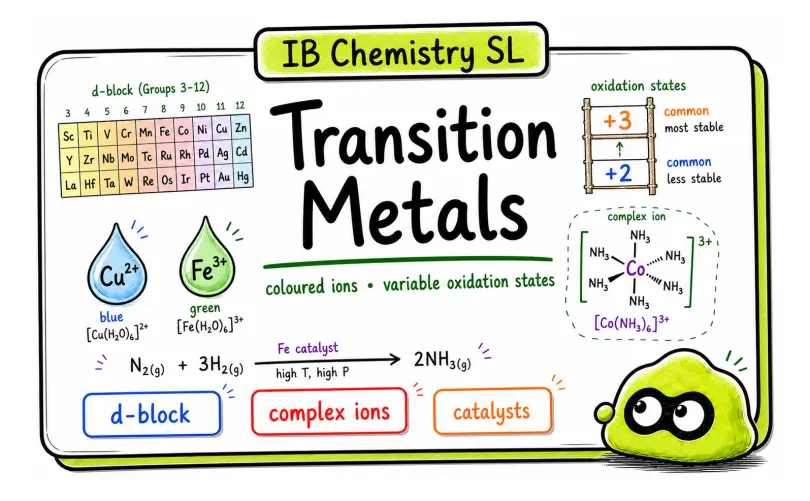
Transition Metals Explained for IB Chemistry
Revise transition metals in IB Chemistry, including coloured ions, variable oxidation states, complex ions, catalysts and common exam mistakes.
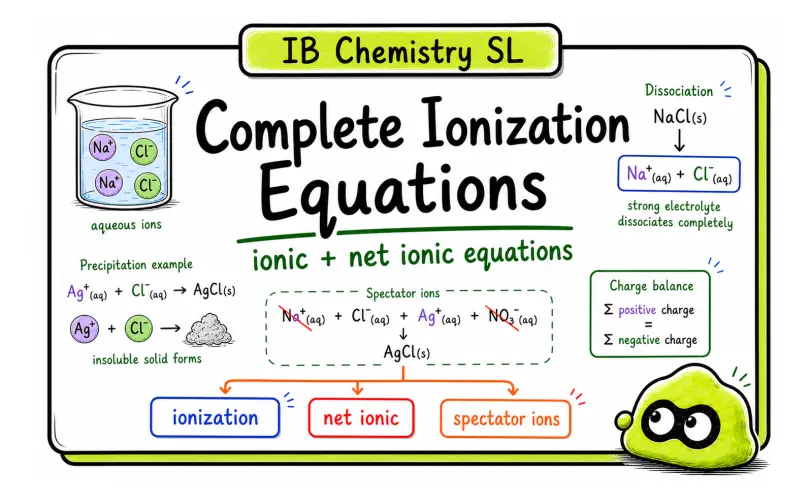
How to Complete Ionization and Net Ionic Equations
Learn complete ionization and net ionic equations for IB Chemistry, with ion charges, state symbols, spectator ions, worked examples and practice.