Electron Affinity in IB Chemistry: Definition and Trend
Revise electron affinity in IB Chemistry with definition wording, energy change, periodic trend, common traps and exam-style practice.
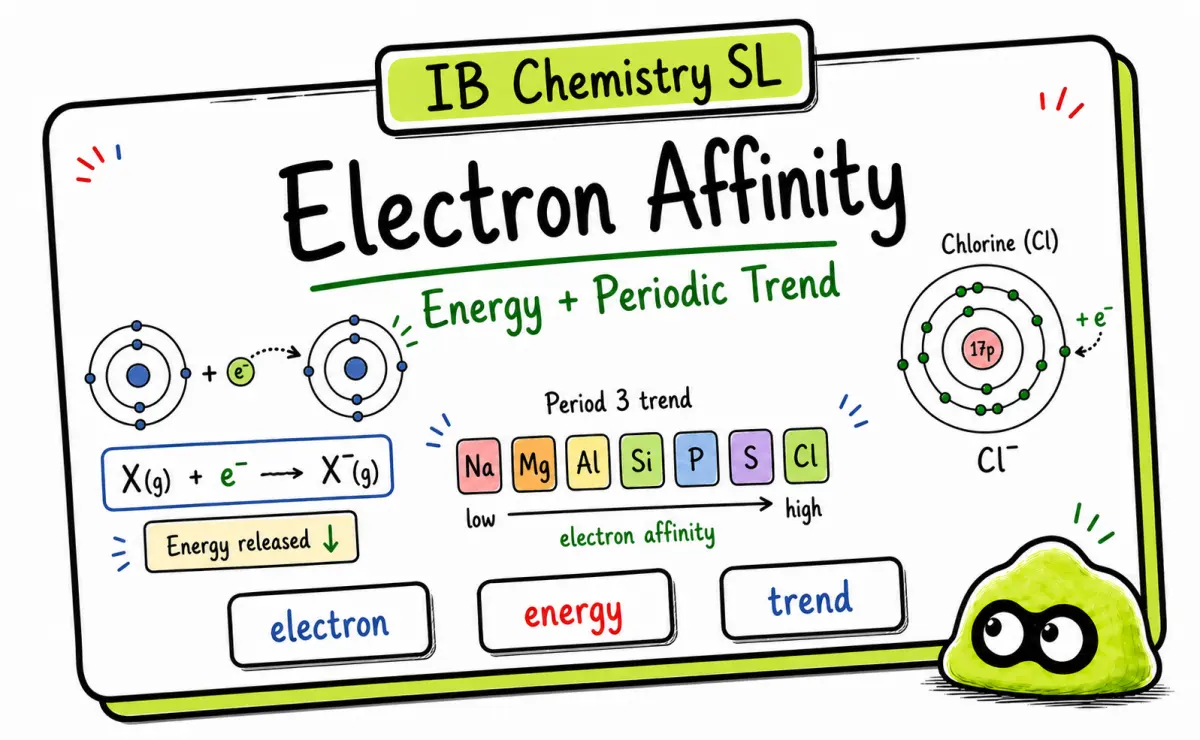
Electron affinity is an IB Chemistry term that students often mix up with electronegativity. The safest definition is: electron affinity is the enthalpy change when one mole of gaseous atoms gains one mole of electrons to form one mole of gaseous negative ions.
That wording matters because exam questions may reward the gaseous state, the electron gain, and the energy change.
Quick Answer
| Term | What it means | Common trap |
|---|---|---|
| Electron affinity | Enthalpy change when gaseous atoms gain electrons | Not the same as electronegativity |
| First electron affinity | X(g) + e- -> X-(g) | Usually exothermic |
| Trend | Often becomes more negative across a period | Exceptions can occur |
| Second electron affinity | Adding an electron to a negative ion | Usually endothermic |
What Electron Affinity Means
Electron affinity is about adding an electron to a gaseous atom. It is not about attraction for a shared pair of electrons in a bond. That second idea is electronegativity.
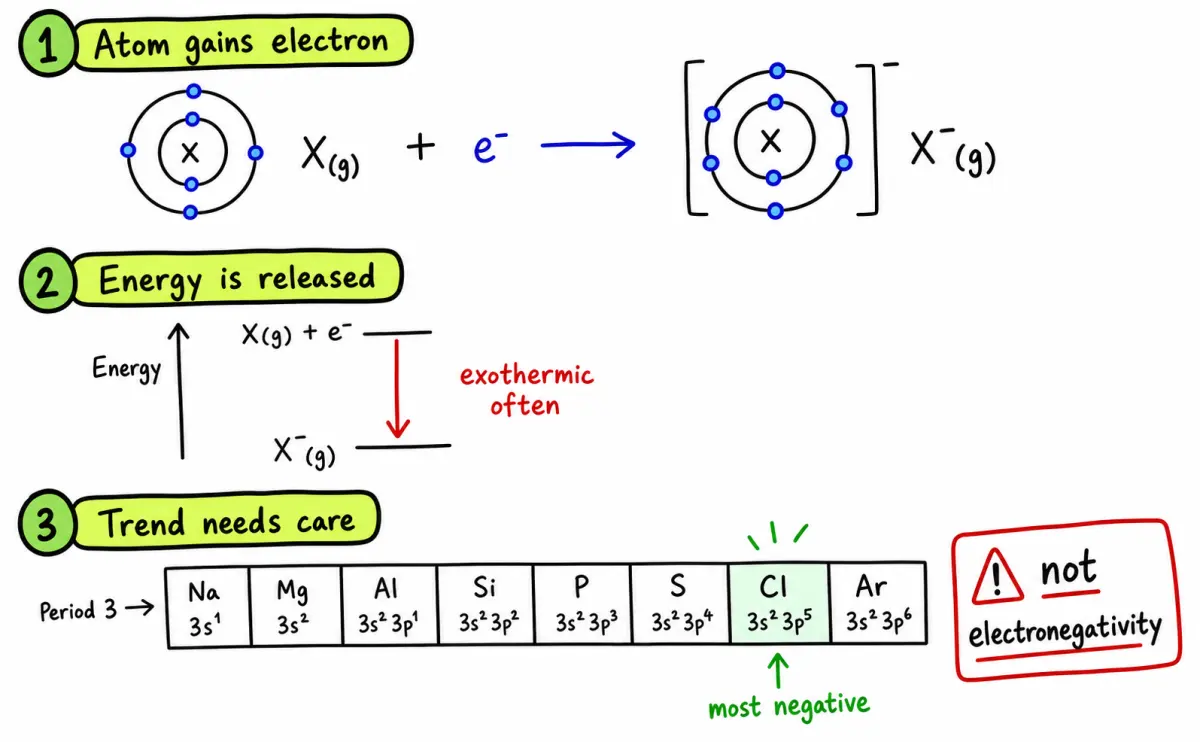
The general equation for first electron affinity is:
X(g) + e- -> X-(g)
Use gaseous state symbols because electron affinity is defined for isolated gaseous atoms and ions.
Electron Affinity vs Electronegativity vs Ionization Energy
These three terms all involve electrons, but they test different ideas.
| Term | What happens | Energy idea | Exam-safe wording |
|---|---|---|---|
| Electron affinity | Atom gains an electron | Enthalpy change | Gaseous atom forms gaseous negative ion |
| Electronegativity | Atom attracts bonding electrons | Relative attraction | Attraction for shared pair in a bond |
| Ionization energy | Atom loses an electron | Energy required | Gaseous atom forms gaseous positive ion |
If the question mentions a covalent bond, think electronegativity. If it mentions removing an electron, think ionization energy. If it mentions gaining an electron, think electron affinity.
Periodic Trend in Electron Affinity
Across a period, first electron affinity usually becomes more exothermic because nuclear charge increases and atoms can attract an incoming electron more strongly. Students often describe this as becoming more negative.
Down a group, electron affinity generally becomes less exothermic because the incoming electron is added further from the nucleus and experiences more shielding. Electron affinity has exceptions, so avoid writing trend sentences as if there are no irregular values.
Worked Example
Write a definition of first electron affinity.
A mark-worthy answer is: first electron affinity is the enthalpy change when one mole of gaseous atoms gains one mole of electrons to form one mole of gaseous negative ions.
The important parts are one mole, gaseous atoms, electron gain, gaseous negative ions and enthalpy change.
Why Second Electron Affinity Is Different
Second electron affinity means adding an electron to an ion that is already negative. That is usually endothermic because the incoming electron is repelled by the negative ion.
For example, adding an electron to X-(g) to form X2-(g) requires energy input. The exam point is not just "second means two electrons"; it is that electron-electron repulsion makes the second addition harder.
Common Mistakes
| Mistake | Why it loses marks | Better wording |
|---|---|---|
| Calling it attraction in a bond | That is electronegativity | Enthalpy change when atoms gain electrons |
| Missing gaseous state | Definitions often require gaseous atoms and ions | Use X(g) and X-(g) |
| Saying it is always simple across a period | There are exceptions | Describe the general trend carefully |
| Forgetting the ion charge | The atom becomes negative | X(g) + e- -> X-(g) |
| Confusing gain and loss | Ionization energy is electron removal | Electron affinity is electron gain |
Markscheme-Style Wording
For definitions, include these pieces:
- enthalpy change
- one mole of gaseous atoms
- one mole of electrons gained
- one mole of gaseous negative ions formed
That wording is safer than saying "how much an atom wants an electron".
Mini Practice Set
- Write an equation for the first electron affinity of chlorine.
- Explain why electron affinity is not the same as electronegativity.
- State one reason periodic trends in electron affinity can have exceptions.
- Explain why second electron affinity is usually endothermic.
Practice This Topic
Try this exam-style question:
Define first electron affinity and explain why it is different from electronegativity.
Answer guide:
- First electron affinity is an enthalpy change for gaseous atoms gaining electrons.
- Use the idea of forming gaseous negative ions.
- Electronegativity is attraction for a bonding pair of electrons.
- Do not describe electron affinity as attraction inside a covalent bond.
Practice this exact topic
Practice periodicity and electron affinity questions
Some questions may require an EduNinja membership.
Browse broader practice
Browse the full IB Chemistry SL Question Bank
Use this if you want to explore more available practice by topic.
Related Study Links
- Explore the course Study Hub
- Electronegativity Trend Across a Period: IB Chemistry Guide
- Inert Gas vs Noble Gas: IB Chemistry Group 18 Guide
- Vaporization in IB Chemistry: Definition and Energy
FAQ
What is electron affinity in IB Chemistry?
Electron affinity is the enthalpy change when gaseous atoms gain electrons to form gaseous negative ions. For first electron affinity, one mole of gaseous atoms gains one mole of electrons. The definition is wording-heavy, so include gaseous state and negative ion formation. A vague phrase such as "attraction for electrons" is not precise enough.
Is electron affinity the same as electronegativity?
No, electron affinity and electronegativity are different. Electron affinity is an enthalpy change when an atom gains an electron. Electronegativity is the ability of an atom in a bond to attract the shared pair of electrons. Mixing them up is a common periodicity mistake. Check whether the question is about isolated atoms or bonded atoms.
How is electron affinity different from ionization energy?
Electron affinity involves gaining an electron, while ionization energy involves removing an electron. Electron affinity forms a negative ion from a gaseous atom. Ionization energy forms a positive ion from a gaseous atom. Check whether the question says gain or remove. That single verb often tells you which definition the examiner wants.
Why is second electron affinity endothermic?
Second electron affinity is usually endothermic because an electron is being added to an ion that is already negative. The incoming electron is repelled by the negative ion, so energy must be supplied. This is different from many first electron affinities, which are often exothermic. Mention repulsion if the question asks why energy is needed.
What should I include in an electron affinity definition?
Include enthalpy change, one mole of gaseous atoms, one mole of electrons gained, and one mole of gaseous negative ions formed. If the question asks for an equation, write X(g) + e- -> X-(g), then connect it to the definition. State symbols are useful because they show the gaseous condition clearly.
Final Takeaway
For electron affinity, keep the definition separate from electronegativity and ionization energy. If your answer says enthalpy change, gaseous atoms and negative ions, you are much closer to markscheme wording.
Put topic practice back into your full IB Chemistry SL study plan.
Return to the complete course overview, or move directly into the most relevant study tool.
Related articles
More course notes, updates and study resources from the EduNinja blog.
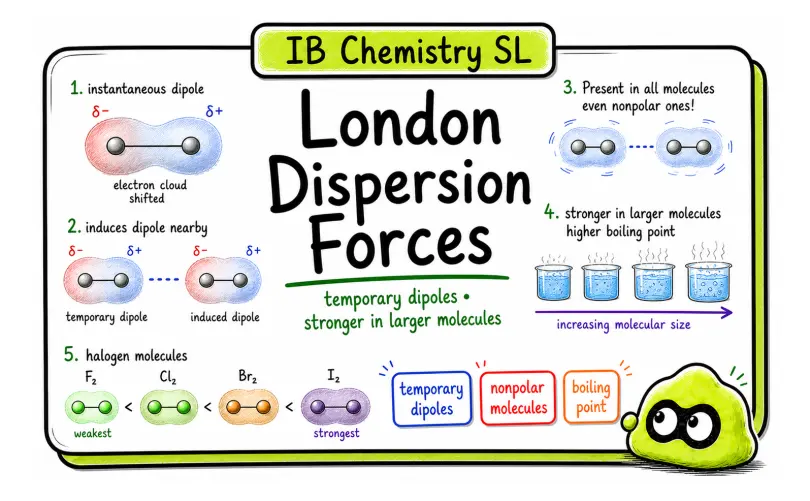
London Dispersion Forces Explained for IB Chemistry
Learn London dispersion forces for IB Chemistry with temporary dipoles, induced dipoles, molecular size, boiling point trends, examples and practice.
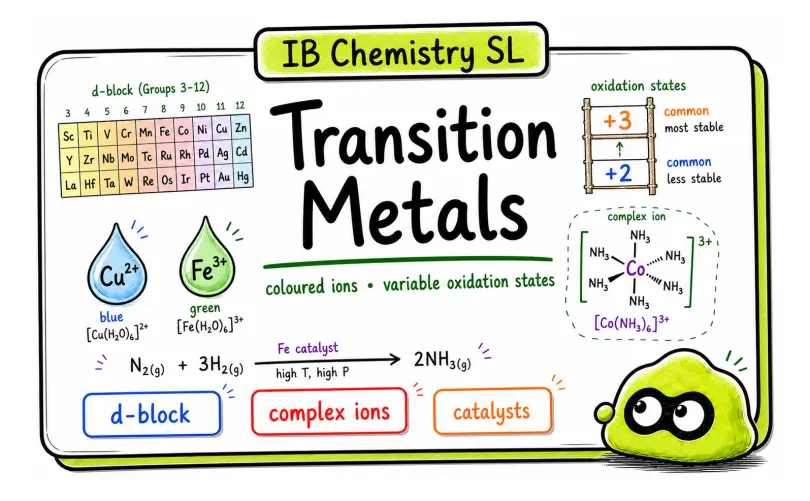
Transition Metals Explained for IB Chemistry
Revise transition metals in IB Chemistry, including coloured ions, variable oxidation states, complex ions, catalysts and common exam mistakes.
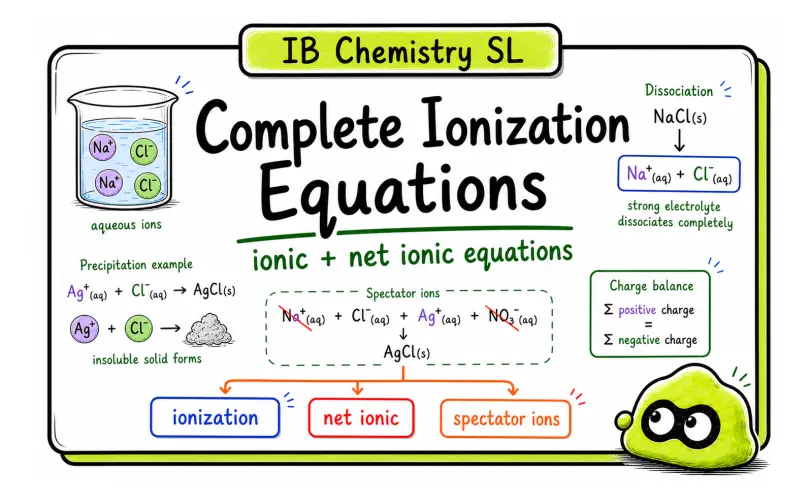
How to Complete Ionization and Net Ionic Equations
Learn complete ionization and net ionic equations for IB Chemistry, with ion charges, state symbols, spectator ions, worked examples and practice.