Binary Fission Explained | Biology
Learn binary fission with the cell-division sequence, genetically identical daughter cells, examples and key comparisons with mitosis.

Binary fission is a form of asexual reproduction in which one prokaryotic cell copies its DNA and divides to form two genetically identical daughter cells. The process is common in bacteria. To answer exam questions well, remember the sequence: DNA replicates, the cell elongates, the copies separate, and the cytoplasm divides.
Quick Answer
Binary fission produces two genetically identical cells from one parent cell. It does not involve the fusion of gametes and does not use mitosis because prokaryotes do not have a nucleus containing chromosomes arranged like those in eukaryotic cells.

Binary Fission in Bacteria
Bacteria are prokaryotes, so their genetic material is not held inside a nucleus. During binary fission, the bacterial DNA replicates and the cell membrane helps the cell form a division between the two copies. The result is two daughter cells with the same genetic information as the parent cell, which is why binary fission is a form of asexual reproduction.
For a concise exam answer, describe the sequence rather than saying only that the cell "splits": DNA replication, cell elongation, separation of the DNA copies, and division of the cell membrane and cytoplasm. You can review the wider context in A-Level Biology cell structure revision and IB Biology cell biology revision.
The Binary Fission Sequence
The stages can be described in a simple chain:
- The circular DNA molecule replicates.
- The two DNA copies move apart as the cell elongates.
- A division begins across the middle of the cell.
- The cytoplasm separates, forming two daughter cells.
Each daughter cell receives a copy of the genetic material. Under suitable conditions, the daughter cells can grow and divide again.
Why It Is Asexual Reproduction
Binary fission is asexual because it involves one parent cell and no gamete fusion. The daughter cells are genetically identical to the parent and to each other, apart from any mutations that may arise during DNA copying.
| Feature | Binary fission |
|---|---|
| Number of parent cells | One |
| Gametes involved | No |
| Main genetic outcome | Genetically identical daughter cells |
| Number of daughter cells | Two |
| Typical organisms | Prokaryotes such as bacteria |
Binary Fission and Growth
Binary fission allows a population to increase rapidly when resources and conditions are favourable. The time needed for one cell to divide is often called the generation time. Short generation times can produce exponential population growth, although real populations are eventually limited by nutrients, space, waste products or other environmental factors.
Binary Fission Compared with Mitosis
Both processes can produce genetically identical daughter cells, but they are not the same process. Binary fission occurs in prokaryotes and does not involve a nucleus. Mitosis occurs in eukaryotic cells and includes chromosome movement through stages of nuclear division.

Sexual reproduction is different again: gametes from two parents fuse, creating genetic variation in the offspring. Do not write that binary fission creates variation through the process itself. Variation can arise from mutation, but the usual outcome of binary fission is two clones.
Common Exam Mistakes
| Mistake | Correction |
|---|---|
| Saying the cell divides by mitosis | Use binary fission for prokaryotic cell division |
| Saying two gametes fuse | Binary fission uses one parent cell and no gametes |
| Saying the daughter cells are always completely identical | They are genetically identical in the usual process, but mutations can occur |
| Omitting DNA replication | State that DNA is copied before the cell divides |
Mini Practice
Explain how binary fission produces two genetically identical daughter cells.
Answer guide: The DNA replicates, the copies move to opposite parts of the elongating cell, and a division forms across the middle. The cytoplasm then separates, so each daughter cell receives one copy of the genetic material.
Practice This Topic
Practise related IB Biology SL cell and reproduction questions, then check that your answer includes DNA replication, cell division and genetic identity.
FAQ
What is binary fission?
Binary fission is asexual reproduction in which one prokaryotic cell copies its DNA and divides into two genetically identical daughter cells.
Does binary fission use mitosis?
No. Binary fission is the division process used by prokaryotes, which do not have a nucleus. Mitosis is a eukaryotic nuclear-division process.
Why are the daughter cells genetically identical?
Each daughter cell receives a copy of the replicated genetic material. The process does not combine genetic material from two parents, although mutations may arise during copying.
Related Study Links
- Explore the course Study Hub
- IB Biology SL cell and reproduction questions
- A-Level Biology cell structure revision
- IB Biology cell biology revision guide
- IB Biology SL cell biology revision guide
Final Takeaway
Remember the sequence: copy the DNA, elongate the cell, separate the copies, and divide the cytoplasm. One parent cell becomes two genetically identical daughter cells.
Choose a course and continue studying.
Pick your curriculum and subject, then continue into the right question bank or notes.
Related articles
More course notes, updates and study resources from the EduNinja blog.
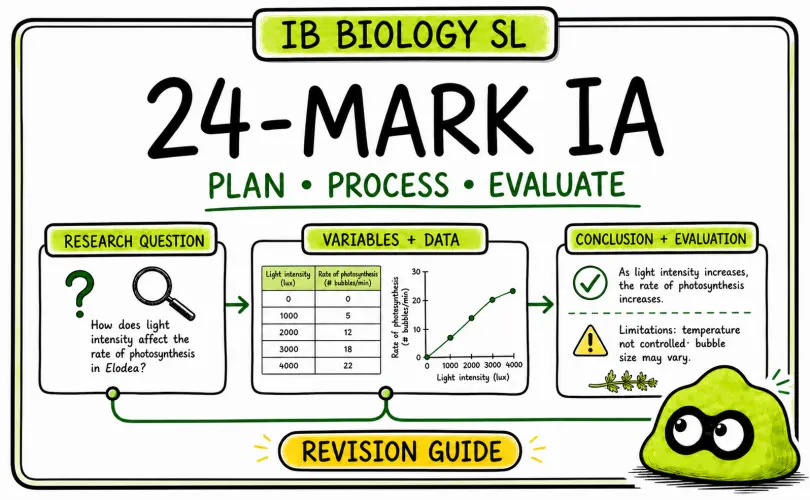
IB Biology Scientific Investigation Guide: How to Build a Strong 24-Mark IA
A practical IB Biology guide to the 24-mark Scientific Investigation: choose a workable research question, control variables, process data, draw a supported conclusion and evaluate limitations with specific improvements.
Abiotic Factors Explained | IB Biology SL
Revise IB Biology SL abiotic factors, tolerance ranges, limiting factors and how environmental variables affect distribution.
Active Transport vs Passive Transport | A-Level Biology
Revise A-Level Biology active and passive transport with concentration gradients, ATP, carrier proteins, examples, common mistakes and practice.