Abiotic Factors Explained | IB Biology SL
Revise IB Biology SL abiotic factors, tolerance ranges, limiting factors and how environmental variables affect distribution.
Abiotic factors are non-living conditions that affect where organisms can survive and how large their populations become. In IB Biology SL, the most useful examples are temperature, light intensity, pH, water availability and mineral ions because each can change growth, reproduction or distribution.
Quick Answer
An abiotic factor is a non-living environmental variable. A species can survive only within a tolerance range for each factor. The factor furthest from its optimum, or in shortest supply, can limit population growth and restrict distribution.
What Are Abiotic Factors?
Abiotic factors are physical or chemical parts of an ecosystem rather than living organisms. They include temperature, light, pH, water availability, salinity, oxygen concentration and mineral nutrients. Their effects are often measured by comparing a factor value with the abundance or distribution of a species.
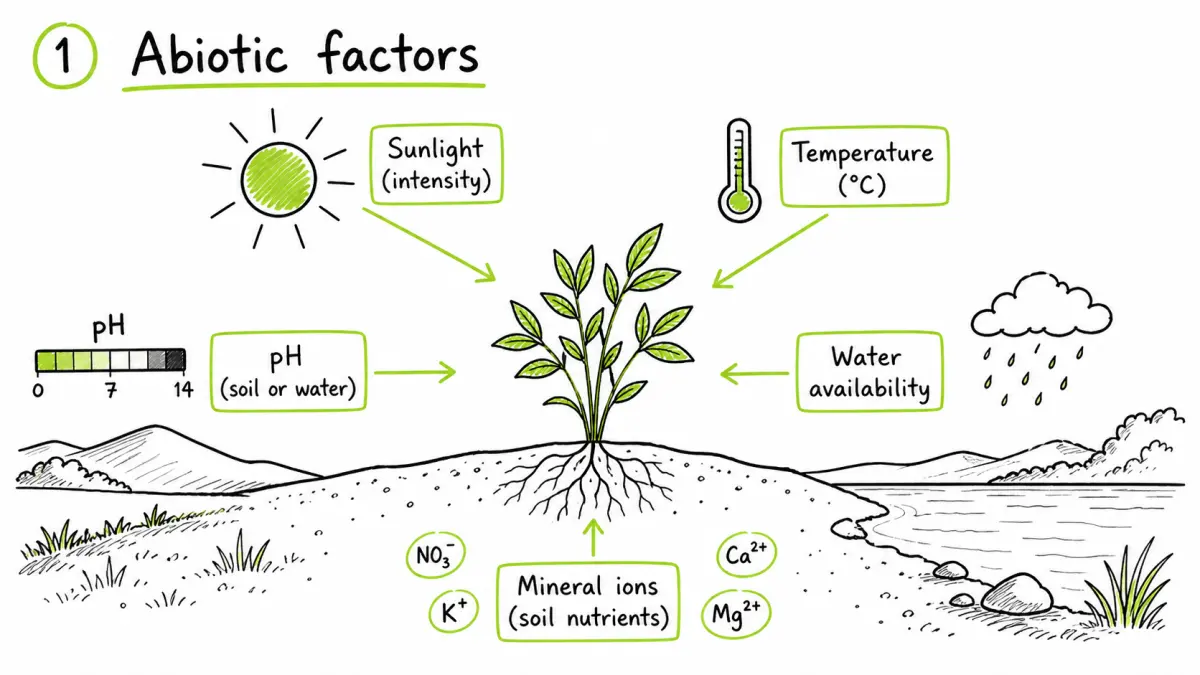
The same factor can help one species and limit another. For example, a plant adapted to acidic soil may grow well where a different plant cannot. This is why an exam answer should connect the factor to a biological response rather than only list environmental conditions.
Limiting Factors and Tolerance Ranges
For each abiotic factor, a species has a lower tolerance limit, an optimum range and an upper tolerance limit. Growth and population density are usually greatest near the optimum. At either extreme, the factor becomes limiting and fewer individuals survive or reproduce.
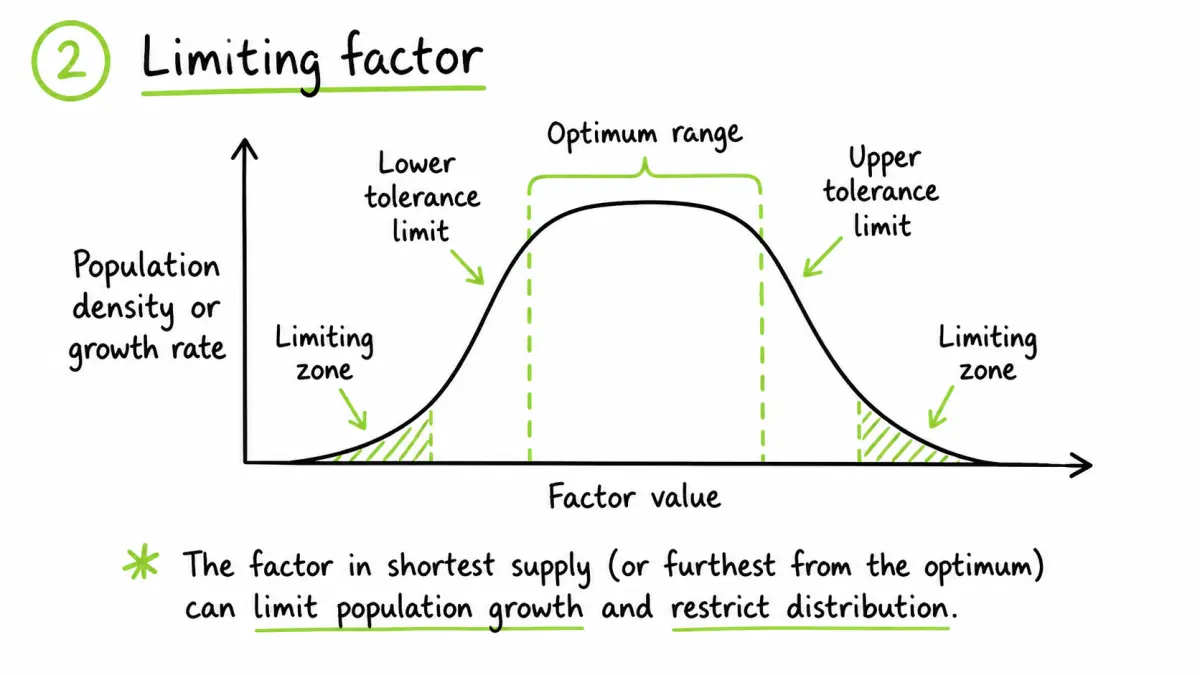
A limiting factor is the condition that most restricts a process at a particular place or time. If water is scarce, increasing light may not increase plant growth. In a mark-scheme answer, state the factor, describe the change and link it to survival, enzyme activity, photosynthesis, reproduction or distribution.
Worked Example
Explain how temperature can act as an abiotic limiting factor for a species.
Answer: Temperature affects enzyme-controlled reactions and therefore the rate of metabolism. At temperatures below or above the species' optimum, enzyme activity and growth may decrease; at an extreme temperature, proteins may lose their functional shape and fewer individuals survive or reproduce. The species' distribution is therefore restricted to locations within its tolerance range.
Common Exam Mistakes
- Calling a predator or competitor an abiotic factor. Those are biotic factors.
- Describing temperature as simply “good” or “bad” without naming an optimum or tolerance range.
- Saying a factor causes distribution without explaining the effect on survival or reproduction.
- Confusing correlation with proof of causation when interpreting a fieldwork graph.
Practice This Topic
Try this exam-style question:
Explain why a change in pH can alter the distribution of a plant species.
Answer guide:
- The plant has a tolerance range and an optimum pH.
- Away from the optimum, mineral uptake or enzyme-controlled processes may be reduced.
- Growth and reproduction decrease near the tolerance limits, so the plant is less abundant there.
Practice this topic
Practise IB Biology SL abiotic variables questions
FAQ
What is the difference between abiotic and biotic factors?
Abiotic factors are non-living conditions such as temperature and pH. Biotic factors involve living organisms, including predators, competitors, pathogens and food sources.
What does tolerance range mean?
It is the range of values of an environmental factor within which a species can survive. The optimum is where performance is greatest, while the limits are where survival or reproduction becomes very difficult.
Why are abiotic factors important in fieldwork?
Measuring them helps explain patterns in distribution and abundance. A strong investigation compares the factor with a biological measurement and controls or records other relevant variables.
Related Study Links
- Explore the subject Study Hub
- Review IB Biology SL concepts
- Practise IB Biology SL abiotic variables questions
- Revise IB Biology ecology
- Review natural selection in IB Biology
Final Takeaway
Abiotic factors are non-living variables that shape survival, reproduction and distribution. Use tolerance ranges, optimum conditions and limiting-factor language to turn an observation into a clear IB Biology explanation.
Put abiotic factors back into your full IB Biology SL study plan.
Return to the complete course overview, or move directly into the most relevant study tool.
Related articles
More course notes, updates and study resources from the EduNinja blog.
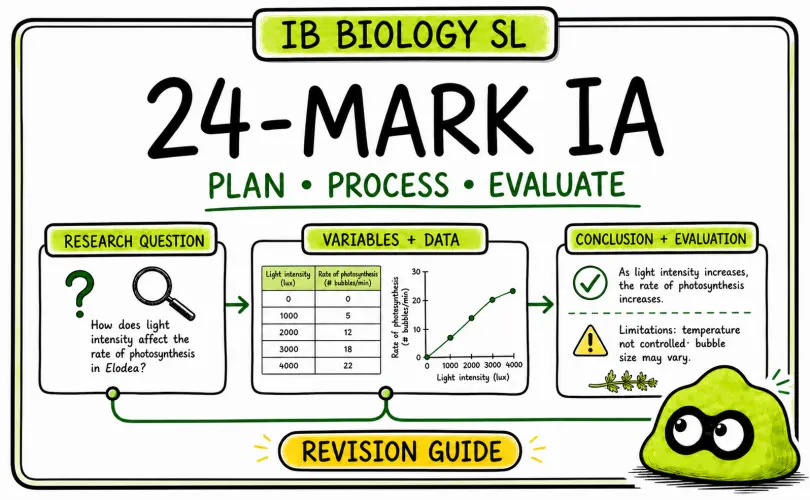
IB Biology Scientific Investigation Guide: How to Build a Strong 24-Mark IA
A practical IB Biology guide to the 24-mark Scientific Investigation: choose a workable research question, control variables, process data, draw a supported conclusion and evaluate limitations with specific improvements.
Active Transport vs Passive Transport | A-Level Biology
Revise A-Level Biology active and passive transport with concentration gradients, ATP, carrier proteins, examples, common mistakes and practice.

Binary Fission Explained | Biology
Learn binary fission with the cell-division sequence, genetically identical daughter cells, examples and key comparisons with mitosis.