Active Transport vs Passive Transport | A-Level Biology
Revise A-Level Biology active and passive transport with concentration gradients, ATP, carrier proteins, examples, common mistakes and practice.
Active transport and passive transport both move substances across cell membranes, but they use energy differently. In CAIE A-Level Biology, passive transport moves substances down a concentration gradient without ATP, while active transport uses ATP and a membrane protein to move substances against a concentration gradient. The direction, energy source and protein involved are the fastest way to compare them in an exam.
Quick Answer
- Passive transport moves particles down a concentration gradient.
- Simple diffusion can occur directly through the phospholipid bilayer.
- Facilitated diffusion uses channel or carrier proteins but no ATP.
- Active transport moves particles against a concentration gradient.
- Active transport requires ATP and a specific carrier protein.
What Is Passive Transport?
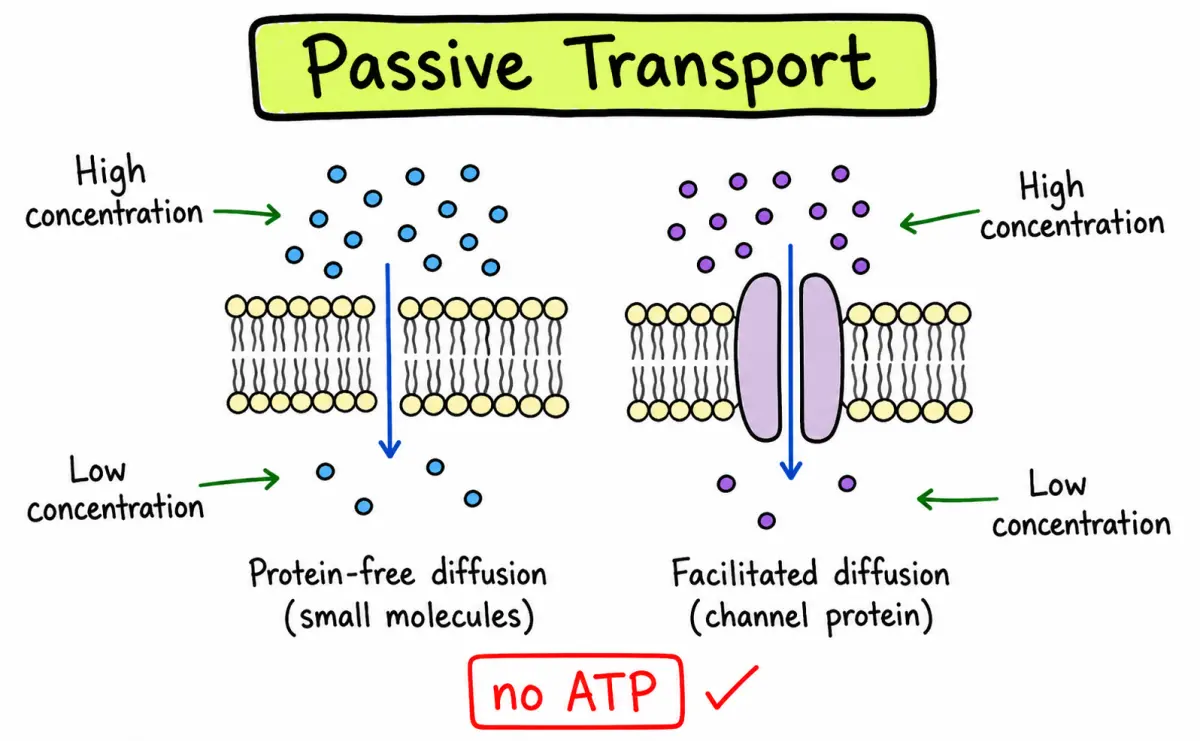
Passive transport is the net movement of particles from a region of higher concentration to a region of lower concentration. The movement is down the concentration gradient, so it does not require energy from ATP.
Small non-polar molecules can pass directly through the phospholipid bilayer. Larger, charged or polar substances may need channel proteins or carrier proteins. This is called facilitated diffusion, but it remains passive because the particles still move down the gradient.
What Is Active Transport?
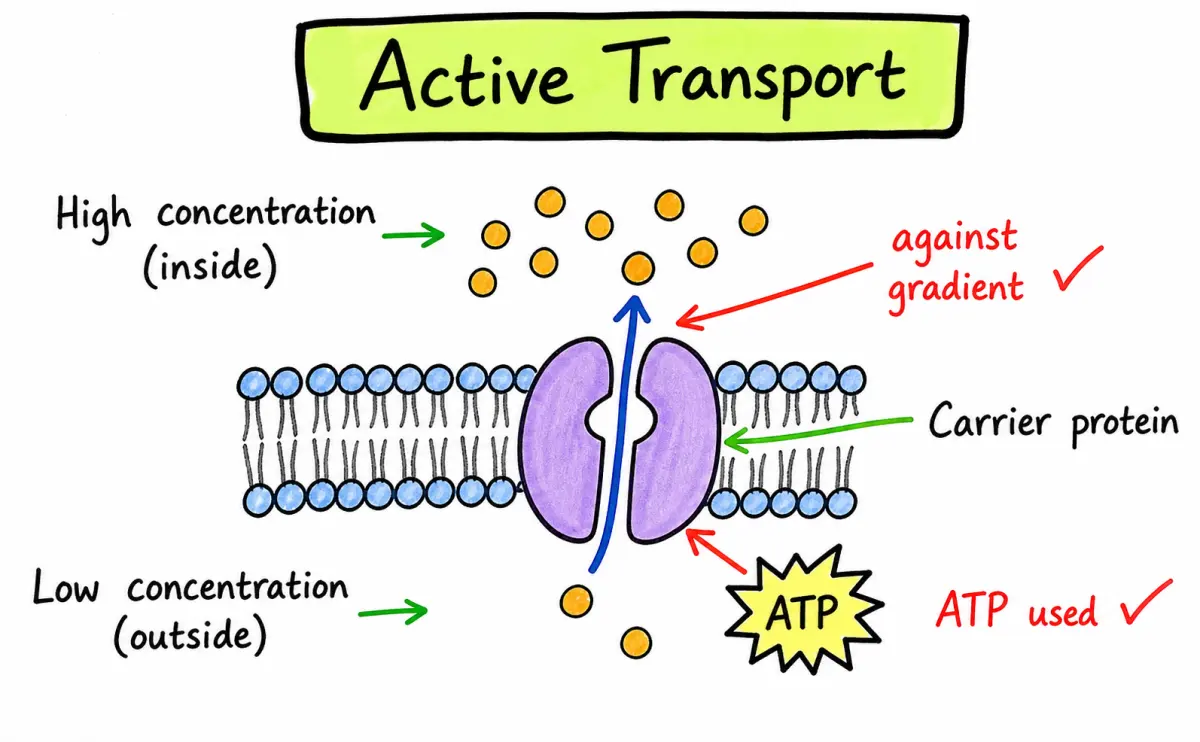
Active transport moves a substance from lower concentration to higher concentration, against the concentration gradient. The process requires ATP from respiration and a specific carrier protein in the cell-surface membrane.
The carrier protein changes shape when ATP is hydrolysed. This allows the substance to be moved across the membrane even when diffusion would move it in the opposite direction.
Active vs Passive Transport
| Feature | Passive transport | Active transport |
|---|---|---|
| Direction | Down the concentration gradient | Against the concentration gradient |
| ATP | Not required | Required |
| Protein | May be absent or may use a channel/carrier | Specific carrier protein required |
| Examples | Diffusion and facilitated diffusion | Mineral ion uptake by root hair cells |
| Main purpose | Move particles towards equilibrium | Accumulate a substance against a gradient |
Do not decide from the word “protein” alone. Facilitated diffusion uses a protein but does not use ATP. The direction and energy requirement must both be stated.
How to Explain the Process in an Exam
For a passive transport question, use this chain:
- There is a concentration difference across the membrane.
- Particles move from high concentration to low concentration.
- The movement is down the concentration gradient.
- No ATP is used.
For an active transport question, use this chain:
- Particles are moved from low concentration to high concentration.
- This is against the concentration gradient.
- ATP from respiration supplies energy.
- A specific carrier protein changes shape to move the particles.
Worked Example
Question: Root hair cells contain a higher concentration of nitrate ions than the surrounding soil. Explain how nitrate ions can still enter the cells.
Answer: Nitrate ions enter by active transport because they move from a lower concentration in the soil to a higher concentration in the root hair cell. ATP from respiration supplies energy, and carrier proteins in the cell-surface membrane transport the nitrate ions.
Factors That Affect Transport
For diffusion, a larger concentration gradient, higher temperature and greater membrane surface area can increase the rate of movement. A thicker membrane increases the distance particles must cross and can reduce the rate.
For active transport, the rate depends on ATP supply, the number of suitable carrier proteins and the concentration of the substance. A respiratory inhibitor can reduce active transport by lowering ATP production.
Common Exam Mistakes
| Mistake | Better wording |
|---|---|
| Saying all transport through a protein is active | Facilitated diffusion uses proteins without ATP |
| Saying active transport moves from high to low concentration | Active transport moves against the gradient, from low to high |
| Forgetting ATP | Link active transport to ATP from respiration |
| Writing “energy is needed” without naming the source | State that ATP hydrolysis provides energy |
| Describing osmosis as active transport | Osmosis is passive movement of water down a water-potential gradient |
Mini Practice
A cell has a lower concentration of potassium ions than the surrounding solution, but potassium ions continue to enter the cell. State the transport method and explain your answer.
Answer guide: The method is active transport because potassium ions move against the concentration gradient. ATP supplies energy and a specific carrier protein transports the ions across the membrane.
Practice This Topic
Try this exam-style question: Compare active transport with facilitated diffusion across a cell-surface membrane.
Answer guide:
- Both may use membrane proteins.
- Facilitated diffusion moves down the concentration gradient and does not use ATP.
- Active transport moves against the concentration gradient.
- Active transport requires ATP and a specific carrier protein.
Practise A-Level Biology membrane transport questions.
FAQ
Does facilitated diffusion require ATP?
No. Facilitated diffusion uses channel or carrier proteins, but particles still move down the concentration gradient and no ATP is required.
Why does active transport need carrier proteins?
Carrier proteins bind specific particles and change shape to move them across the membrane. This allows movement against the concentration gradient when diffusion cannot provide the required direction.
What is the main difference between active and passive transport?
Passive transport moves down a concentration gradient without ATP. Active transport moves against the gradient using ATP and a specific carrier protein.
Related Study Links
- Review the complete syllabus Study Hub
- A-Level Biology cell structure and membrane notes
- A-Level Biology Question Bank
- A-Level Biology cell structure revision guide
- IB Biology membranes and transport
Final Takeaway
Use a three-part comparison in every answer: direction of movement, ATP requirement and protein involvement. That keeps active, simple diffusion and facilitated diffusion distinct.
Put active transport back into your full A-Level CAIE Biology AS study plan.
Return to the complete course overview, or move directly into the most relevant study tool.
Related articles
More course notes, updates and study resources from the EduNinja blog.
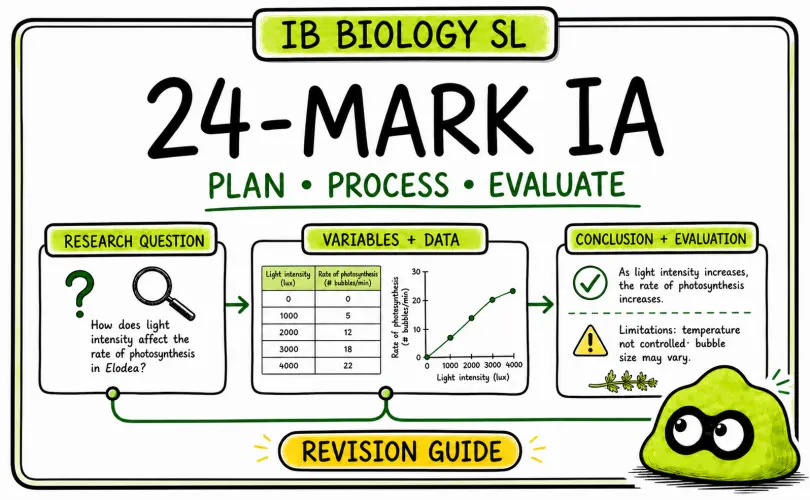
IB Biology Scientific Investigation Guide: How to Build a Strong 24-Mark IA
A practical IB Biology guide to the 24-mark Scientific Investigation: choose a workable research question, control variables, process data, draw a supported conclusion and evaluate limitations with specific improvements.
Abiotic Factors Explained | IB Biology SL
Revise IB Biology SL abiotic factors, tolerance ranges, limiting factors and how environmental variables affect distribution.

Binary Fission Explained | Biology
Learn binary fission with the cell-division sequence, genetically identical daughter cells, examples and key comparisons with mitosis.