IB Biology B2/D2 Cell Biology: Cells, Membranes and Division
Revise IB Biology 2025 B2/D2 cell-level topics with cell theory, membranes, transport, stem cells, endosymbiosis and mitosis.

Cell biology feels like a chapter of definitions until a question asks you to explain why cells stay small, why membranes control movement, or why mitochondria support endosymbiotic theory. The marks are not in naming the topic; they are in connecting structure, function, and evidence.
Current syllabus map: This article is aligned to the IB Biology first assessment 2025 roadmap, especially A2 cell origins and structure, B2.1 membranes and D2.1 cell and nuclear division.
This guide rebuilds Chapter 1 into a source-backed revision route for IB Biology students.
Quick Answer
For IB Biology cell biology revision, focus on these high-yield links:
- cell theory states that living things are made of cells, cells are the smallest unit of life, and cells come from pre-existing cells
- exceptions such as striated muscle, aseptate fungal hyphae, and giant algae show the model has edge cases
- high surface area to volume ratio improves exchange efficiency
- prokaryotes lack a nucleus; eukaryotes are compartmentalised by membrane-bound organelles
- membrane structure explains diffusion, osmosis, facilitated diffusion, active transport, endocytosis, and exocytosis
- stem cells self-renew and differentiate, but therapy questions need benefits and risks
- mitosis supports growth, repair, asexual reproduction, and embryonic development
Use the relevant EduNinja course pages as your base:
Do not open every link at once. Start with the notes or topic page, then move into question practice and use any PDF resource only when it helps clarify the exact idea you are revising.
Core Concept That Gets Marks
Cell biology answers usually need one of three moves:
| Exam move | What to connect |
|---|---|
| Structure to function | organelle, membrane, or cell structure -> what it does |
| Model to exception | cell theory -> example that challenges a simple model |
| Process to evidence | mitosis, endosymbiosis, transport -> what changes or what supports it |
Cell Theory and Its Exceptions
Cell theory has three core statements:
| Part of cell theory | Exam wording |
|---|---|
| Living things are made of cells | cells are the basic structural units of organisms |
| The cell is the smallest unit of life | a cell can carry out the functions of life |
| Cells come from pre-existing cells | new cells arise by division of existing cells |
IB Biology often tests whether you can handle exceptions. Striated muscle fibres are long and multinucleate. Aseptate fungal hyphae have continuous cytoplasm and many nuclei. Giant algae such as Acetabularia are single cells but can be large and complex.
The point is not that cell theory fails. The point is that biological models can be useful while still having edge cases.
Weak Answer vs Mark-Worthy Answer
| Weak answer | Mark-worthy answer |
|---|---|
| Cells are small because diffusion is easier. | Small cells have a higher surface area to volume ratio, giving more membrane area per unit volume and shorter diffusion pathways for exchange. |
| Prokaryotes have no DNA. | Prokaryotes have DNA, but it is not enclosed in a nucleus and is usually found as circular DNA in the cytoplasm. |
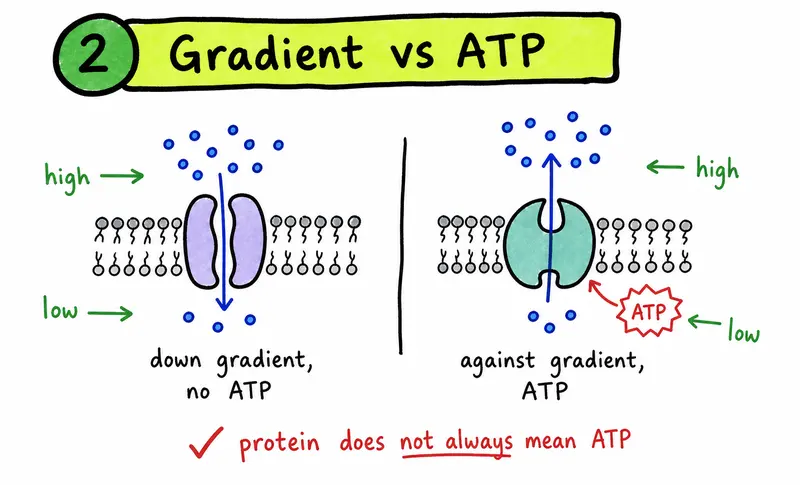
| Facilitated diffusion is active transport because it uses proteins. | Facilitated diffusion uses channel or carrier proteins but moves substances down a concentration gradient without ATP. |
| Mitosis makes cells split. | Mitosis separates copied chromosomes into genetically identical nuclei, followed by cytokinesis dividing the cytoplasm. |
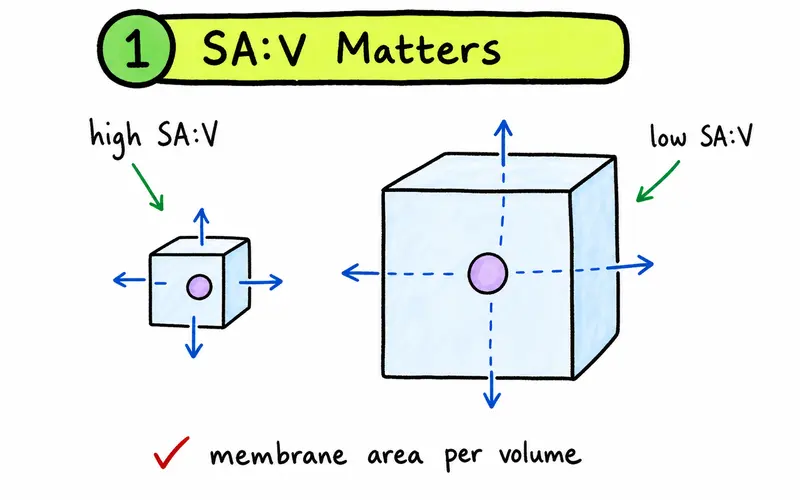
Surface Area to Volume Ratio
Surface area to volume ratio explains why cells remain small and why exchange surfaces are folded or specialised. As a cell gets larger, volume increases faster than surface area. Demand rises faster than exchange capacity.
Useful exam sentence:
A higher surface area to volume ratio increases exchange efficiency because substances cross the membrane over shorter diffusion distances.
Worked Example 1: Why Cells Stay Small
Question: Explain why very large cells can have difficulty exchanging materials efficiently.
Markscheme-style answer: As cell size increases, volume increases faster than surface area. This lowers the surface area to volume ratio, so there is less membrane surface available per unit volume and longer diffusion pathways. Exchange may become too slow to meet the cell's metabolic needs.
Why this scores: It gives the mathematical relationship, the membrane consequence, and the biological consequence.
Functions of Life and Emergent Properties
Unicellular organisms can perform all functions of life independently: metabolism, response, homeostasis, growth, excretion, reproduction, and nutrition. In exam answers, link the function to an example rather than only listing the terms.
Emergent properties arise when smaller parts interact to produce a new property at a higher level of organisation:
atoms -> molecules -> cells -> tissues -> organs -> organ systems -> organism
Stem Cells and Differentiation
Stem cells can self-renew and differentiate. Most body cells contain the same genome, but different genes are active in different specialised cells.
| Potency term | Meaning |
|---|---|
| Totipotent | can form all cell types, including extra-embryonic tissues |
| Pluripotent | can form many body cell types |
| Multipotent | can form a limited range of related cell types |
| Unipotent | can form one cell type |
Therapy questions need balance. Stem cells can replace damaged cells, but answers should also consider source, compatibility, tumour risk, and ethical concerns.
Prokaryotes and Eukaryotes
| Feature | Prokaryote | Eukaryote |
|---|---|---|
| Nucleus | no nucleus | has a nucleus |
| DNA | usually circular DNA in cytoplasm | DNA stored in nucleus as chromosomes |
| Organelles | no membrane-bound organelles | has membrane-bound organelles |
| Division | binary fission | mitosis or meiosis |
| Example | bacteria such as E. coli | animals, plants, fungi, protists |
Avoid writing that prokaryotes have no organelles at all. They have ribosomes, but not membrane-bound organelles.
Organelles and Ultrastructure
| Structure | Mark-worthy function wording |
|---|---|
| Ribosome | site of polypeptide synthesis |
| Nucleus | stores genetic material; nucleolus assembles ribosomes |
| Rough ER | protein transport and processing |
| Smooth ER | lipid-related functions |
| Golgi apparatus | modifies, sorts, stores, and exports products |
| Mitochondrion | site of aerobic respiration |
| Chloroplast | site of photosynthesis |
| Lysosome | hydrolysis of macromolecules |
| Cell wall | support and mechanical strength |
| Vacuole | helps maintain pressure in plant cells |
Resolution is the ability to distinguish two close points. Magnification is how much larger an image appears than the real object:
magnification = image size / actual size
Membrane Structure and Transport
The membrane is based on a phospholipid bilayer. Phospholipids are amphipathic: hydrophilic heads face the aqueous environment, and hydrophobic tails face inward.
| Transport type | Direction | Protein needed? | Energy? |
|---|---|---|---|
| Simple diffusion | down gradient | no | no |
| Osmosis | water down water potential gradient | sometimes aquaporins | no |
| Facilitated diffusion | down gradient | channel or carrier | no |
| Primary active transport | against gradient | pump | ATP |
| Secondary active transport | coupled to another gradient | co-transporter | indirect |
| Endocytosis | into cell by vesicle | membrane remodelling | yes |
| Exocytosis | out of cell by vesicle | membrane remodelling | yes |
Worked Example 2: Facilitated Diffusion vs Active Transport
Question: A student says that any transport using a membrane protein must require ATP. Explain why this is incorrect.
Markscheme-style answer: Facilitated diffusion uses channel or carrier proteins but moves substances down a concentration gradient, so it does not require ATP. Active transport uses protein pumps or co-transporters to move substances against a gradient and requires energy directly or indirectly.
Why this scores: It separates protein use from energy use and mentions the direction of the gradient.
Origin of Cells and Endosymbiosis
Biogenesis states that cells arise from pre-existing cells. Abiogenesis is the idea that early life came from non-living chemical processes before cells existed.
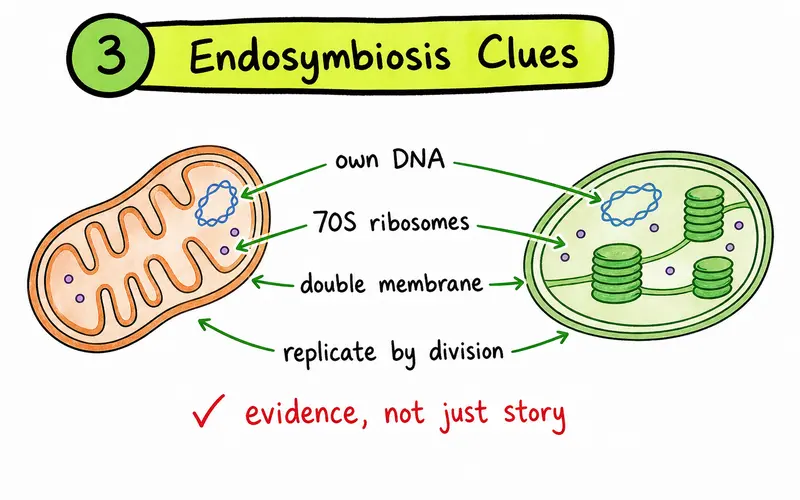
Endosymbiotic theory explains how mitochondria and chloroplasts may have originated from prokaryotes engulfed by early eukaryotic cells. Evidence includes their own DNA, 70S ribosomes, double membranes, bacterial size, antibiotic susceptibility, and replication from pre-existing organelles. To practise this evidence path, use A2.1 origins of cells questions.
Mitosis and the Cell Cycle
Mitosis is used for growth, asexual reproduction in some eukaryotes, tissue repair, and embryonic development.
| Stage | What changes |
|---|---|
| Prophase | chromosomes supercoil and the nuclear membrane breaks down |
| Metaphase | chromosomes line up at the equator |
| Anaphase | sister chromatids separate |
| Telophase | nuclei reform and chromosomes decondense |
| Cytokinesis | cytoplasm divides |
Cyclins and cyclin-dependent kinases help control cell cycle progression. If regulation fails, uncontrolled division can produce tumours.
Question-Type Breakdown
| Question type | What the examiner is testing | First move in your answer | Common trap |
|---|---|---|---|
| Cell theory exception | model plus edge case | state the theory before the exception | saying exceptions disprove the theory |
| SA:V explanation | exchange efficiency | compare surface area and volume | saying "diffusion is faster" without why |
| Organelle function | precise structure-function wording | use function phrases, not one-word labels | "mitochondria make energy" |
| Transport comparison | gradient and ATP | identify direction first | assuming all protein transport uses ATP |
| Endosymbiosis evidence | evidence-based explanation | name DNA/ribosomes/double membrane | giving only a story |
| Mitosis stage | physical chromosome movement | describe what moves or separates | listing PMAT only |
Exam-Ready Mini Checklist
Before moving on, check:
- Did I state cell theory accurately?
- Did I know at least three exceptions and why they matter?
- Did I link SA:V to membrane area and diffusion path length?
- Did I say prokaryotes lack a nucleus, not DNA?
- Did I separate facilitated diffusion from active transport?
- Did I explain endosymbiotic evidence, not just the theory?
- Did I describe what happens during each mitosis stage?
Use A2.2 cell structure questions for targeted practice, then broaden into the IB Biology question bank. Turn repeated transport and mitosis errors into flashcards.
Topic-Specific Revision Route
Use this route when the topic feels too wide:
- Revise cell theory and exceptions before memorising organelles.
- Compare prokaryotic and eukaryotic cells using nucleus, DNA, organelles, and ribosomes.
- Practise membrane transport with diagrams and direction of movement.
- Link mitosis to genetically identical daughter cells and growth or repair.
- Use one mixed question set so the chapter does not split into isolated facts.
Common Mistakes That Cost Marks
- Revising the notes without doing a topic-specific question.
- Writing a correct keyword but not linking it to the evidence in the question.
- Skipping the markscheme after a nearly correct answer.
- Letting one repeated mistake stay vague instead of turning it into a correction rule.
How EduNinja Helps
A clean revision loop is easier when the tools sit in one place. Rebuild the idea in EduNinja Notes, test it in the Questionbank, then turn every missed mark into a flashcard or a follow-up AI Tutor prompt. That keeps the article's method practical: learn the concept, answer a real question, mark it, and fix the exact weakness.
Related Study Links
- Review the full IB Biology SL syllabus
- IB Biology notes
- IB Biology question bank
- A-Level cell structure guide
- molecular biology guide
FAQ
What is the most important part of IB Biology cell biology?
The most important part is connecting structures to functions. IB questions often reward precise links: membrane structure explains transport, surface area to volume ratio explains exchange rate, organelles explain compartmentalisation, and mitosis explains growth and repair.
Why is surface area to volume ratio tested so often?
Surface area to volume ratio links cell size to exchange efficiency. It explains why cells are small, why cells divide, and why exchange surfaces such as villi and alveoli are folded or highly branched.
What is the difference between facilitated diffusion and active transport?
Facilitated diffusion uses membrane proteins but moves substances down a concentration gradient without ATP. Active transport moves substances against a gradient and requires energy directly or indirectly.
What evidence supports endosymbiotic theory?
Mitochondria and chloroplasts have their own DNA, 70S ribosomes, double membranes, bacterial-like size, and replicate from pre-existing organelles. These features support the idea that they originated from engulfed prokaryotes.
How should I revise mitosis for IB Biology?
Revise mitosis as a sequence of physical events, not just PMAT labels. For each stage, know what happens to chromosomes, spindle fibres, nuclear membranes, and the cytoplasm.
Put cell biology back into your full IB Biology SL study plan.
Return to the complete course overview, or move directly into the most relevant study tool.
Related articles
More course notes, updates and study resources from the EduNinja blog.
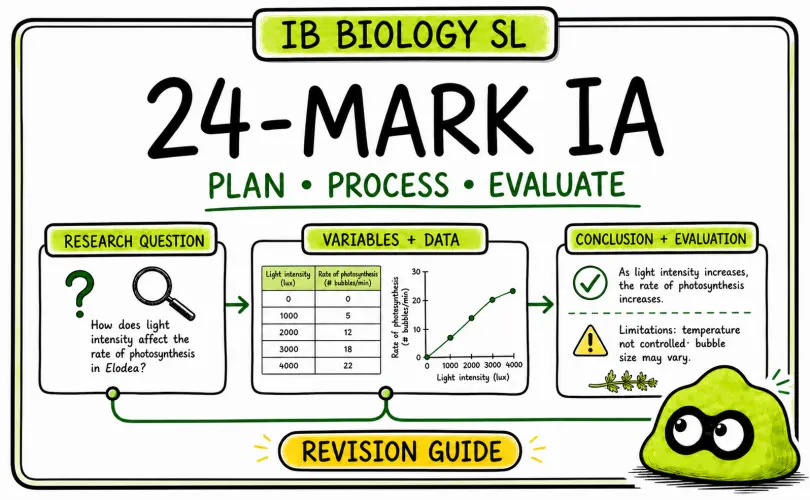
IB Biology Scientific Investigation Guide: How to Build a Strong 24-Mark IA
A practical IB Biology guide to the 24-mark Scientific Investigation: choose a workable research question, control variables, process data, draw a supported conclusion and evaluate limitations with specific improvements.
Abiotic Factors Explained | IB Biology SL
Revise IB Biology SL abiotic factors, tolerance ranges, limiting factors and how environmental variables affect distribution.
Active Transport vs Passive Transport | A-Level Biology
Revise A-Level Biology active and passive transport with concentration gradients, ATP, carrier proteins, examples, common mistakes and practice.