
EduNinja

S2.3 Concluding and evaluating Topic Practice

S2.3 Concluding and evaluating Topic Practice
IB Physics syllabusPhysics SL/HLFirst assessment 2025

Build stronger conclusions and evaluations by linking graph evidence, uncertainty ranges, and stated assumptions to the final physics result.

Exam points

  • use a graph or calculated value to decide if data support a model, citing linearity or origin intercept
  • compare an experimental value with a literature value using overlapping uncertainty ranges to judge accuracy
  • state a specific systematic error or model assumption and link it to an overestimate or underestimate

Question 1(b)

[Maximum number: 1]

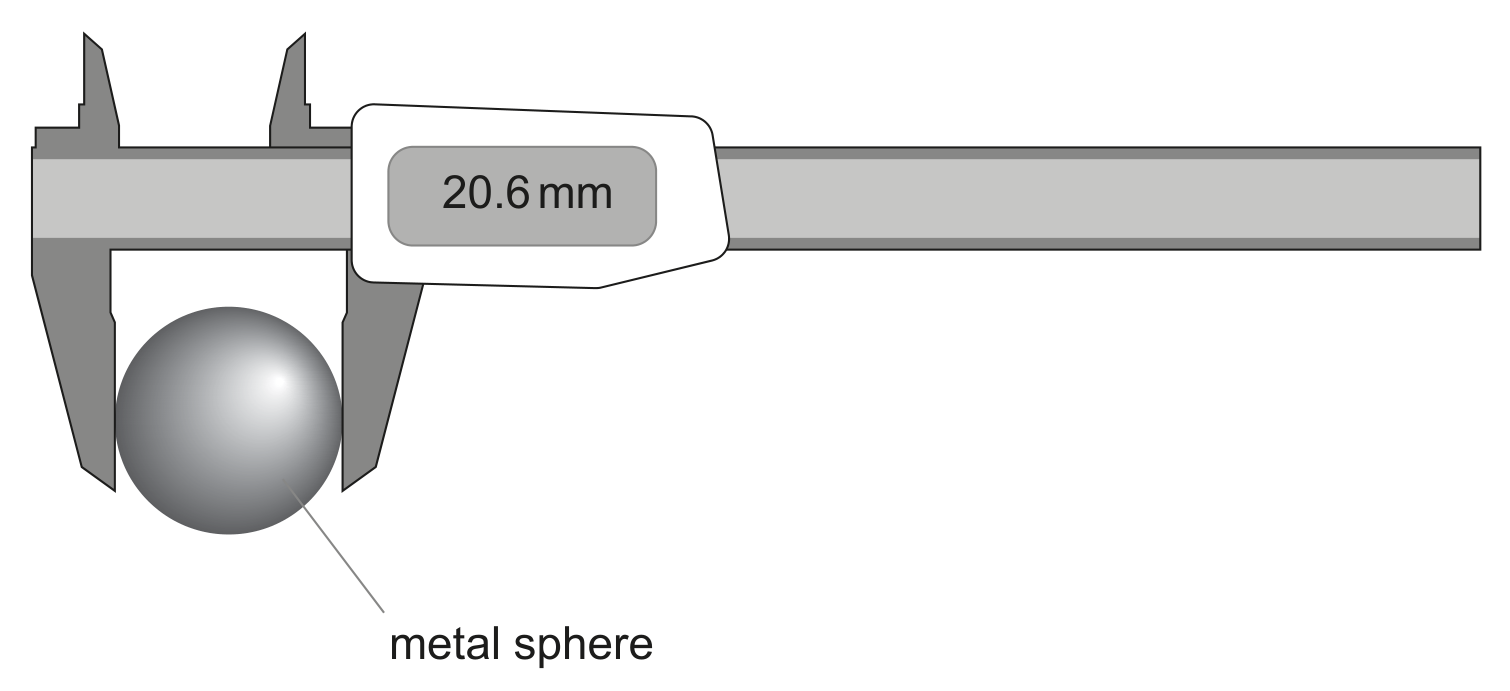
The density of a metal sphere is determined using a digital caliper and a mass balance.

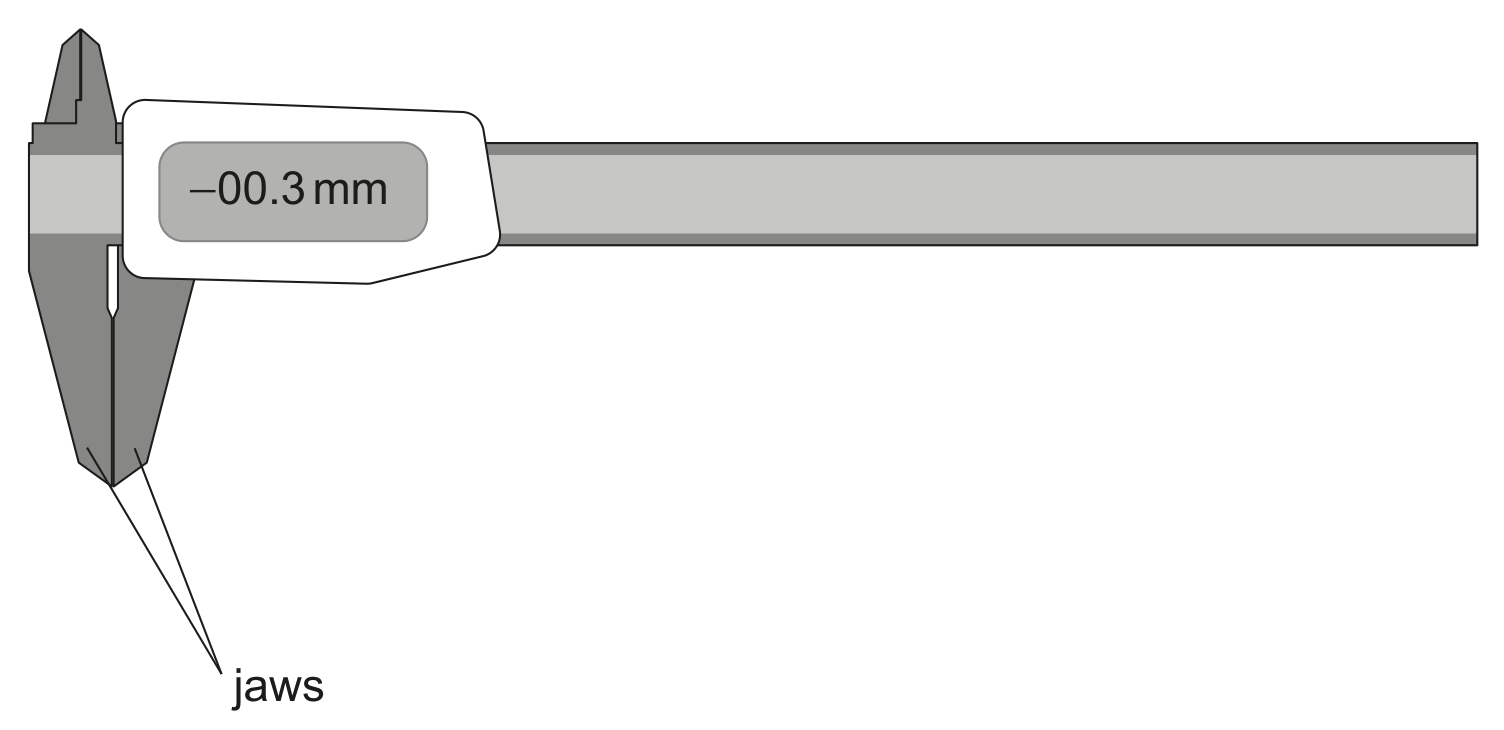
The digital caliper is used to measure the diameter D of the sphere by placing the sphere in the jaws of the digital caliper. This reading is shown.

The sphere is then removed and another reading is taken immediately afterwards with the jaws closed.
Question image
Question image

State one way in which the procedure for the measurement of D can be improved using the same digital caliper.
Question 1(g)

[Maximum number: 1]

A group of students is trying to determine the density and the viscosity of a liquid.

To determine the density, they use a balance to read the mass m of a sphere in air and immersed in the liquid.

They use a sphere of volume V=1.827×10⁷ m3V=1.827 \times 10^{-7} \mathrm{~m}^{3}.
The readings are mair =1.427 gm_{\text {air }}=1.427 \mathrm{~g} in air and mlmmersed =1.208 gm_{\text {lmmersed }}=1.208 \mathrm{~g} in the liquid.
The readings are different due to buoyancy. The buoyancy force FbF_{\mathrm{b}} is given by

Fb=ρVgF_{\mathrm{b}}=\rho V g

where V is the volume of the sphere and ρ\rho is the density of the liquid.

Suggest a conclusion reached by the students.

Question 2(b)

[Maximum number: 2]

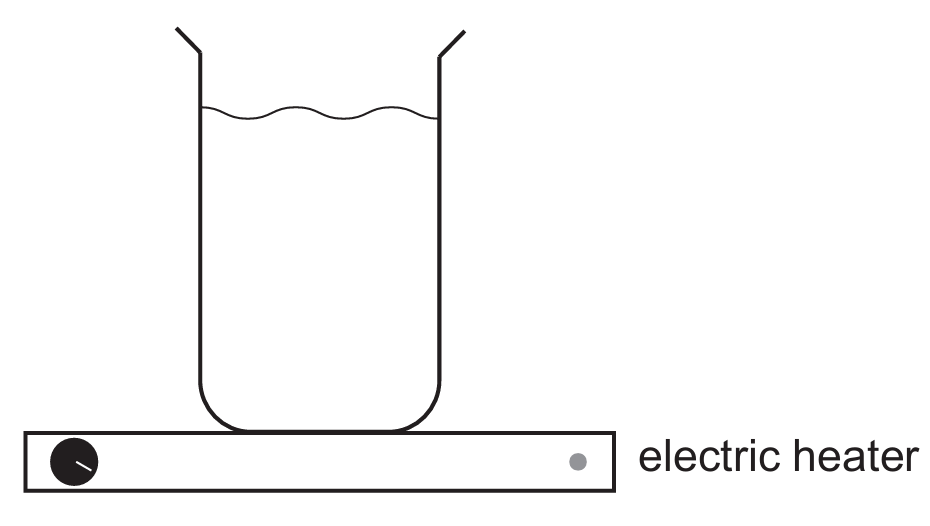
An experiment is conducted to measure the specific heat capacity of water. A mass of water is placed in a glass beaker and energy is transferred from an electric heater.

Question image

The data collected are:

Mass of water =(0.250±0.002)kg=(0.250 \pm 0.002) \mathrm{kg}
Change in temperature of the water =(14.0±0.5)C=(14.0 \pm 0.5)^{\circ} \mathrm{C}
Energy transferred from the electric heater =(16000±300)J=(16000 \pm 300) \mathrm{J}

Outline one source of systematic error in the experiment and its effect on the calculated value of the specific heat capacity of water. provided.

Question 2(b)

[Maximum number: 2]

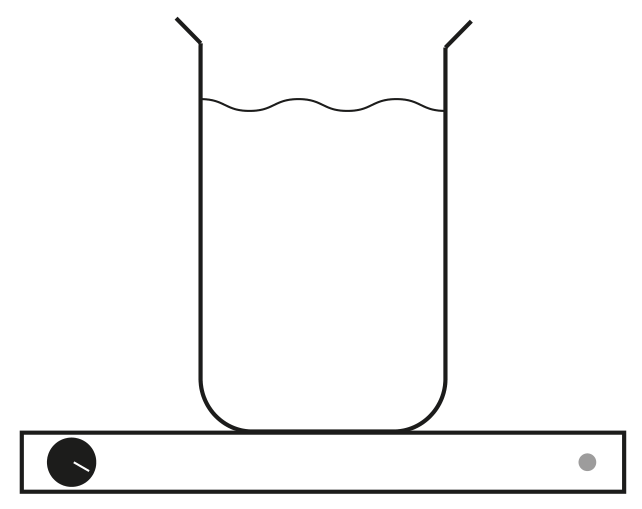
An experiment is conducted to measure the specific heat capacity of water. A mass of water is placed in a glass beaker and energy is transferred from an electric heater.

electric heater

electric heater

The data collected are:

Mass of water =(0.250±0.002)kg=(0.250 \pm 0.002) \mathrm{kg}
Change in temperature of the water =(14.0±0.5)C=(14.0 \pm 0.5)^{\circ} \mathrm{C}
Energy transferred from the electric heater =(16000±300)J=(16000 \pm 300) \mathrm{J}

Outline one source of systematic error in the experiment and its effect on the calculated value of the specific heat capacity of water. provided.

Question 2(d)

[Maximum number: 1]

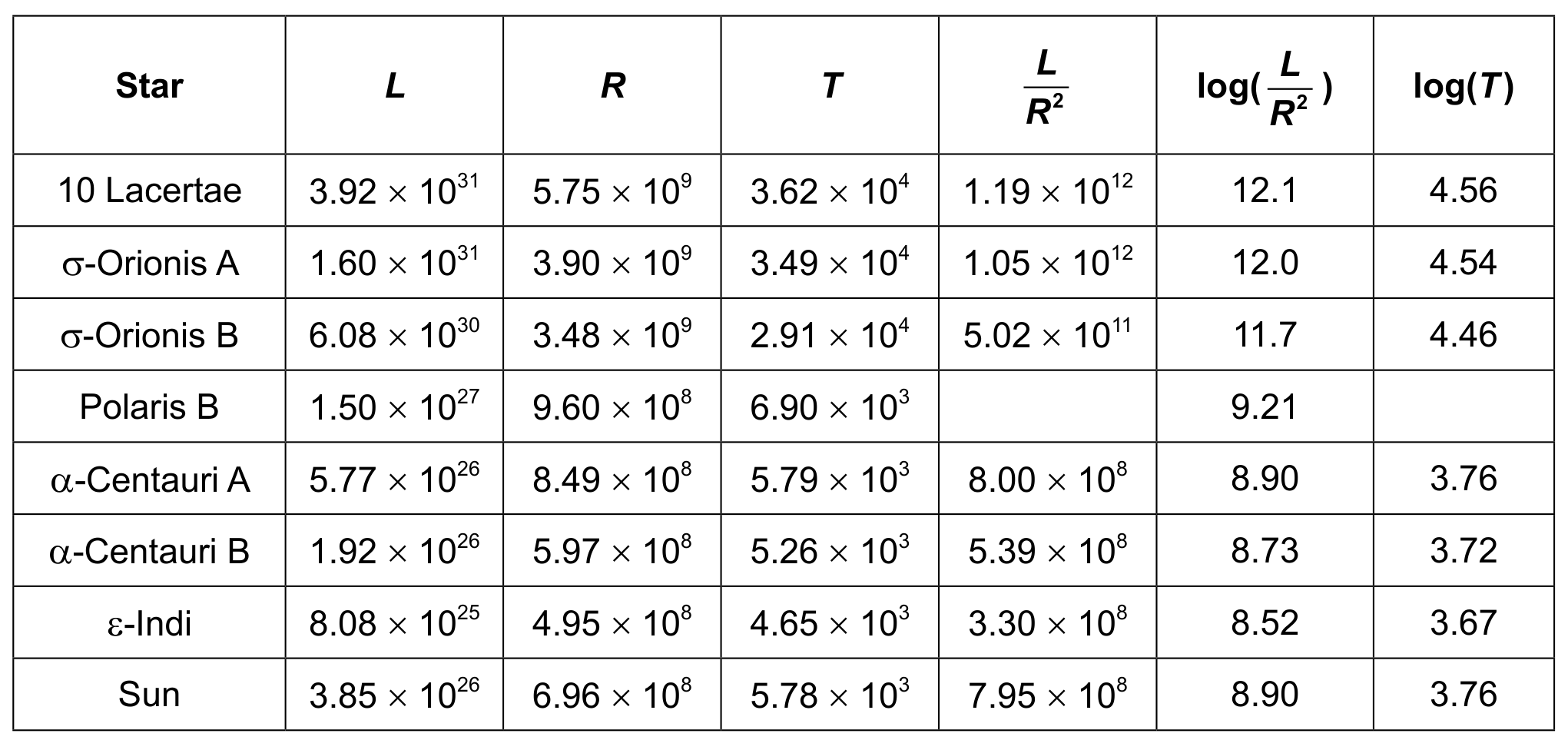
A student investigates whether the Stefan-Boltzmann law, L=4πσR2T4L=4 \pi \sigma R^{2} T^{4}, applies to stars.
L= luminosity of the star, in W
σ=\sigma= Stefan-Boltzmann constant
R= radius of the star, in m
T= surface temperature of the star, in K
To verify the law, they obtain values from databases and manipulate the data as shown.

Table

Outline a conclusion for the investigation.

Question 2(d)

[Maximum number: 1]

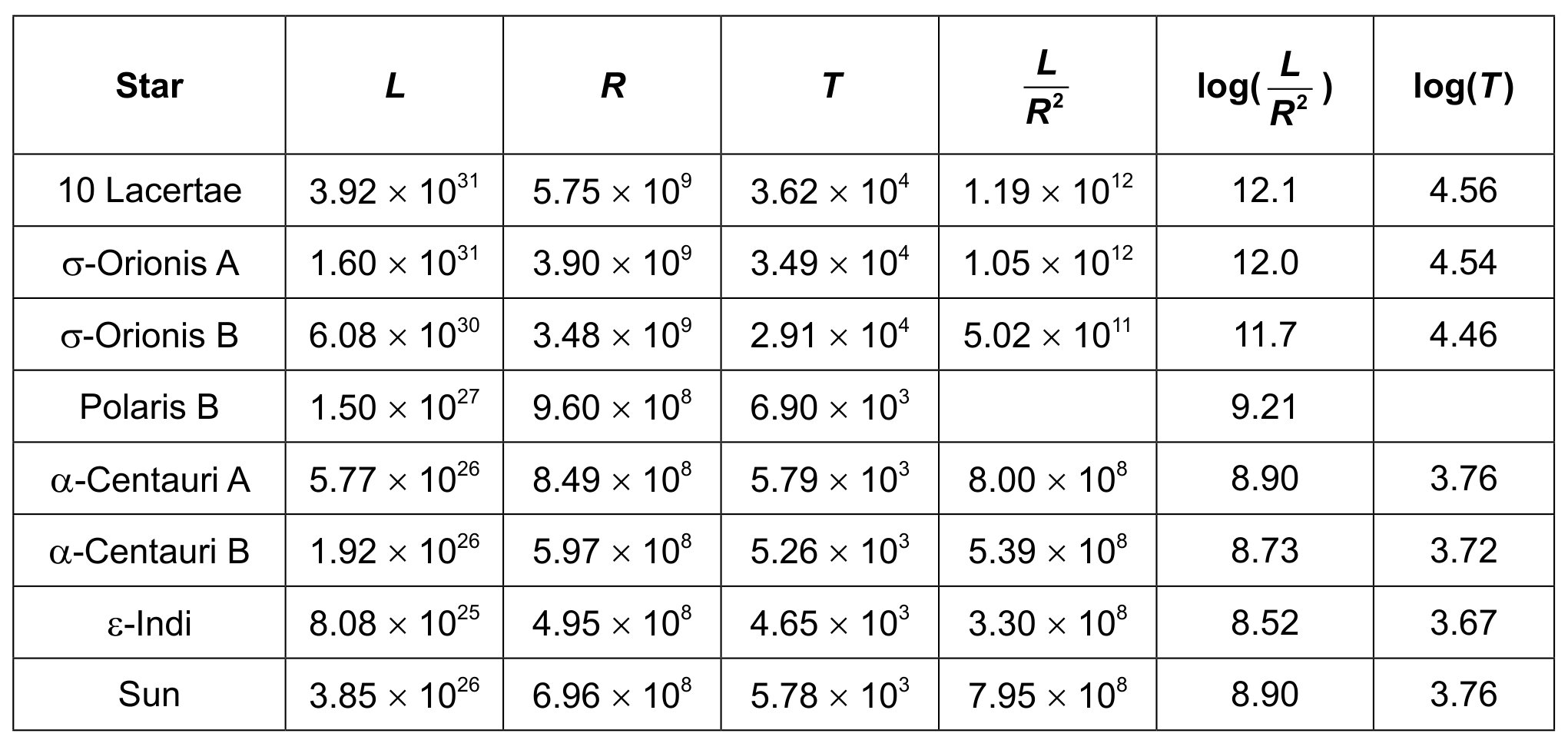
A student investigates whether the Stefan-Boltzmann law, L=4πσR2T4L=4 \pi \sigma R^{2} T^{4}, applies to stars.
L= luminosity of the star, in W
σ=\sigma= Stefan-Boltzmann constant
R= radius of the star, in m
T= surface temperature of the star, in K
To verify the law, they obtain values from databases and manipulate the data as shown.

Table

Outline a conclusion for the investigation.

Question 8(a)(iii)

[Maximum number: 1]

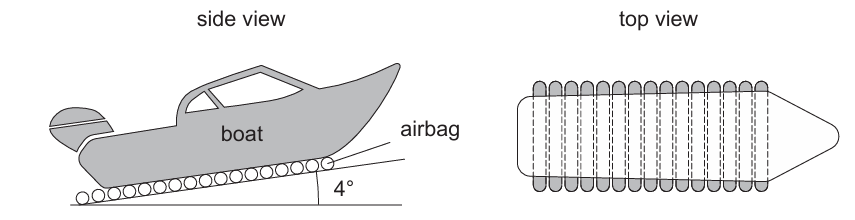
A boat is moved from land to water by rolling it across a set of cylindrical airbags.

Question image

When fully inflated, an unloaded airbag has a diameter of 1.80 m and a length of 24.0 m . At a temperature of 15C15^{\circ} \mathrm{C}, an airbag can hold 4200 mol of gas.

Identify an assumption used in this estimation.

The boat is then released to roll down across the airbags. When the boat loses contact with an airbag at the top of the slope, the airbag expands adiabatically.

0 selected