EduNinja

C.2 Wave model Topic Practice

C.2 Wave model Topic Practice
IB Physics syllabusPhysics SL/HLFirst assessment 2025

Build the wave model by reading graphs, using v = f lambda and linking particle motion, energy transfer and wave type in context.

Exam points

  • extract wavelength or period from a graph, then use v = f lambda to calculate the missing quantity
  • use a wave diagram or statement to distinguish longitudinal from transverse motion in the medium

Question 2(a)(i)

[Maximum number: 2]

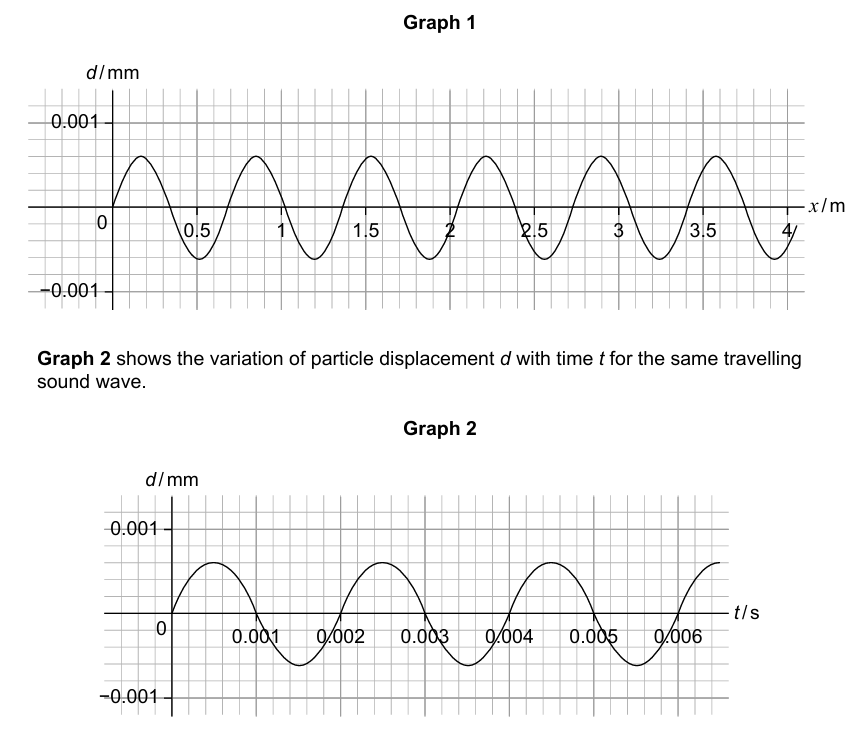
Graph 1 shows the variation of particle displacement d with position x for a travelling sound wave.
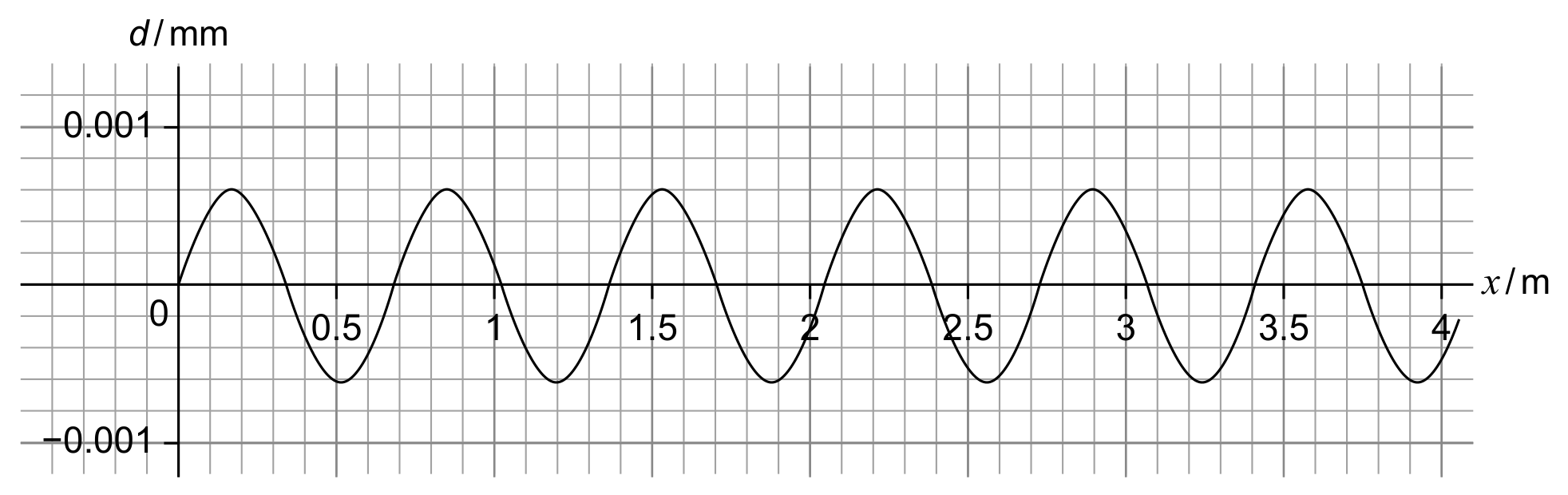
Graph 1

Graph 1

Graph 2 shows the variation of particle displacement d with time t for the same travelling sound wave.
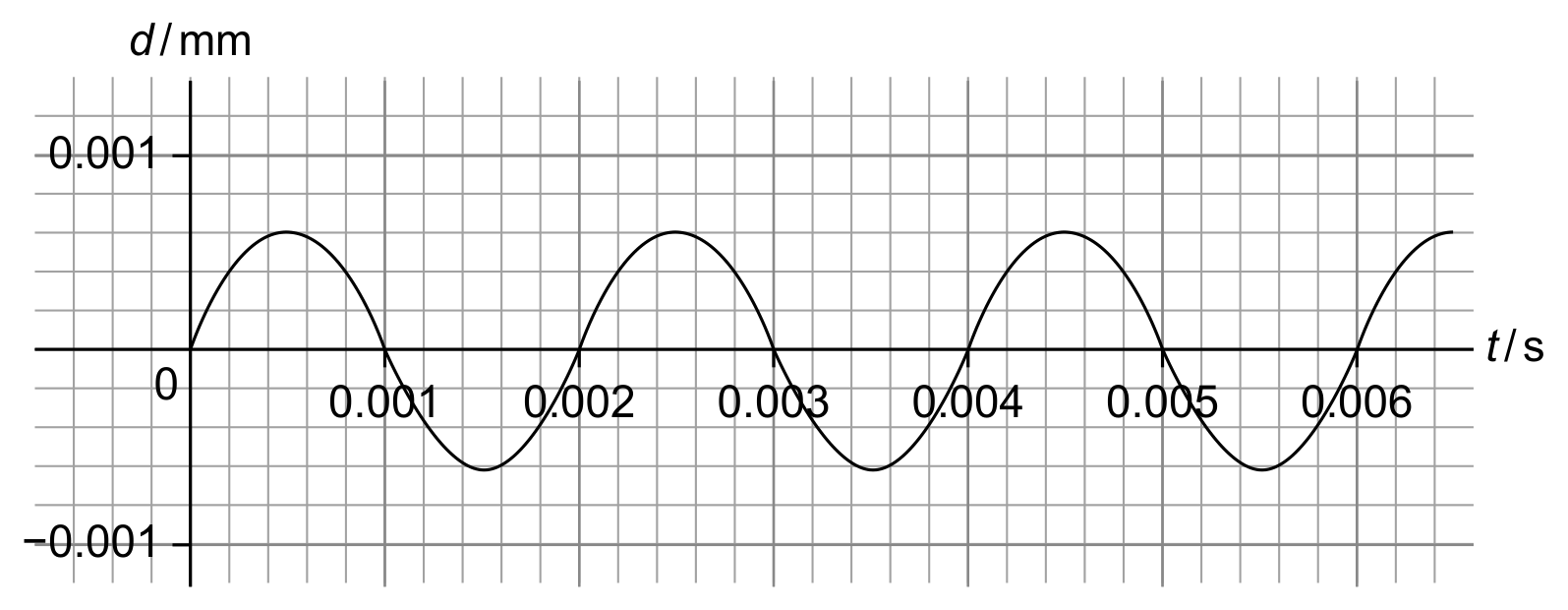
Graph 2

Graph 2

State the wavelength and the period of the sound wave.
Question 14

[Maximum number: 1]

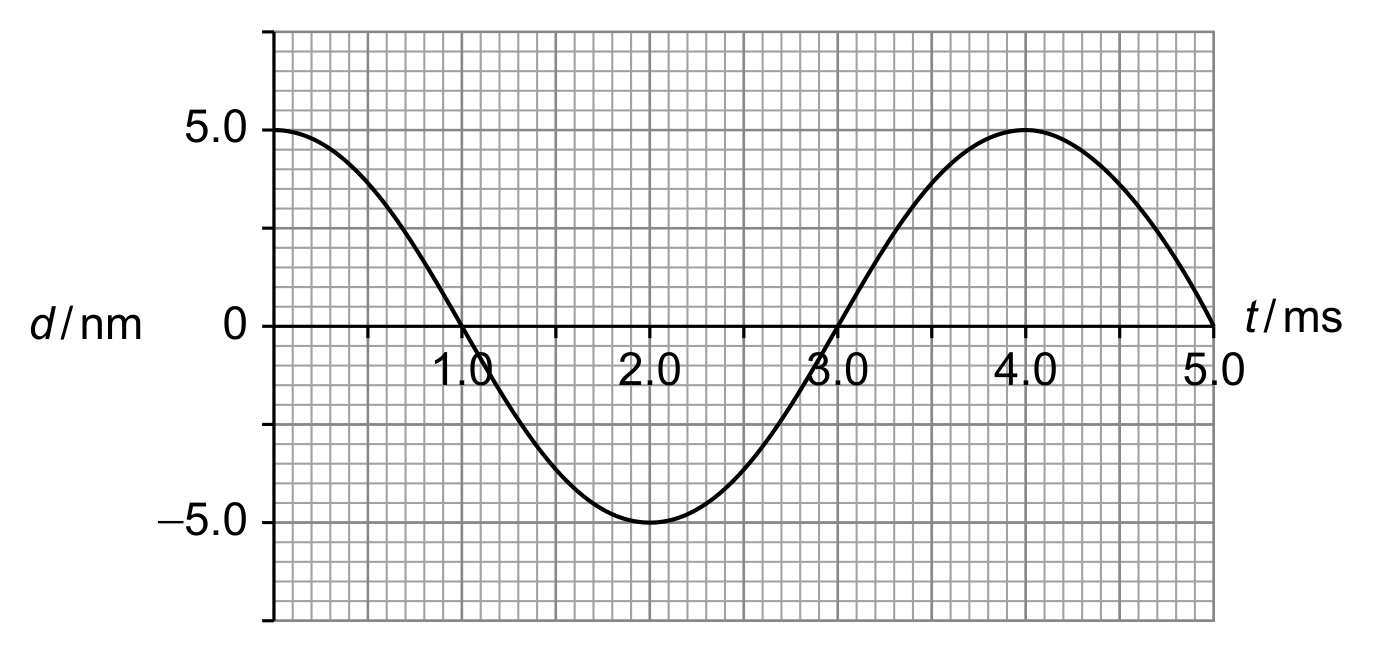
A wave is travelling through a medium. The variation with time t of the displacement d of a particle in the medium is shown.

Question image

What is the frequency and the amplitude of the wave?

Frequency / Hz

Amplitude/nm

4.0×1034.0 \times 10^{-3}

5.0

250

5.0

4.0×1034.0 \times 10^{-3}

10.0

250

10.0

Question 4(b)(i)

[Maximum number: 1]

Calculate the wavelength of the sound wave in air.

Question 4

Question 4(a)

(a)

Identify two differences between sound waves in air and light waves.

[ 2 ]

Question 4(b)

(b)

Graph 1 shows the variation of particle displacement d with position x for a travelling sound wave.

Question image
[ 3 ]

Question 4(b)(i)

(i)

State the wavelength and the period of the sound wave.
[ 2 ]

Question 4(b)(ii)

(ii)

Calculate the speed of the sound wave.

The Doppler effect applies to both sound and light waves.

[ 1 ]

Question 5(b)(i)

[Maximum number: 1]

A sound detector moves along a line connecting it to a stationary loudspeaker.

The loudspeaker emits a sound of frequency 1700 Hz . The speed of sound in air is 340 ms1340 \mathrm{~ms}^{-1}. The detected frequency of the sound is 1600 Hz .

Calculate the wavelength of the sound wave in air.

Question 5(e)(ii)

[Maximum number: 4]

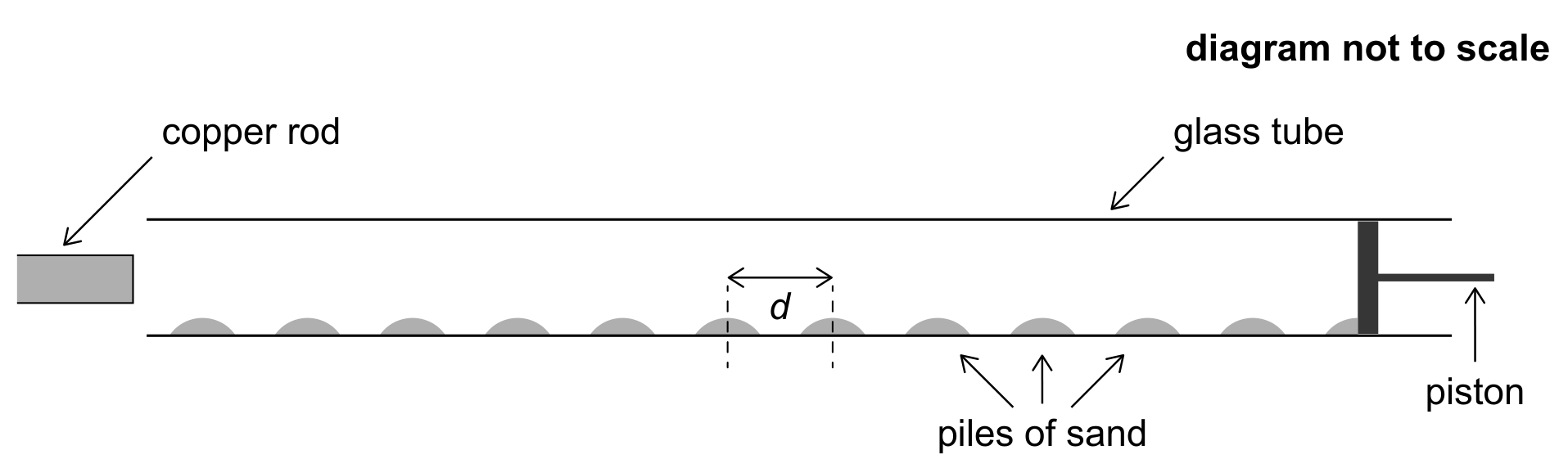
The copper rod is brought close to a glass tube that contains light sand. When the left-hand end of the rod is tapped with a hammer and the length of the tube is adjusted by moving the piston, a standing wave is established in the tube. Sand collects in piles as shown. The distance between the centres of two consecutive piles of sand is d.

Question image

The following data are available:

d=1.8 cm speed of sound in air =330 ms1 length of copper rod =34 cm\begin{aligned} d & =1.8 \mathrm{~cm} \\ \text { speed of sound in air } & =330 \mathrm{~ms}^{-1} \\ \text { length of copper rod } & =34 \mathrm{~cm} \end{aligned}

Determine the speed of sound in copper.

Question 9(e)(ii)

[Maximum number: 4]

The copper rod is brought close to a glass tube that contains light sand. When the left-hand end of the rod is tapped with a hammer and the length of the tube is adjusted by moving the piston, a standing wave is established in the tube. Sand collects in piles as shown. The distance between the centres of two consecutive piles of sand is d.

Question image

The following data are available:

d=1.8 cm speed of sound in air =330 ms1 length of copper rod =34 cm\begin{aligned} d & =1.8 \mathrm{~cm} \\ \text { speed of sound in air } & =330 \mathrm{~ms}^{-1} \\ \text { length of copper rod } & =34 \mathrm{~cm} \end{aligned}

Determine the speed of sound in copper.

0 selected