
EduNinja

A.3 Work, energy and power Topic Practice

A.3 Work, energy and power Topic Practice
IB Physics syllabusPhysics SL/HLFirst assessment 2025

Practise work, energy, and power by calculating transfers, reading diagrams, and checking whether energy conservation fits the model used.

Exam points

  • use W = Fs, ΔEk, or ΔEp with correct units to calculate an energy change or work done
  • read a Sankey diagram or energy table to calculate efficiency and identify the main loss pathway
  • use P = ΔE/Δt or P = Fv to find power, keeping unit conversions consistent throughout

Question 2(d)

[Maximum number: 3]

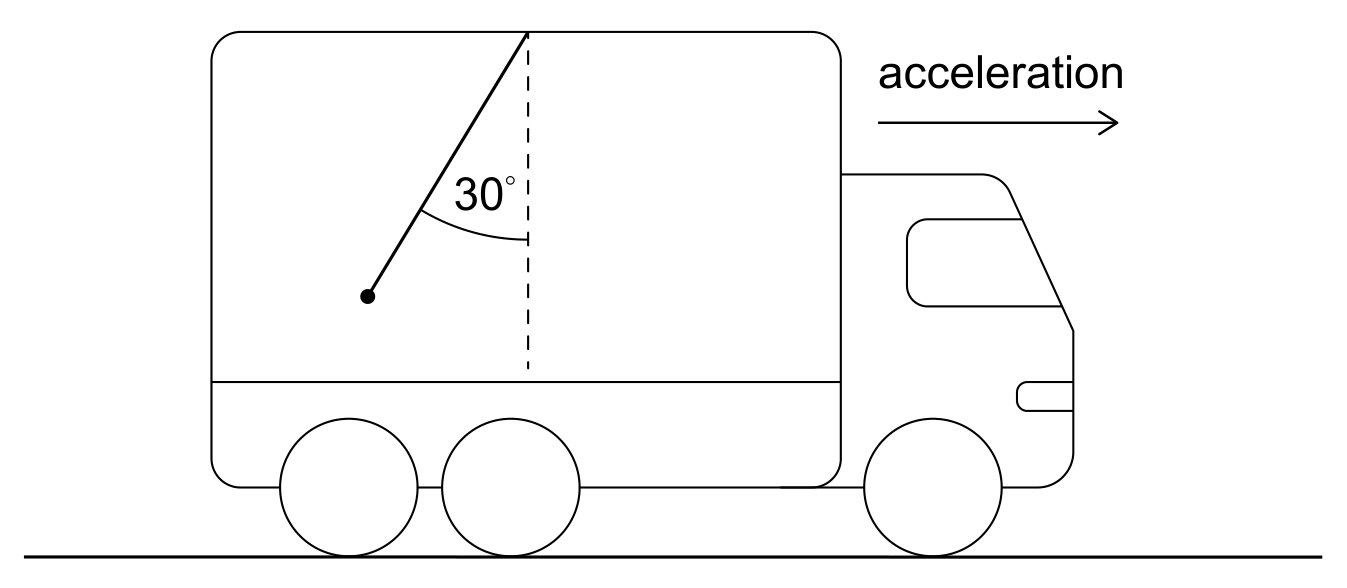
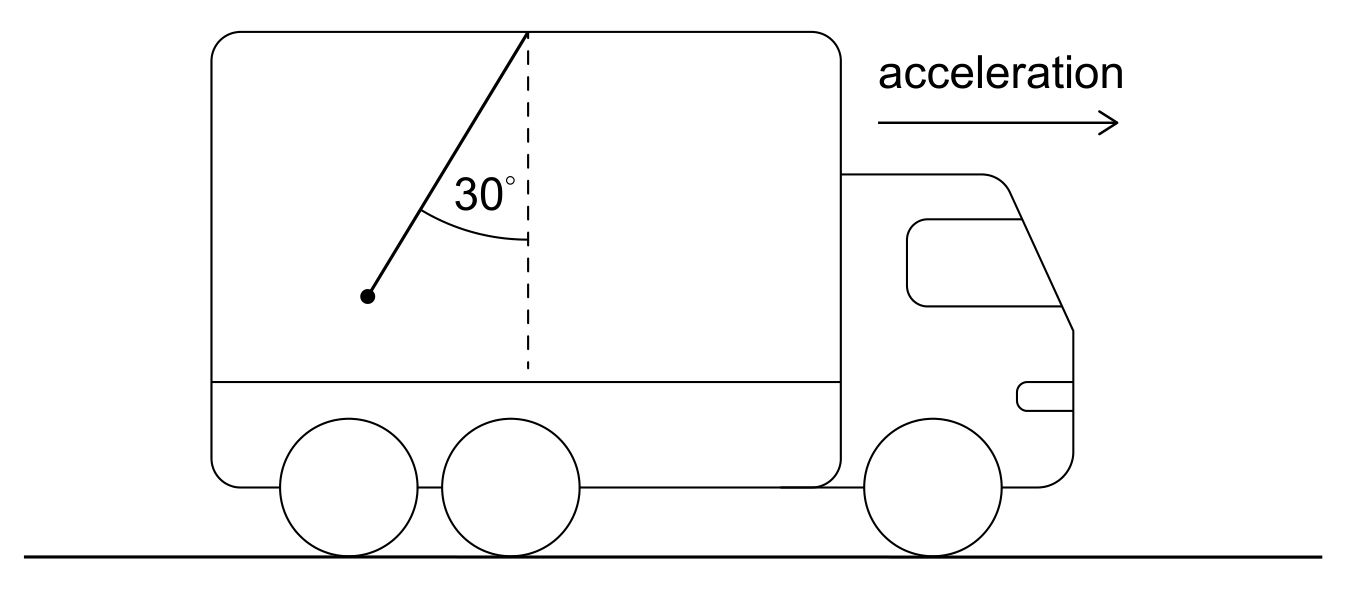
A ball is connected to a string that is attached to the ceiling of a truck. The truck accelerates to the right on a horizontal road. The string makes an angle of 3030^{\circ} with the vertical.

Question image

The truck runs out of fuel just as it enters the semicircle with speed 15 m s115 \mathrm{~m} \mathrm{~s}^{-1}. The resultant force opposing the motion has magnitude 520 N . The mass of the truck is 1400 kg . A service station is at the other end of the semicircle.

Determine whether the truck will be able to reach the service station.
Question 2(d)

[Maximum number: 3]

A ball is connected to a string that is attached to the ceiling of a truck. The truck accelerates to the right on a horizontal road. The string makes an angle of 3030^{\circ} with the vertical.

Question image

The truck runs out of fuel just as it enters the semicircle with speed 15 ms115 \mathrm{~ms}^{-1}. The resultant force opposing the motion has magnitude 520 N . The mass of the truck is 1400 kg . A service station is at the other end of the semicircle.

Determine whether the truck will be able to reach the service station.
Question 5

[Maximum number: 1]

0.25 J\quad 0.25 \mathrm{~J} of work is done to compress a spring by a distance of 0.10 m from its unstretched length. What is the spring constant?

A

2.5Nm12.5 \mathrm{Nm}^{-1}

B

5.0Nm15.0 \mathrm{Nm}^{-1}

C

25Nm125 \mathrm{Nm}^{-1}

D

50Nm150 \mathrm{Nm}^{-1}

Question 5

[Maximum number: 1]

A pump has efficiency η\eta when raising water from a well of depth d. The mass of water raised per second is R. Changes in kinetic energy of the water are considered negligible.

What is the input power to the pump required to raise the water?

A

Rdηg\frac{R d}{\eta g}

B

ηRgd\frac{\eta R}{g d}

C

ηRgd\eta R g d

D

Rdgη\frac{R d g}{\eta}

Question 6

[Maximum number: 1]

An electric motor of efficiency 75 % raises a mass of 120 kg at a constant speed of 0.50 ms10.50 \mathrm{~ms}^{-1}. What is the power input to the motor?

A

20 W

B

450 W

C

600 W

D

800 W

Question 6

[Maximum number: 1]

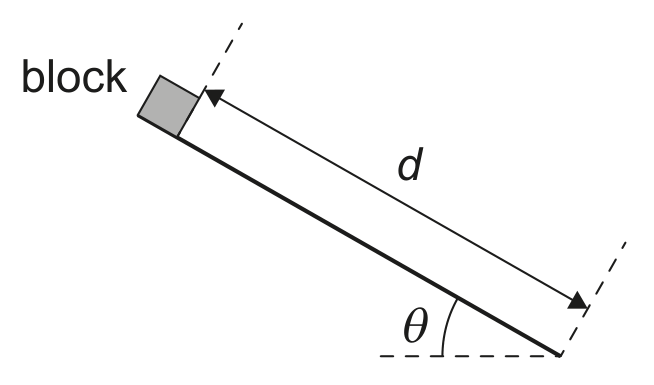
A block of mass m is released from rest and slides down a ramp of length d that makes an angle θ\theta with the horizontal. A constant frictional force F acts on the block.

Question image

What is the kinetic energy of the block at the bottom of the ramp?

A

mgdFdcosθm g d-F d \cos \theta

B

m g d-F d

C

mgdsinθFdcosθm g d \sin \theta-F d \cos \theta

D

mgdsinθFdm g d \sin \theta-F d

Question 9

[Maximum number: 6]

A bar magnet of mass 0.12 kg is suspended from a vertical spring of spring constant 7.4Nm17.4 \mathrm{Nm}^{-1}. The mass of the spring is negligible.

Question 9(a)

(a)

For the magnet in the equilibrium position, calculate the elastic potential energy stored in the spring.

[ 2 ]

Question 9(b)

(b)

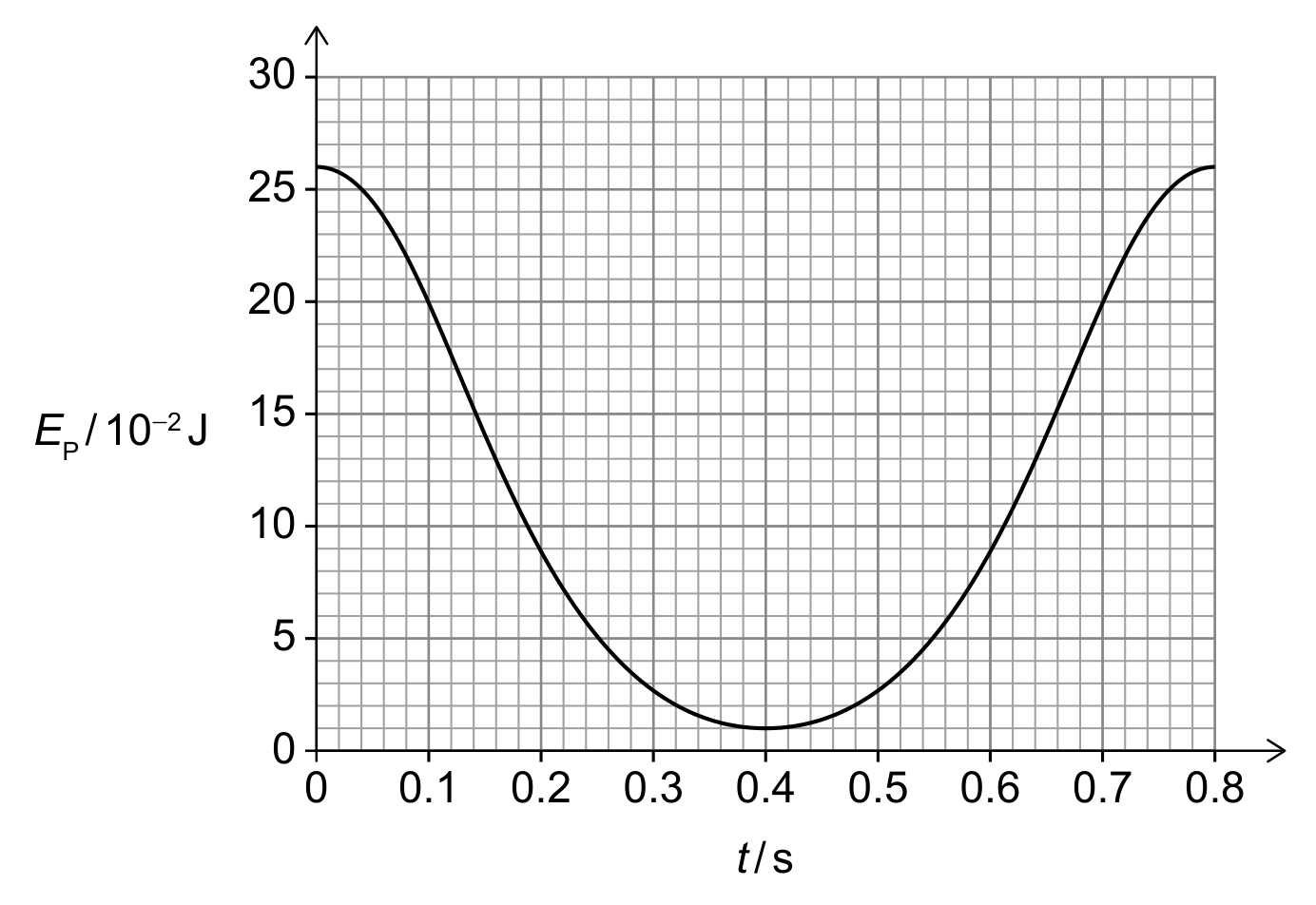
The magnet-spring system performs simple harmonic motion in the vertical direction. The spring remains stretched all the time. The diagram shows how the elastic potential energy EpE_{p} stored in the spring varies with time t during one period of oscillation.

Question image
[ 4 ]

Question 9(b)(i)

(i)

State and explain the direction of motion of the magnet at t=0.2 st=0.2 \mathrm{~s}.

[ 2 ]

Question 9(b)(ii)

(ii)

Describe the energy transfers that take place between t=0.2 st=0.2 \mathrm{~s} and t=0.4 st=0.4 \mathrm{~s}.

[ 2 ]
0 selected