
Question 16
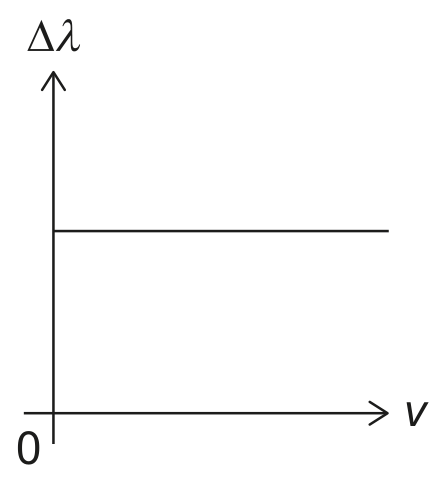
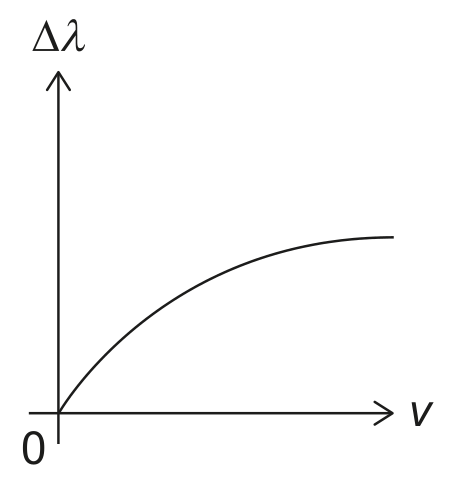
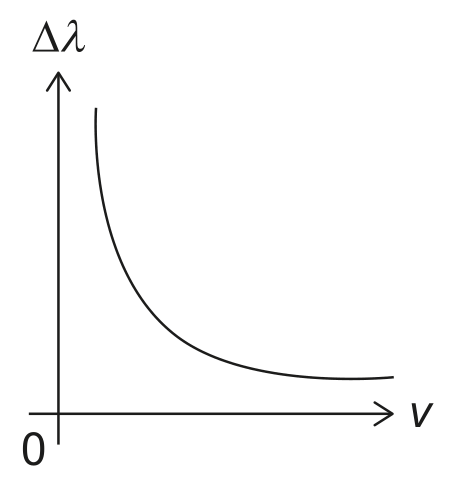
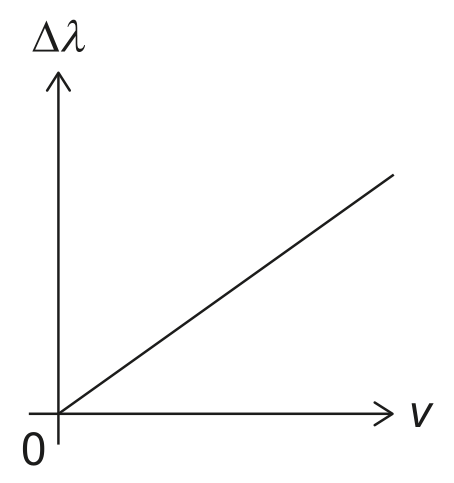
A source moving with speed v away from a stationary observer emits light of wavelength . The wavelength received by the observer is . The speed v is much less than the speed of light.
Which graph gives the variation of with v ?


Practise Doppler effect questions by reading wavefront or spectrum evidence and calculating speed from frequency or wavelength shifts.
A source moving with speed v away from a stationary observer emits light of wavelength λ. The wavelength received by the observer is λ+Δλ. The speed v is much less than the speed of light.
Which graph gives the variation of Δλ with v ?


Explain the Doppler effect.
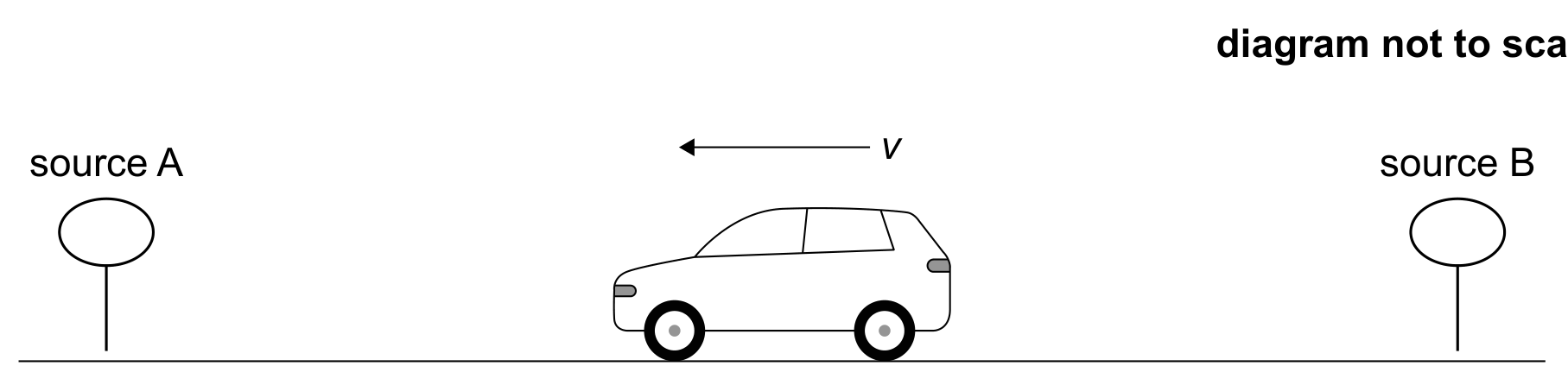
A car is moving at constant velocity v between two sources of sound as shown in the diagram. The sources emit sound at 440 Hz and at 540 Hz . The driver hears both sounds at the same frequency. The speed of sound is 340 ms−1.

Determine v.
The spectrum of light received from a galaxy shows a peak at a wavelength of 659.0 nm . The peak corresponds to an atomic transition in the hydrogen atom that emits a wavelength of 656.1 nm when observed in a laboratory on Earth.
Calculate the velocity of the galaxy with respect to Earth.
A sound detector moves along a line connecting it to a stationary loudspeaker.
The loudspeaker emits a sound of frequency 1700 Hz . The speed of sound in air is 340 ms−1. The detected frequency of the sound is 1600 Hz .
State the direction of motion of the detector.
Calculate the speed of the detector.
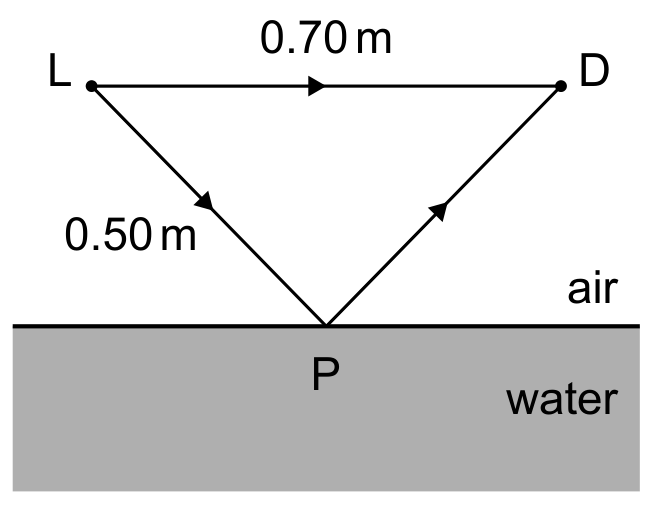
The loudspeaker and the detector are now stationary and above a surface of water. The loudspeaker is at point L and the detector is at point D. L and D are at the same height above the surface of the water. The sound reaches D by two routes: along the direct path LD and the reflection-path LPD.

The following data are given:
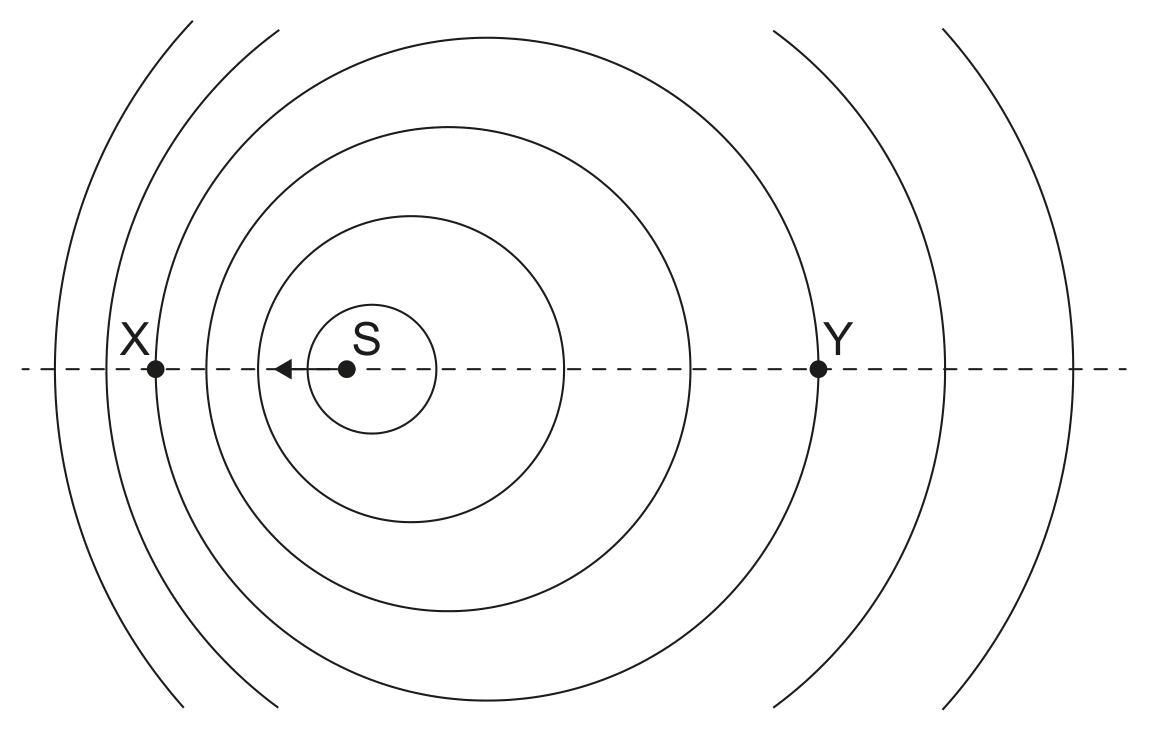
A source S of a sound wave is moving at a constant velocity along a line joining stationary observers X and Y . The diagram shows consecutive wavefronts of the sound.

Consider the following statements:
I. More wavefronts pass X in a unit time than Y .
II. The speed of the wavefronts is greater at X than at Y .
III. The wavelength of the sound at X is less than the wavelength at Y .
Which statements are correct?
I and II only
I and III only
II and III only
I, II and III
The following data are available for the Sun when it entered the main sequence.
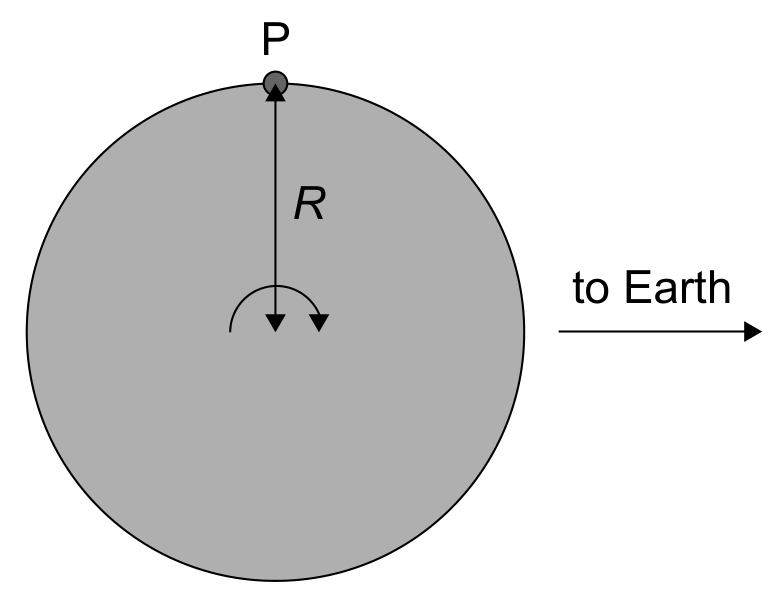
The Sun rotates about its axis. P is a point on the Sun's equator.

A particular spectral line of hydrogen from a laboratory source has wavelength 656.2797 nm . The same spectral line emitted from P has wavelength 656.2753 nm when measured on Earth.
Explain this observation.
Calculate the period of revolution of the Sun.
Star A is a main sequence star.
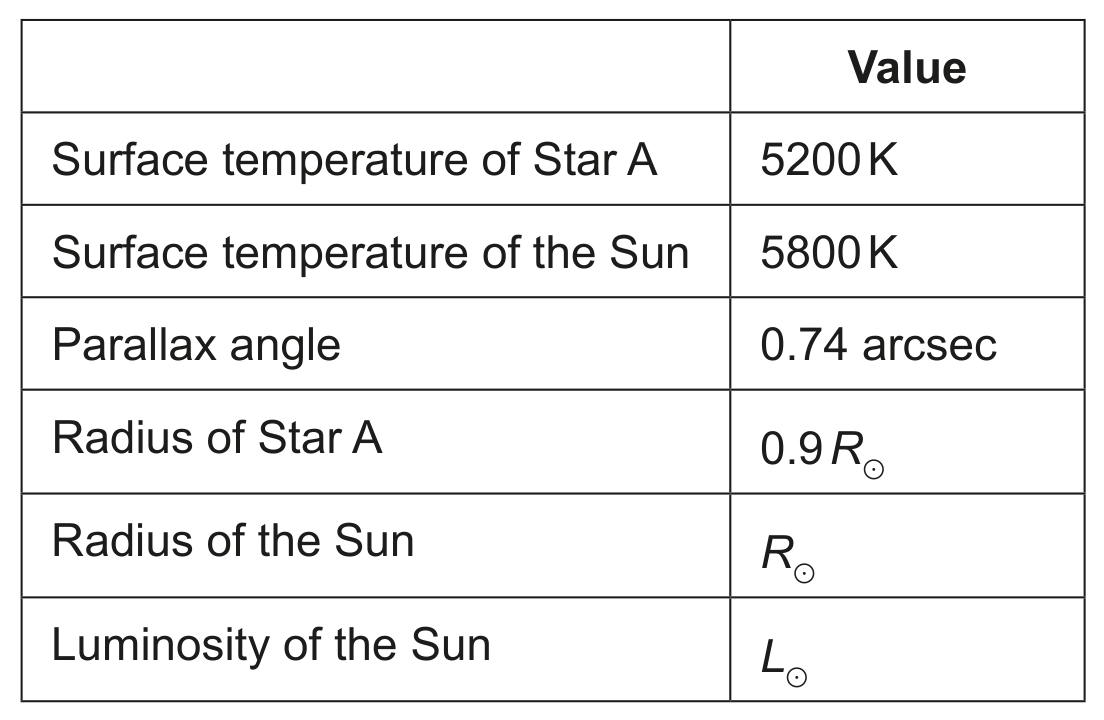
The data for Star A and the Sun are given in a table.

The peak wavelength of the radiation from Star A is measured by an observer on Earth. The observed wavelength is 0.007 % less than the value in (c)(i).
Outline how this difference arises.
Determine the speed, in kms−1, of Star A relative to Earth.
Star A is a main sequence star.
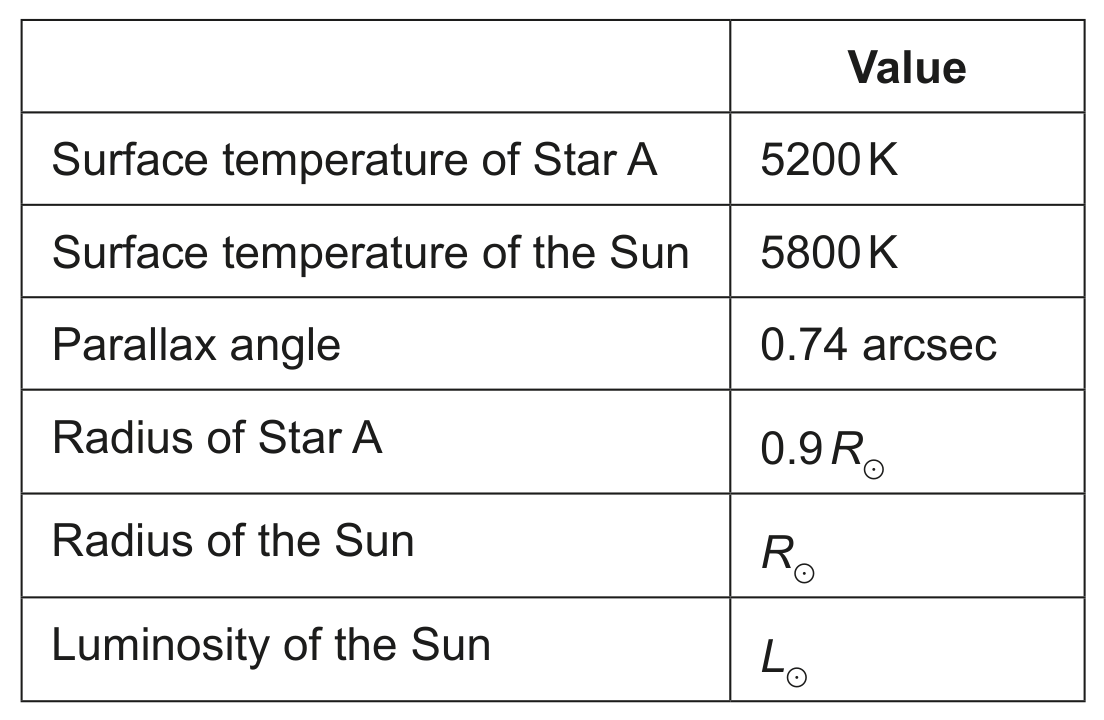
The data for Star A and the Sun are given in a table.

The peak wavelength of the radiation from Star A is measured by an observer on Earth. The observed wavelength is 0.007 % less than the value in (c)(i).
Outline how this difference arises.
Determine the speed, in kms−1, of Star A relative to Earth.