
EduNinja

D.3 Motion in electromagnetic fields Topic Practice

D.3 Motion in electromagnetic fields Topic Practice
IB Physics syllabusPhysics SL/HLFirst assessment 2025

Practise using electric and magnetic field equations and diagrams to predict charge paths, wire forces and circular motion quantities.

Exam points

  • use qE, qvB or mv^2/r with a field diagram to calculate force, radius, acceleration or field strength
  • use a page-based field or circuit diagram to decide force direction, curvature and particle sign
  • apply F = BIL or force per unit length to a wire diagram, then decide attraction, repulsion or motion

Question 3

Question 3(b)

(a)

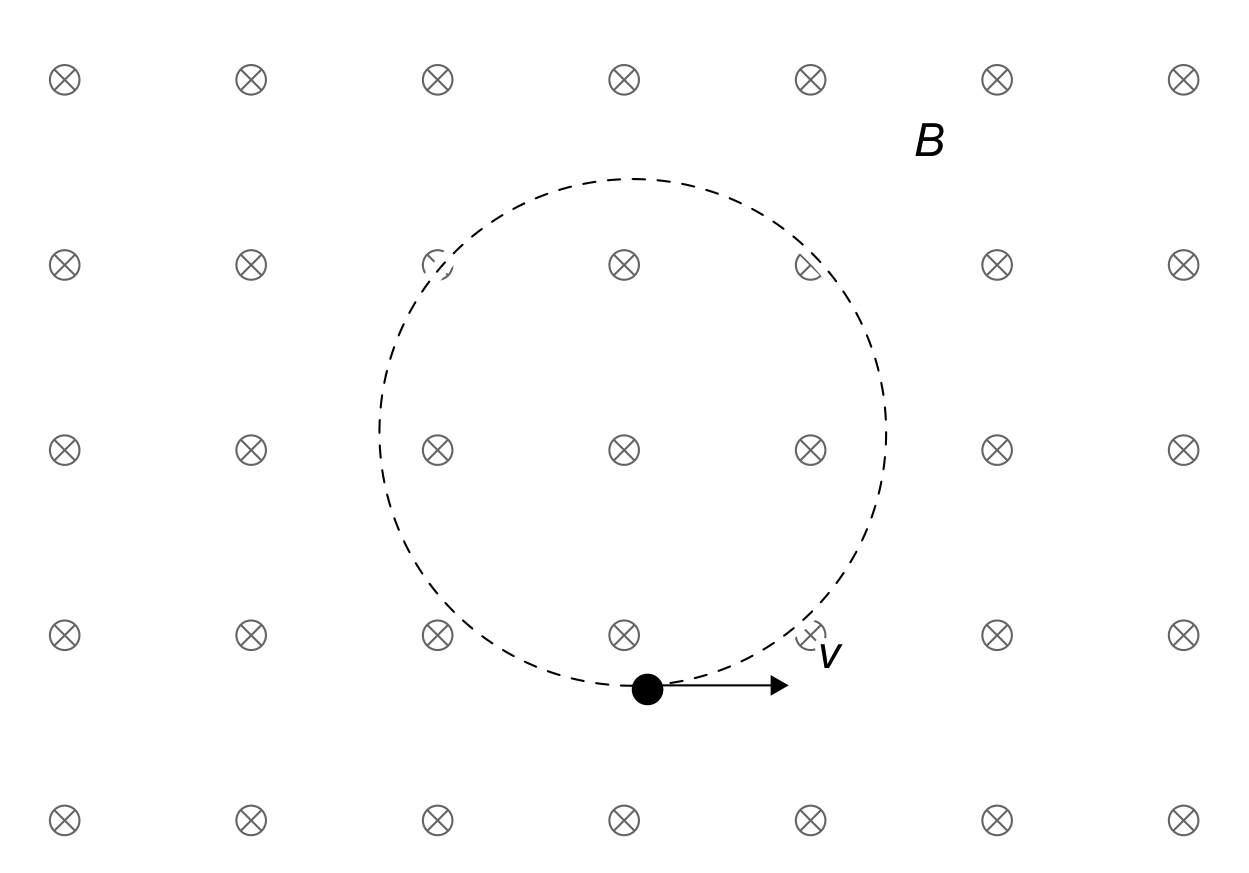
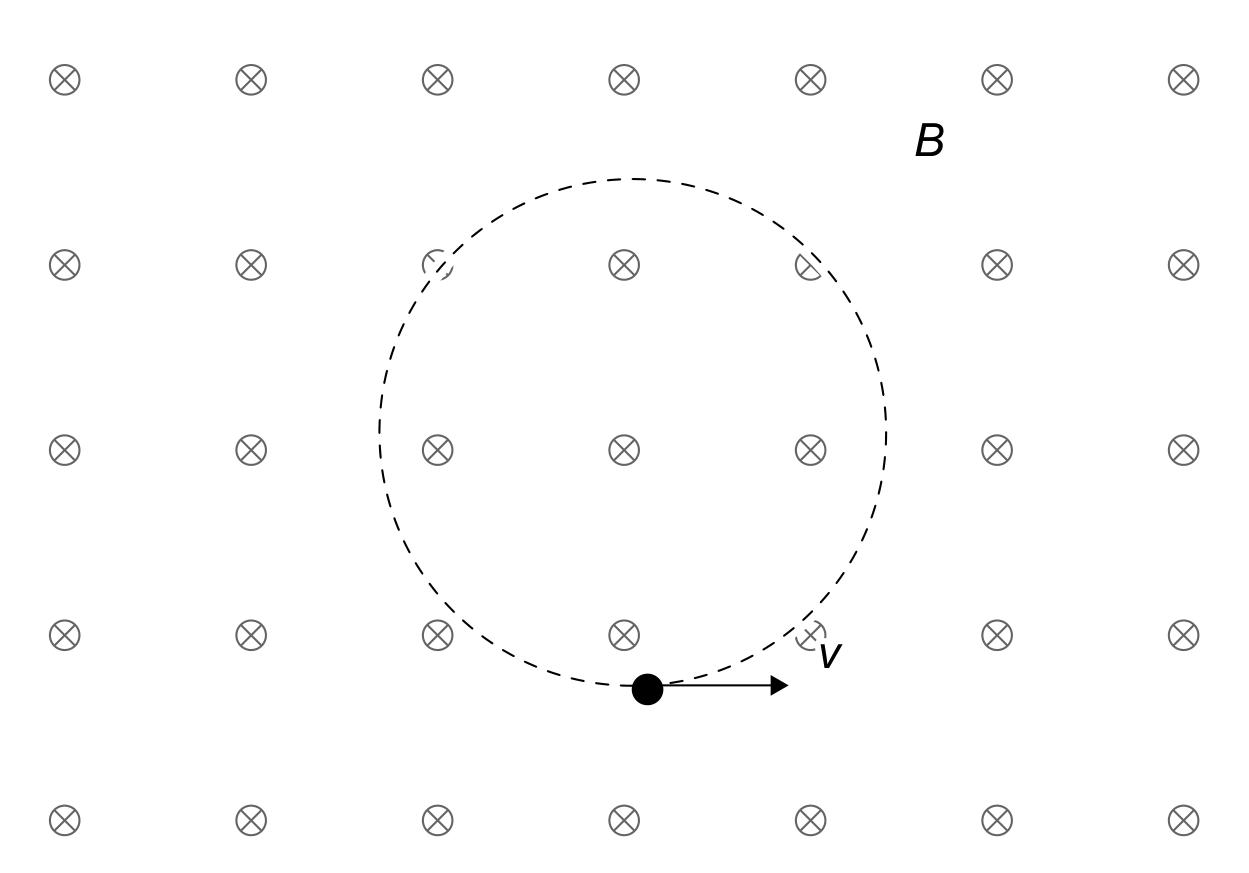
A particle of mass m and positive charge q moves on a circular path with speed v in a vacuum. A uniform magnetic field B is directed into the plane of the page.
Question image
[ 2 ]

Question 3(b)(i)

(i)

Show that the radius R of the circular path is given by R=mvqBR=\frac{m v}{q B}.

[ 1 ]

Question 3(b)(ii)

(ii)

Suggest why the speed of the particle stays constant, even though a force acts on the particle.

[ 1 ]

Question 3(c)

(b)

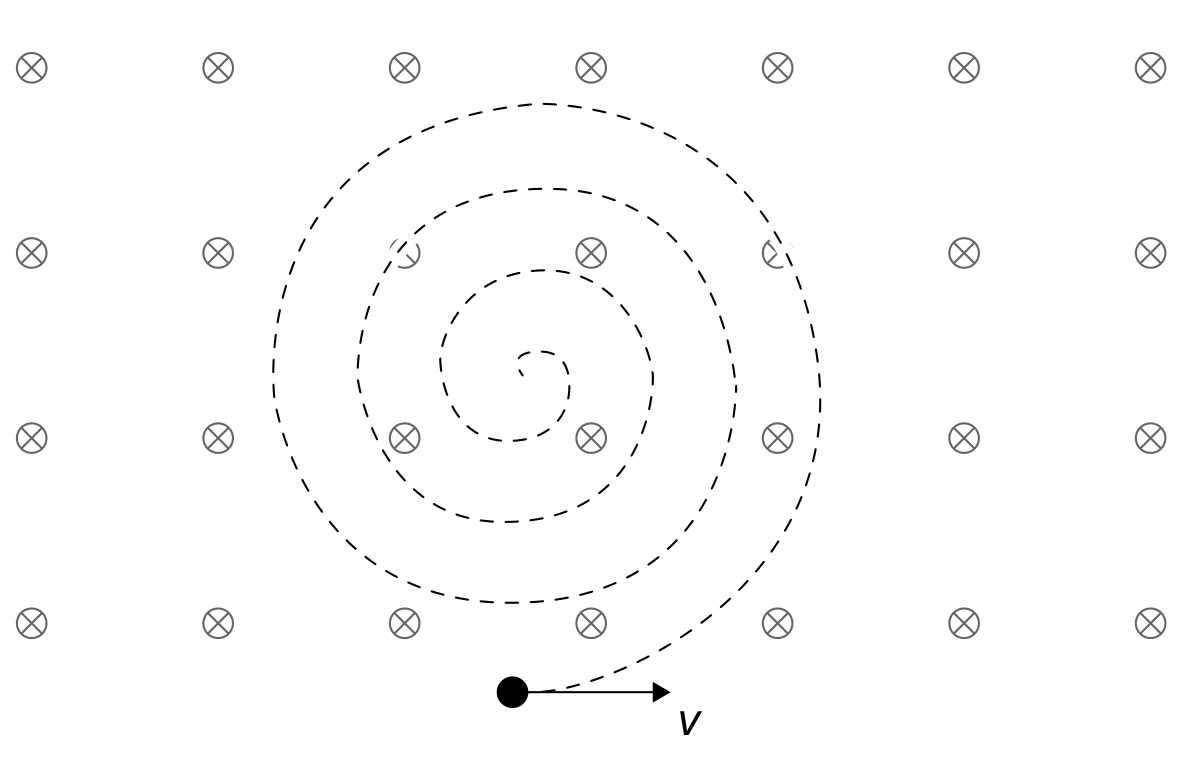
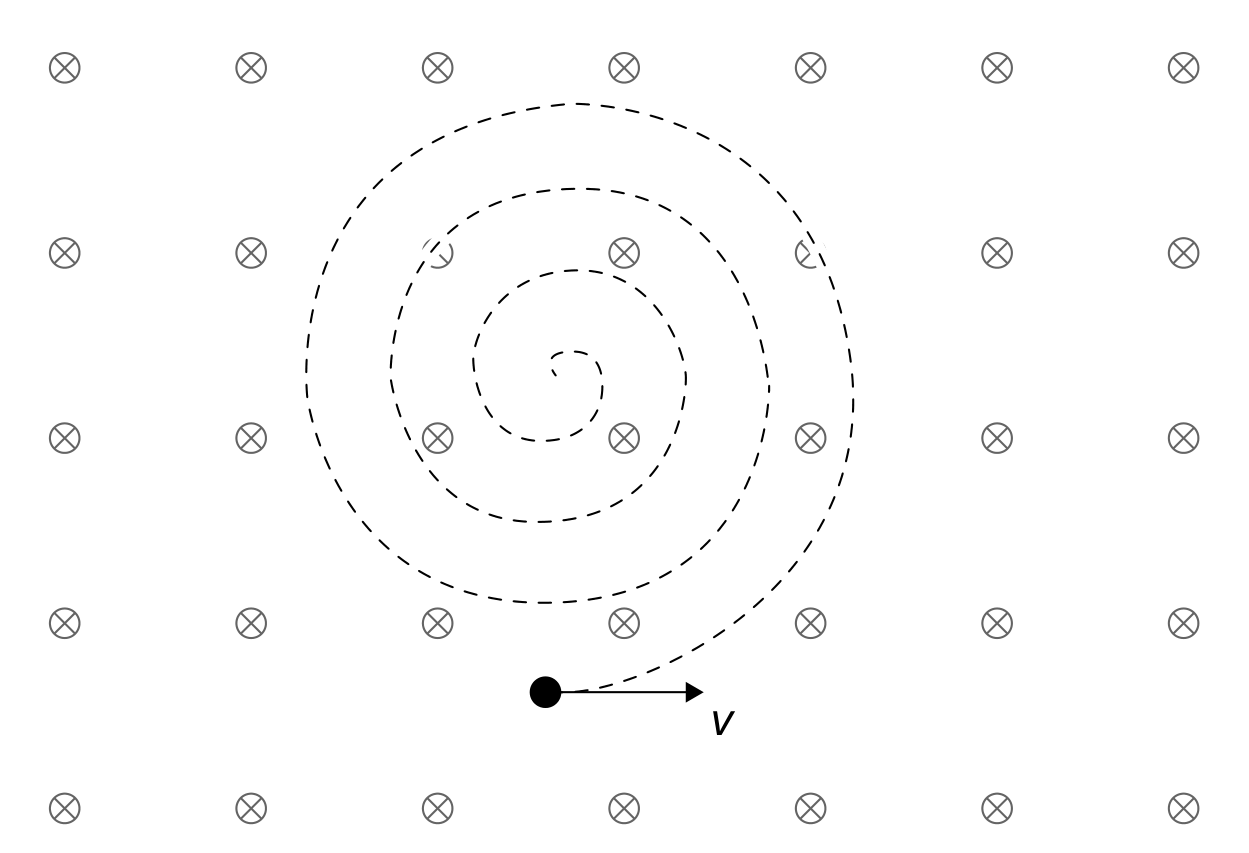
The particle in (b), now moving in a region of magnetic field in air, follows the path shown.
Question image

Explain the shape of this path.

[ 2 ]
Question 3

Question 3(b)

(a)

A particle of mass m and positive charge q moves on a circular path with speed v in a vacuum. A uniform magnetic field B is directed into the plane of the page.

Question image
[ 2 ]

Question 3(b)(i)

(i)

Show that the radius R of the circular path is given by R=mvqBR=\frac{m v}{q B}.

[ 1 ]

Question 3(b)(ii)

(ii)

Suggest why the speed of the particle stays constant, even though a force acts on the particle.

[ 1 ]

Question 3(c)

(b)

The particle in (b), now moving in a region of magnetic field in air, follows the path shown.

Question image

Explain the shape of this path.

[ 2 ]
Question 4

[Maximum number: 6]

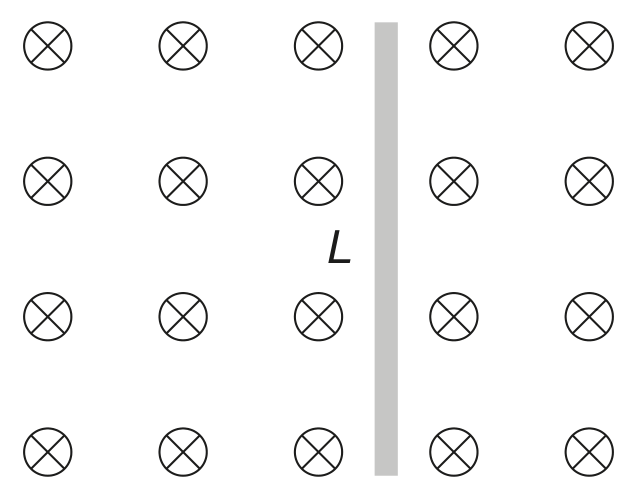
A metal conducting wire is in a region of uniform magnetic field B=1.2 TB=1.2 \mathrm{~T} directed into the page. There is current in the wire and the piece of wire has a length L=0.60 mL=0.60 \mathrm{~m}.

Question image

Question 4(a)

(a)

The wire experiences a magnetic force of 0.084 N toward the right.

[ 2 ]

Question 4(a)(i)

(i)

Show that the current in the wire is about 0.12 A .

[ 1 ]

Question 4(a)(ii)

(ii)

State the direction of the current through the wire.

[ 1 ]

Question 4(b)

(b)

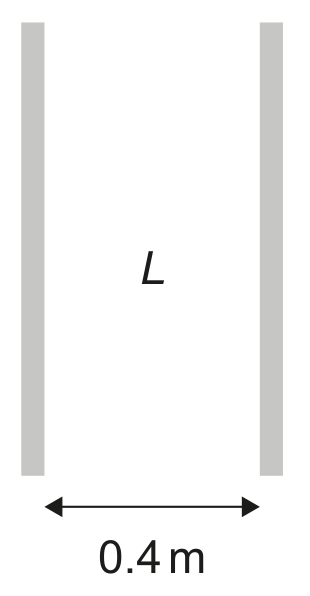
The wire is now removed from the magnetic field and placed at a distance of 0.4 m from another similar conducting wire. Both wires have the same current as before, in the same direction.

Question image
[ 4 ]

Question 4(b)(i)

(i)

State the direction of the force on each wire.

[ 1 ]

Question 4(b)(ii)

(ii)

Determine the force per unit length between the two wires. Give an appropriate SI unit for your answer.

[ 3 ]

Question 20

[Maximum number: 1]

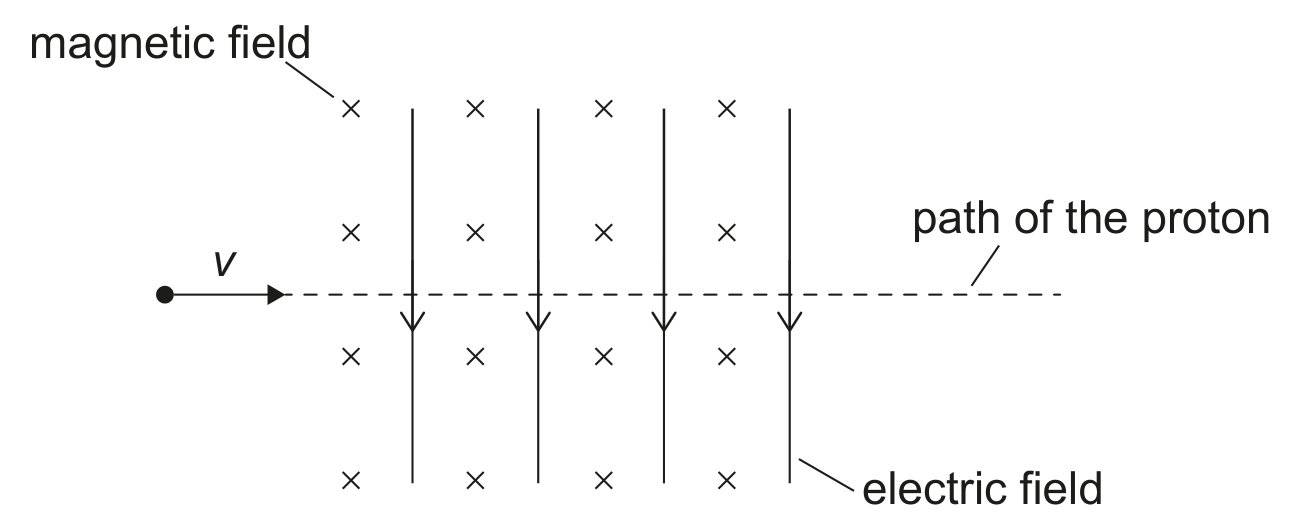
A proton enters a region where electric and magnetic fields are perpendicular to each other. The initial velocity v of the proton is perpendicular to both fields. The path of the proton is not deflected in the fields.

Question image

The proton is replaced by an alpha particle that is also not deflected by the fields. What is the velocity of the alpha particle?

A

v2\frac{v}{2}

B

v

C

2 v

D

4 v

Question 4

[Maximum number: 2]

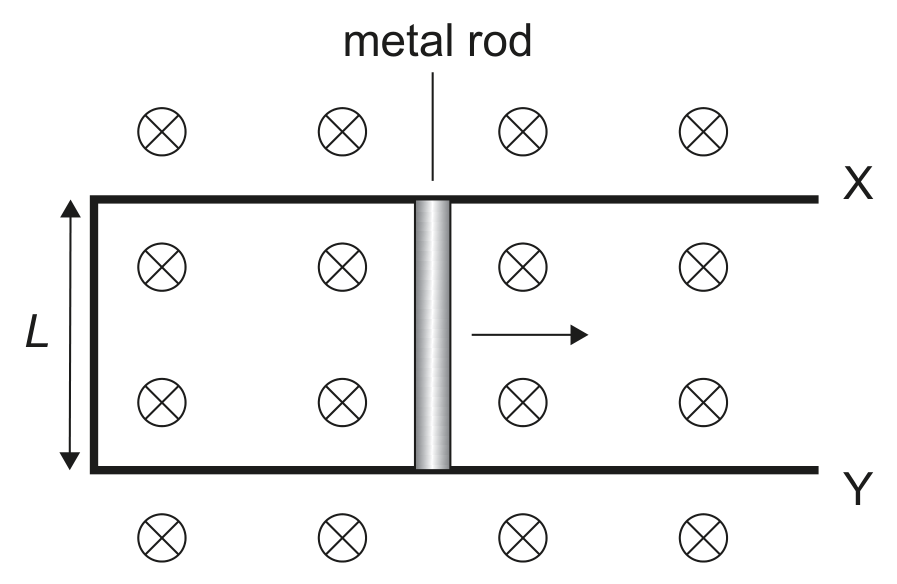
A metal rod is pulled along two horizontal conducting rails X and Y so that it rolls to the right at a constant speed. The two rails are connected by a straight conducting wire of Length L=0.60 mL=0.60 \mathrm{~m}. The system is in a region of uniform magnetic field of magnitude B=1.2 TB=1.2 \mathrm{~T} directed into the page.

Question image

Question 4(a)

(a)

As a result of the motion, the metal rod experiences a magnetic force of 0.084 N .

[ 2 ]

Question 4(a)(i)

(i)

Show that the current in the metal rod is about 0.1 A .

[ 1 ]

Question 4(a)(ii)

(ii)

State the direction of the magnetic force on an electron in the metal rod.

[ 1 ]

Question 28

[Maximum number: 1]

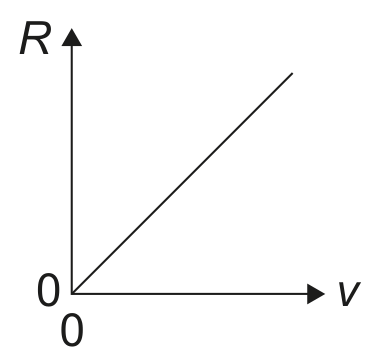
An electron moves with speed v in a region of a uniform magnetic field of strength B. The path of the electron is a circle of radius R. The graph shows how R varies with v.

Question image

What is the gradient of the graph?

A

meBe\frac{m_{\mathrm{e}} B}{e}

B

eBme\frac{e B}{m_{e}}

C

meeB\frac{m_{e}}{e B}

D

emeB\frac{e}{m_{\mathrm{e}} B}

Question 8(b)(i)

[Maximum number: 1]

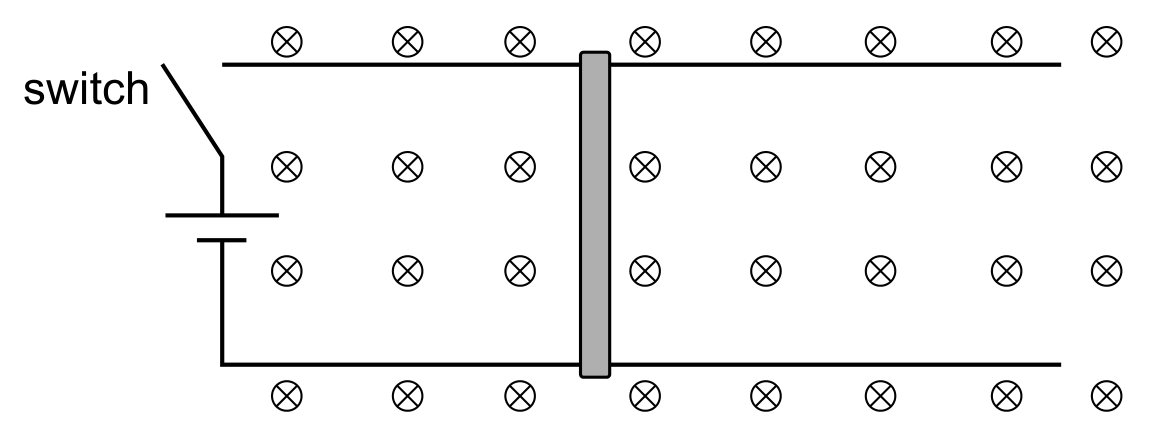
In another experiment, the rod is at rest on the rails. A cell and a switch are inserted as shown.

Question image

The switch is closed.

Suggest what happens to the rod.

0 selected