CAIE A-Level Economics 5.2 Fiscal policy Question Bank

CAIE A-Level Economics 5.2 Fiscal policy Question Bank
Cambridge International AS & A Level Economics 9708 syllabus for exams in 2026, 2027 and 20282026–2028

Practise analysing fiscal policy through budgets, tax, spending, debt and AD/AS effects in data tables and policy scenarios.

Exam points

  • interpret government revenue and spending tables to identify deficits, surpluses or debt effects
  • classify tax and spending decisions as expansionary or contractionary fiscal policy
  • use AD/AS to explain how fiscal policy changes aggregate demand and output

Question 18

[Maximum number: 1]

A government spends money to provide an education for students.
Which type of spending is capital expenditure?

A

computers for classrooms

B

grants for university students

C

rent for school buildings

D

wages for teachers
Question 23

[Maximum number: 1]

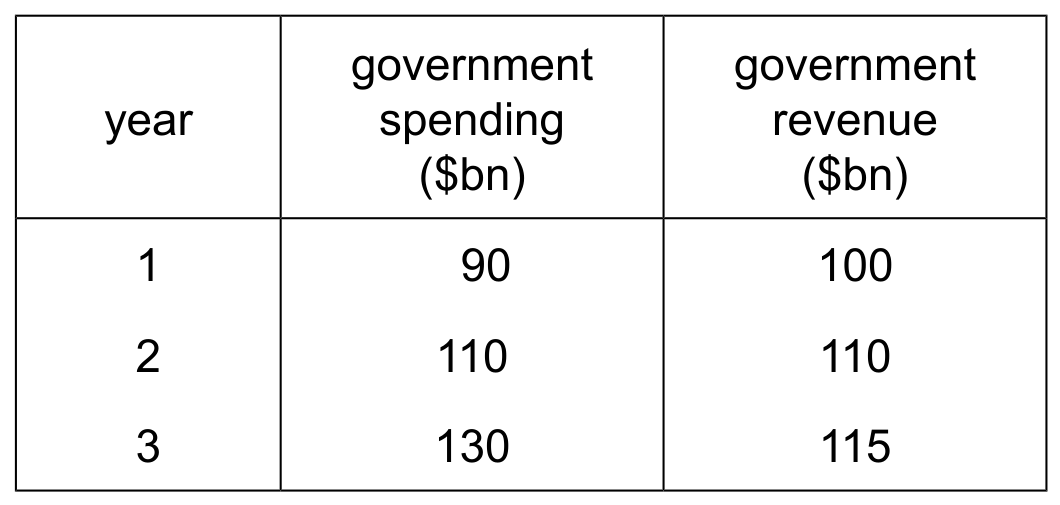
The table shows government spending and revenue over a three-year period.

Table for Question 23 — CAIE A-Level Economics

What can be concluded from the data?

A

A budget surplus becomes a budget deficit in year 3 .

B

National debt is likely to be falling by the end of year 3 .

C

The current account balance is in equilibrium in year 2 .

D

The economy is at full employment equilibrium in year 2.

Question 24

[Maximum number: 1]

What is the most likely consequence when there is an increase in the national debt?

A

the creation of additional money

B

a current account deficit on the balance of payments

C

a surplus in the government's budget

D

the crowding out of private sector investment

Question 24

[Maximum number: 1]

A worker earns $ 10000 and pays $ 1000 in income tax.
Another worker earns $ 30000 and pays $ 4500 in income tax.
A third worker earns $ 150000 and pays $ 50000 in income tax.
Which type of tax is this?

A

indirect

B

progressive

C

proportional

D

regressive

Question 30

[Maximum number: 1]

Which policy's principal aim is to ensure sound public finances?

A

environmental policy

B

fiscal policy

C

monetary policy

D

supply-side policy