
Question 1(b)
Can South Africa escape from its economic difficulties?
South Africa has serious economic difficulties. Despite its vast natural resources, the main economic indicators show a country in trouble. As Fig. 1.1 shows, despite a fall over the last year, unemployment remains very high. It is amongst the highest in the world, particularly for young people, and this has led to one of the highest and most persistent levels of income inequality in the world, with a Gini coefficient of 0.67 .
Economic growth is amongst the worst in Africa and this, together with high government expenditure, means that the country has had a fiscal deficit of more than of GDP in recent years. Despite falls in the value of South Africa's currency (rand), the current account of the balance of payments is projected to move to a significant deficit of of GDP in 2023 and to deteriorate further to about of GDP in 2024. South Africa is also suffering extended power cuts of up to 10 hours per day due to the collapse of the state electricity provider. What can be done?
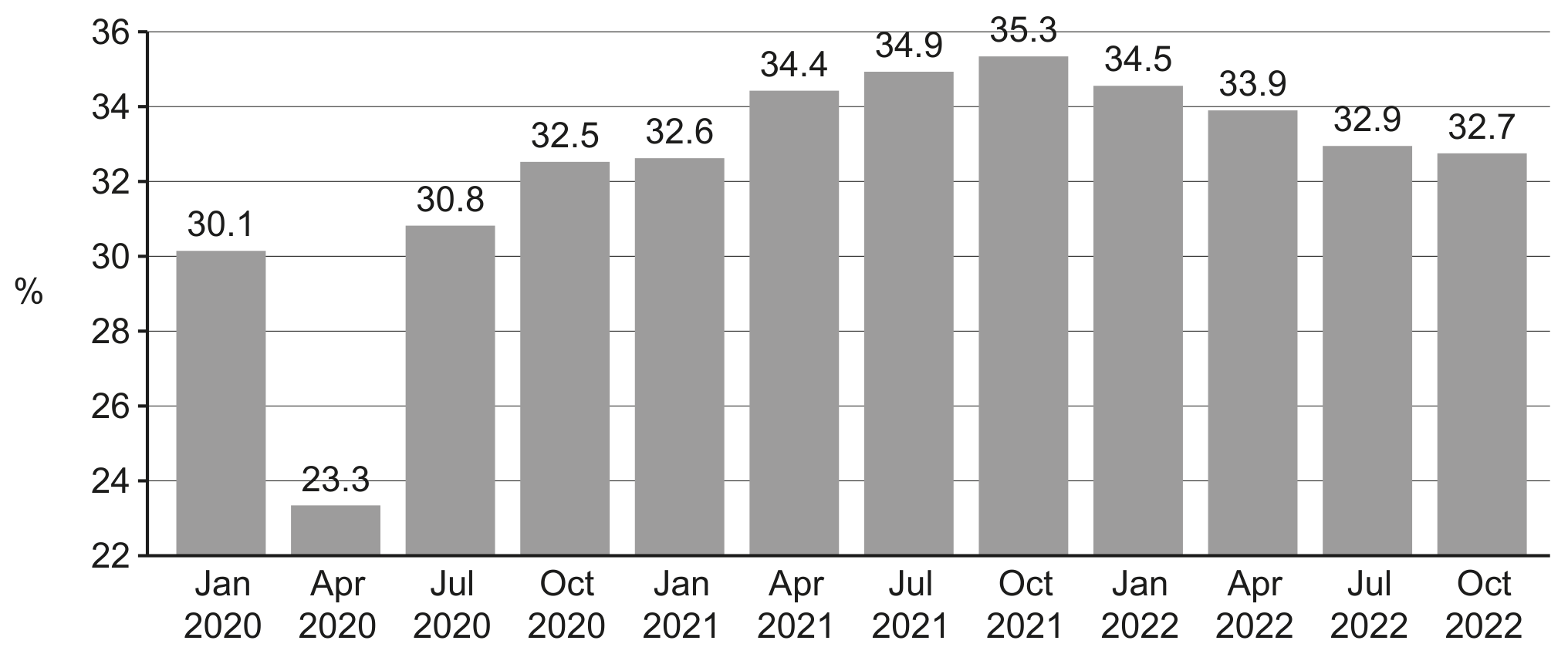
Fig. 1.1 South Africa \% rate of unemployment, January 2020 to October 2022
In a March 2023 statement, the International Monetary Fund (IMF) recommended that the South African government should adopt the following policies:
- Improvements in infrastructure, particularly electricity supplies and transport links. This should be achieved by promoting more private sector investment.
- Encourage more competition within South Africa and free trade with neighbouring countries by reducing protection. Closer links with the African Continental Free Trade Area (AfCFTA) should be established.
- To tackle the very high rates of unemployment and income inequality, a range of policies has been suggested. These include setting the minimum national wage at an appropriate rate to encourage more people back into the workforce. This should be done alongside policies to strengthen employment protection. In addition, other policies include improving levels of education and training and better support for the transition from school to work. Finally, policies to promote entrepreneurship need to be introduced.
However, will these policies help South Africa escape from its economic difficulties?
\section*{Sources: adapted from: FocusEconomics article, 'Will South Africa find a way out of its economic rut?' and IMF concluding statement concerning South Africa, 22 March 2023}
Identify one possible impact on firms in South Africa and one possible impact on the government of South Africa of such a high rate of unemployment.