EduNinja

A-Level CAIE Biology A213.1 Photosynthesis as Energy Transfer ProcessQuestion Bank

Question 1

[Maximum number: 13]

Chloroplasts carry out photosynthesis.
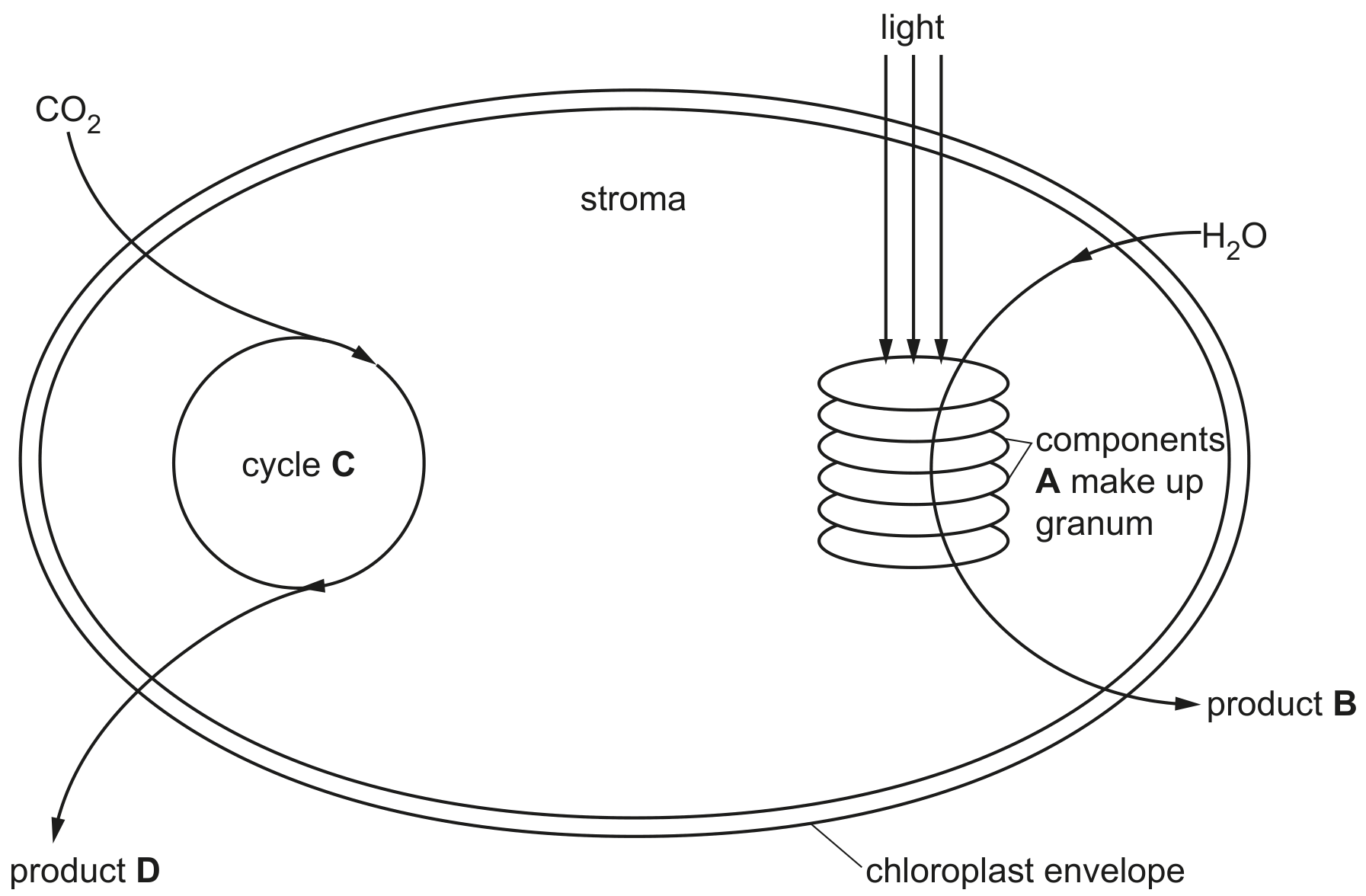
Fig. 1.1 shows some structural features of a chloroplast and some processes that occur within it.
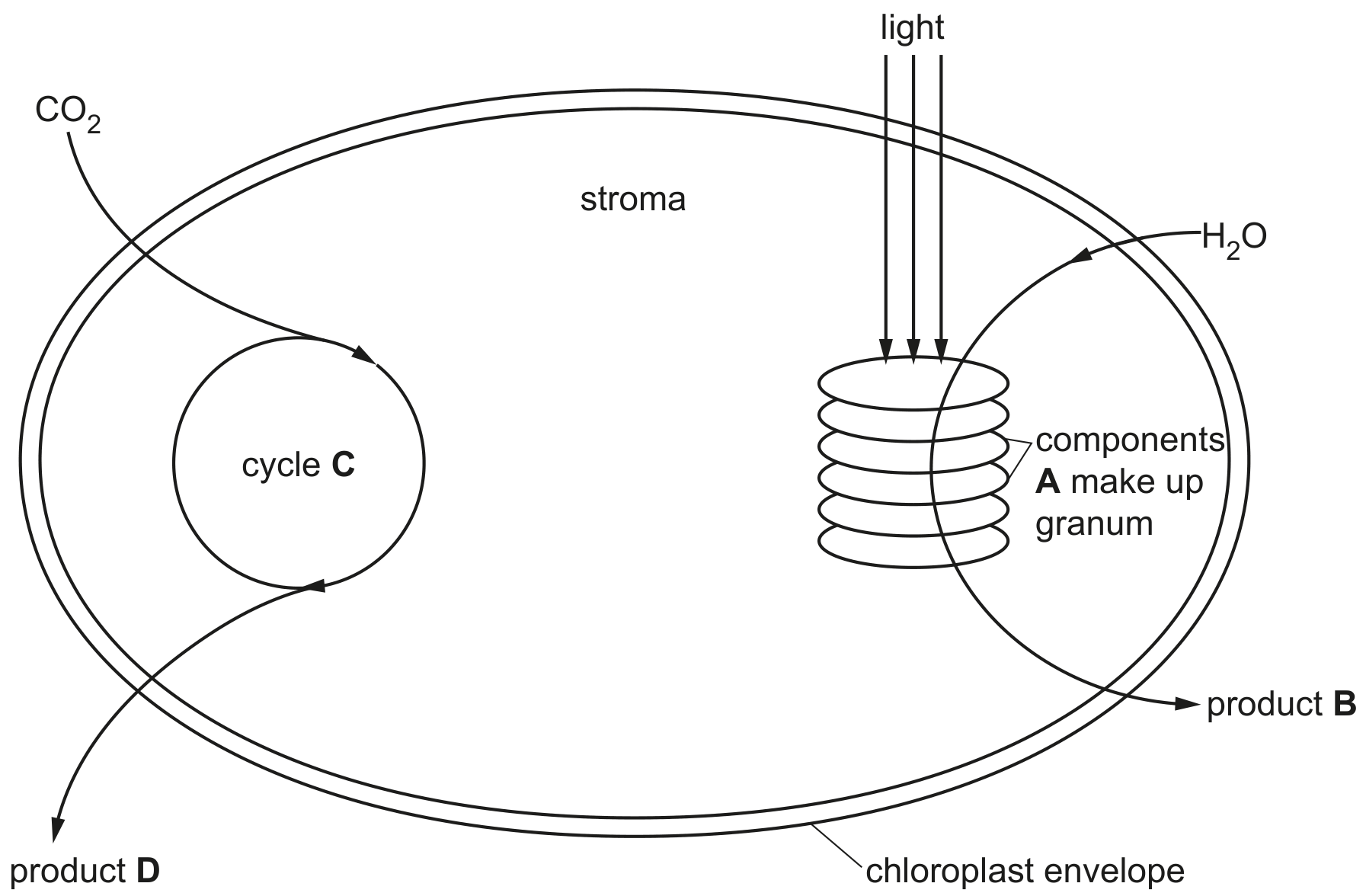
Fig. 1.1

Fig. 1.1

Question 1(a)

Question 1(a)(i)

(a)
(i)

Identify the structures labelled A in Fig. 1.1.

A

[ 1 ]

Question 1(a)(ii)

(ii)

Explain how the structure and appearance of the granum, and the components labelled A, relate to their function.

[ 4 ]

Question 1(b)

Question 1(b)(i)

(b)
(i)

Identify the metabolic pathway labelled cycle C in Fig. 1.1.

C

[ 1 ]

Question 1(b)(ii)

(ii)

Explain why pathway C is described as a cycle.

[ 2 ]

Question 1(c)

Question 1(c)(i)

(c)
(i)

Identify the products of photosynthesis labelled B and D in Fig. 1.1.

B

D

[ 2 ]

Question 1(c)(ii)

(ii)

Suggest and explain the importance of glucose and the product labelled B in Fig. 1.1 to ecosystems.

[ 3 ]
Question 1

Question 1(a)

(a)

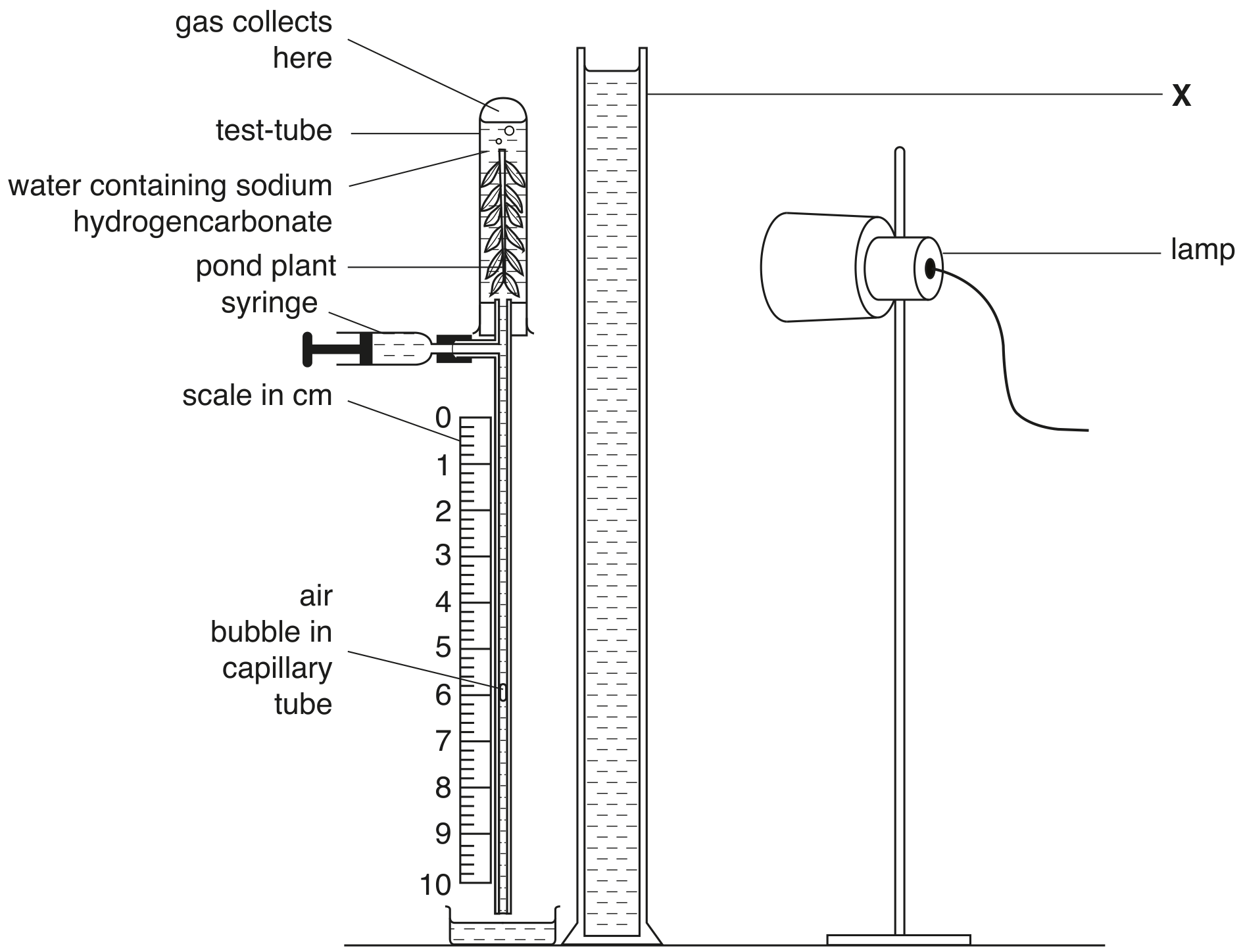
The effect of light intensity on the rate of photosynthesis can be investigated using a cut shoot of a pond plant.

The apparatus used in the investigation is shown in Fig. 1.1.

Fig. 1.1

Fig. 1.1

The light intensity can be changed by placing the lamp at different distances from the pond plant.

[ 1 ]

Question 1(a)(iii)

(i)

Name the gas collected in the test-tube.

[ 1 ]

Question 1(c)

(b)

Some of the light energy absorbed by the pond plant is used in cyclic photophosphorylation. Outline the process of cyclic photophosphorylation.

[ 5 ]

Question 1

Question 1(a)

(a)

On Fig. 1.1, use label lines and letters to label:

A

- the storage site of the carbohydrate product of photosynthesis

B

- the site of the light independent stage.

[ 2 ]

Question 1(b)

Question 1(b)(i)

(b)
(i)

Name the structure labelled C in Fig. 1.1.

C

[ 1 ]

Question 1(b)(ii)

(ii)

Explain how the structure of C is linked to its function.

[ 4 ]

Question 1

[Maximum number: 11]

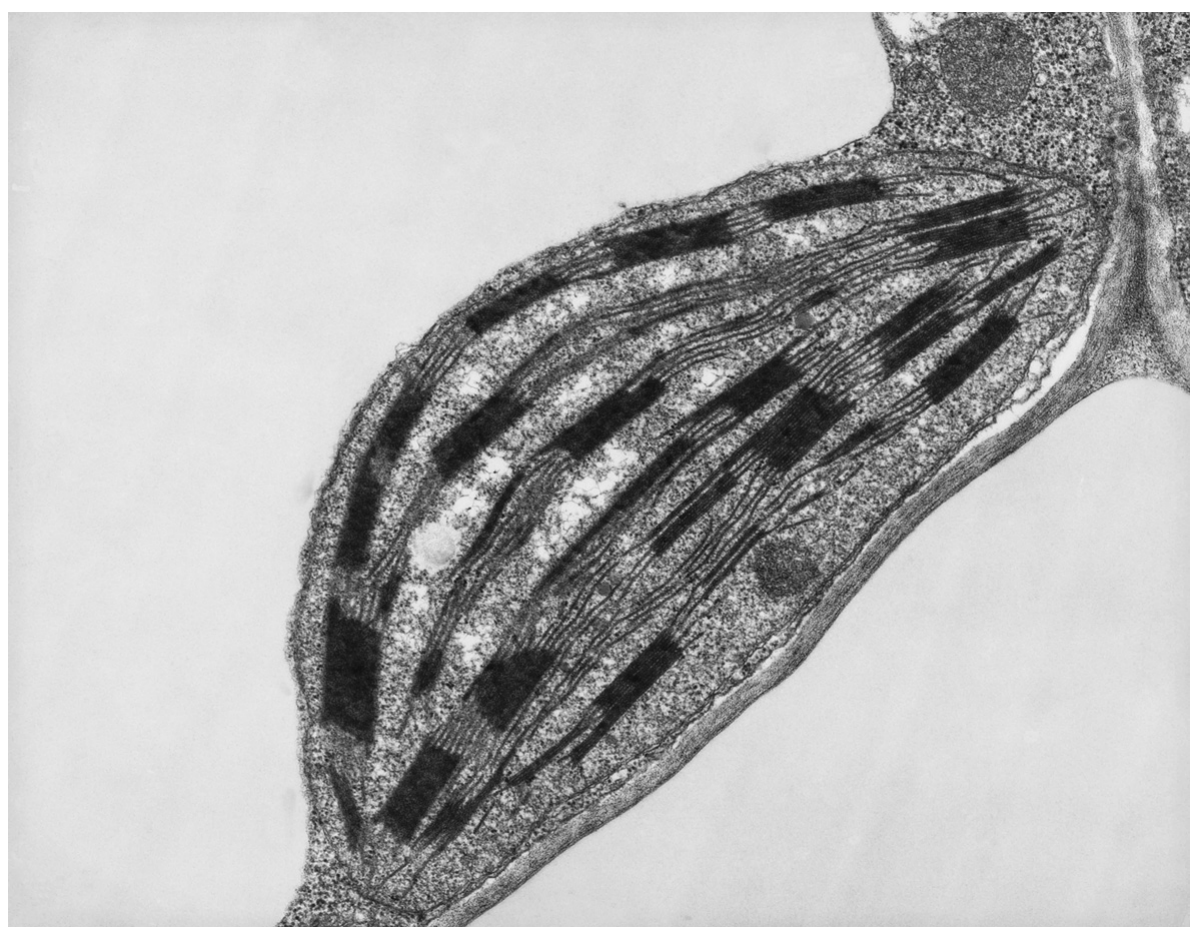
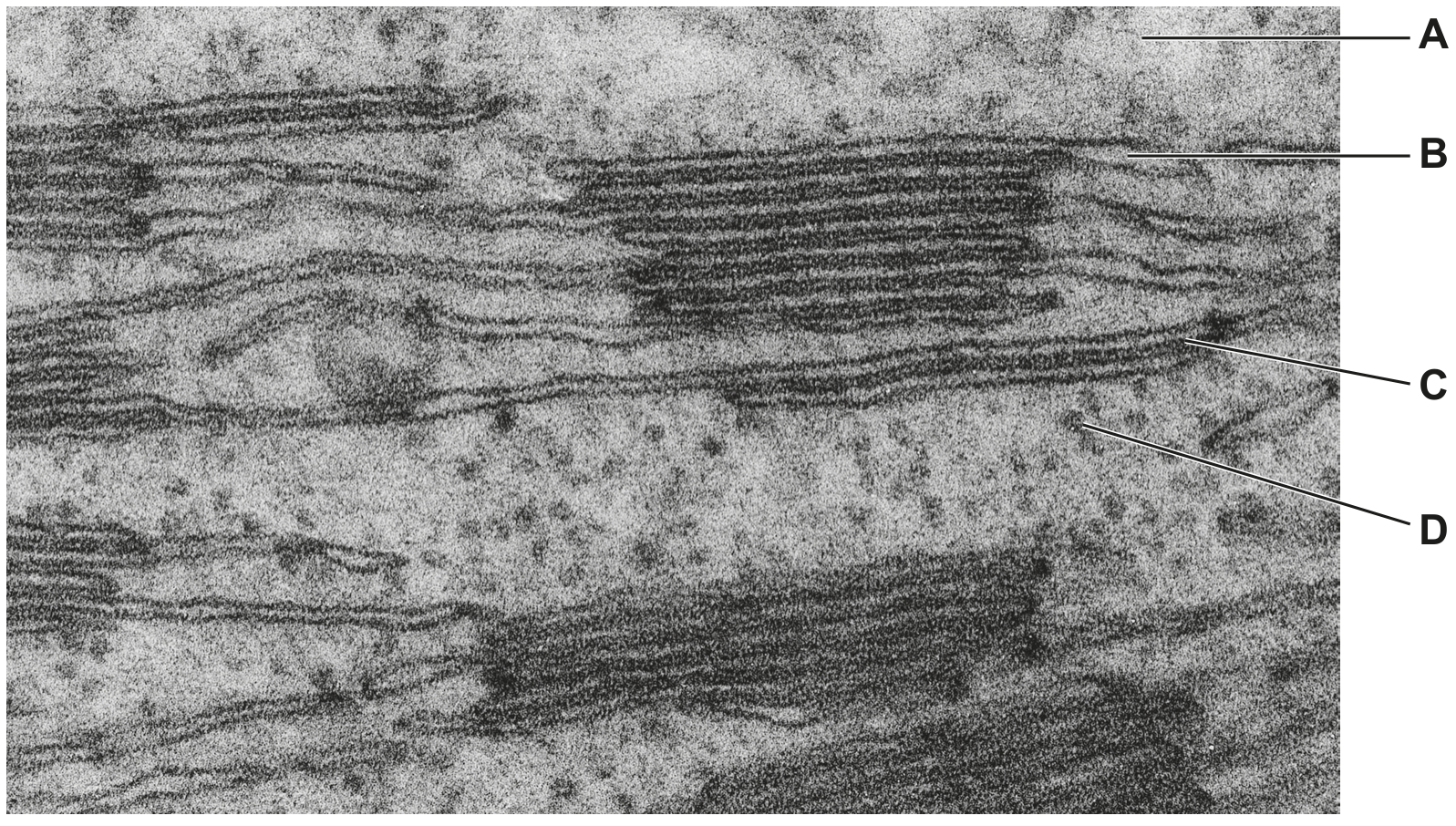
Fig. 1.1 shows a transmission electron micrograph of part of a chloroplast.

Fig. 1.1

Fig. 1.1

Question 1(a)

(a)

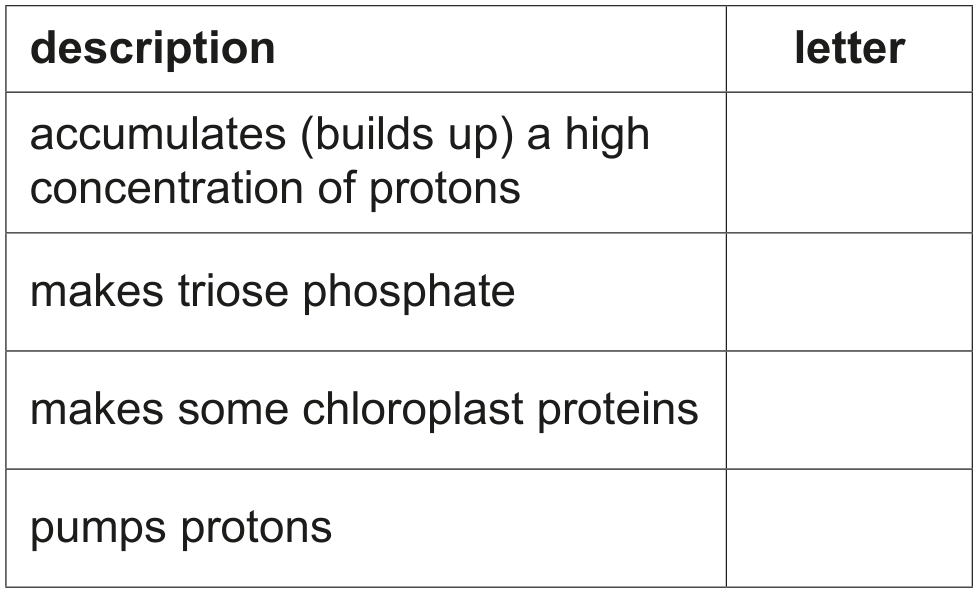
Table 1.1 describes some functions that occur in different parts of a chloroplast.

Complete Table 1.1 by identifying the letter on Fig. 1.1 that is a location matching the description. Each letter may be used once, more than once, or not at all.

Table 1.1

Table 1.1

[ 4 ]

Question 1(b)

(b)

Membranes of the type labelled C in Fig. 1.1 were made into a liquid extract. Chromatography was then used to separate and identify the coloured components (pigments) in this extract. The resulting chromatogram showed that these membranes contain a yellow pigment, an orange pigment, a green-brown pigment and two different green pigments.

[ 7 ]

Question 1(b)(i)

(i)

Describe how you would carry out chromatography to separate and identify the coloured pigments in the liquid extract of C.

[ 4 ]

Question 1(b)(ii)

(ii)

Explain why membrane C has many different coloured pigments to function efficiently.

[ 3 ]

Question 1

Question 1(a)

(a)

Photosynthesis is a complex process involving the transfer of light energy into chemical energy.

[ 4 ]

Question 1(a)(i)

(i)

Describe the role of photosynthetic pigments.

[ 2 ]

Question 1(a)(ii)

(ii)

Name the precise location in a chloroplast of photosynthetic pigments.

[ 1 ]

Question 1(a)(iii)

(iii)

Name a practical technique to separate photosynthetic pigments.

[ 1 ]

Question 1

Question 1(a)

(a)

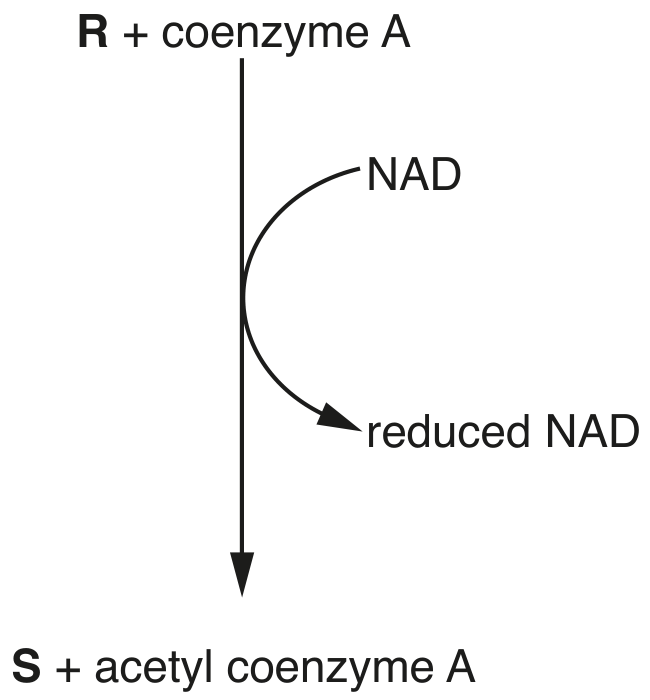
Fig. 1.1 represents the link reaction.

Fig. 1.1

Fig. 1.1

With reference to Fig. 1.1:

[ 2 ]

Question 1(a)(ii)

(i)

explain what happens to the reduced NAD.

[ 2 ]

Question 1

[Maximum number: 13]

Chloroplasts carry out photosynthesis.
Fig. 1.1 shows some structural features of a chloroplast and some processes that occur within it.

Fig. 1.1

Fig. 1.1

Question 1(a)

Question 1(a)(i)

(a)
(i)

Identify the structures labelled A in Fig. 1.1.

[ 1 ]

Question 1(a)(ii)

(ii)

Explain how the structure and appearance of the granum, and the components labelled A, relate to their function.

[ 4 ]

Question 1(b)

Question 1(b)(i)

(b)
(i)

Identify the metabolic pathway labelled cycle C in Fig. 1.1.

[ 1 ]

Question 1(b)(ii)

(ii)

Explain why pathway C is described as a cycle.

[ 2 ]

Question 1(c)

Question 1(c)(i)

(c)
(i)

Identify the products of photosynthesis labelled B and D in Fig. 1.1.

B

D

[ 2 ]

Question 1(c)(ii)

(ii)

Suggest and explain the importance of glucose and the product labelled B in Fig. 1.1 to ecosystems.

[ 3 ]
Question 1

Question 1(b)

(a)

The leaf is the main photosynthetic organ in most plants. For the light-independent stage of photosynthesis to occur, carbon dioxide must be present.

[ 3 ]

Question 1(b)(ii)

(i)

Name the compound that combines with carbon dioxide in the light-independent stage in a C3 plant.

[ 1 ]

Question 1(b)(iii)

(ii)

Outline the role of reduced NADP in the light-independent stage.

[ 2 ]

Question 1

Question 1(a)

(a)

Fig. 1.1 shows an electronmicrograph of a chloroplast.

Fig. 1.1

Fig. 1.1

On Fig. 1.1, use label lines and letters to label one place where:
L - the light-dependent stage takes place
R - the enzyme rubisco is found.

[ 2 ]

Question 1(b)

(b)

Chloroplasts can move within palisade cells.

Suggest two advantages of chloroplast movement within palisade cells.

[ 2 ]

Question 1(c)

(c)

Complete the following paragraph by naming the most suitable compounds to fill in the gaps. Rubisco is involved in the fixation of by RuBP (ribulose bisphosphate) in the Calvin cycle. The resulting six carbon compound immediately splits to give two molecules of glycerate-3-phosphate (GP). GP is converted to triose phosphate (TP) using and produced in the light-dependent stage. Some of the TP produced is used to regenerate ribulose bisphosphate so that the Calvin cycle can continue. The remaining TP may be used to synthesise other compounds including which can directly enter the Krebs cycle.

2 Intracytoplasmic sperm injection (ICSI) is a modification of the procedure for in-vitro fertilisation (IVF). A single sperm is injected into an oocyte rather than allowing one of many sperm to fertilise the oocyte.

[ 4 ]

Question 1

Question 1(a)

(a)

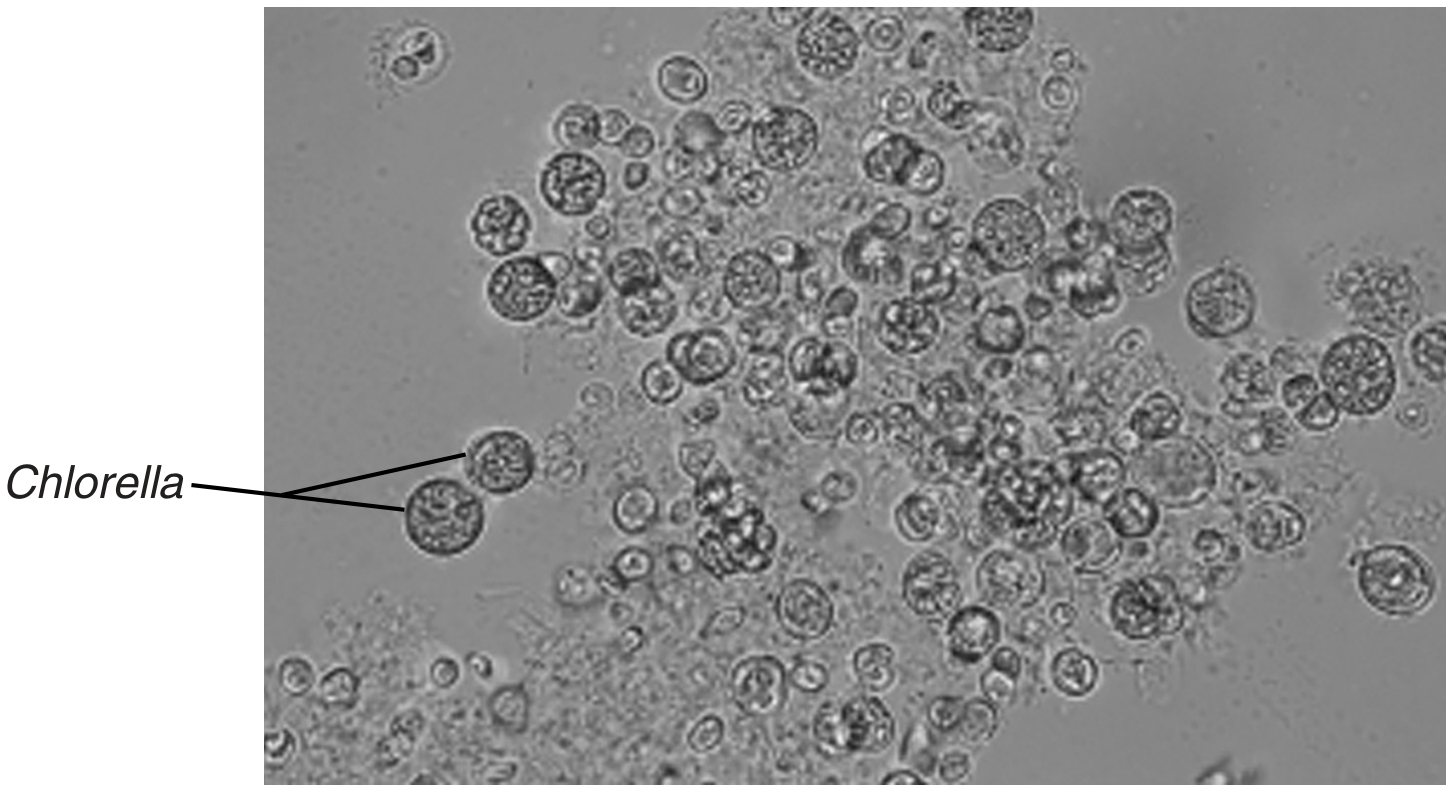
The unicellular green alga, Chlorella, a photosynthetic protoctist, was originally studied for its potential as a food source. Although large-scale production proved to be uneconomic, the many health benefits provided by Chlorella mean that it is now mass produced and harvested for use as a health food supplement.

Fig. 1.1 shows cells of Chlorella.

Fig. 1.1

Fig. 1.1

[ 5 ]

Question 1(a)(i)

(i)

State precisely where in the chloroplast RuBP and GP are located.

[ 1 ]

Question 1(a)(ii)

(ii)

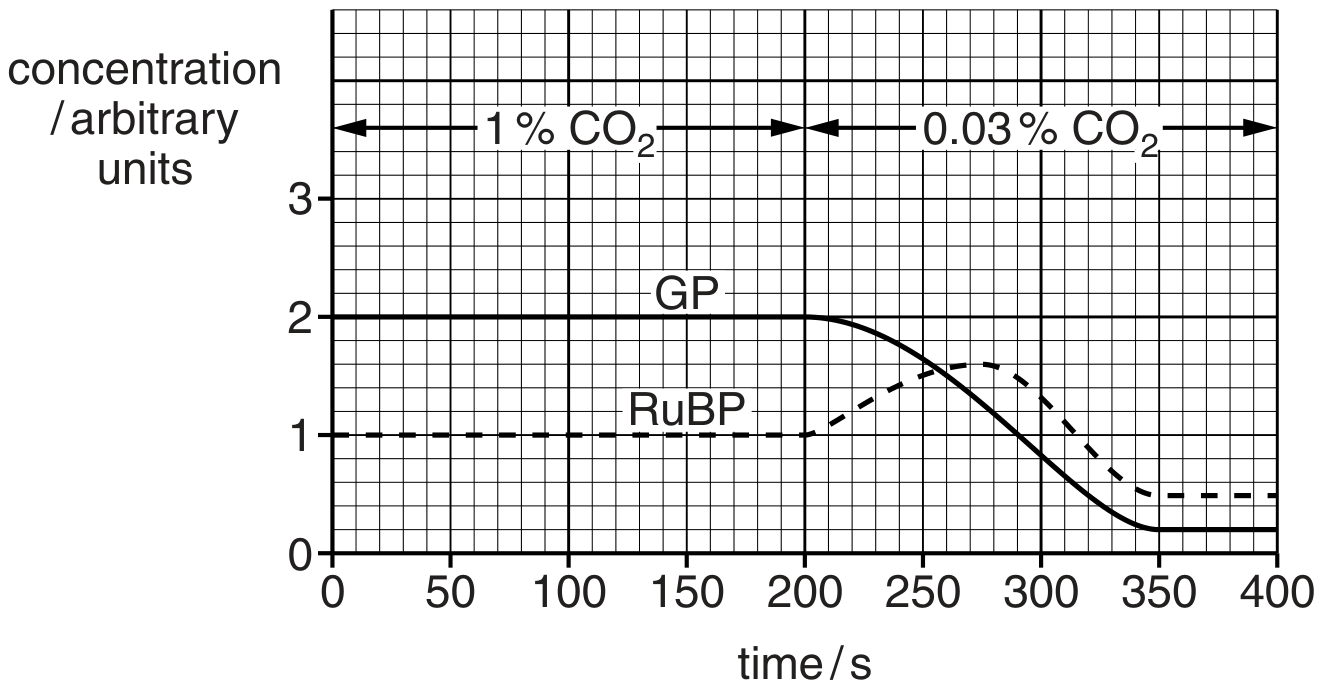
Explain why the concentration of RuBP changed between 200 and 275 seconds.

[ 2 ]

Question 1(a)(iii)

(iii)

Calculate the rate of decrease per second in the concentration of GP between 200 and 350 seconds.

Show your working and give your answer to two decimal places.
answer arbitrary units per second

[ 2 ]

Question 1(b)

(b)

In one study into the productivity of Chlorella, carbon dioxide concentration was altered to investigate its effects on the light-independent stage of photosynthesis.
- A cell suspension of Chlorella was illuminated using a bench lamp.
- The suspension was supplied with carbon dioxide at a concentration of 1 % for 200 seconds.
- The concentration of carbon dioxide was then reduced to 0.03 % for a further 200 seconds.
- The concentrations of RuBP and GP (PGA) were measured at regular intervals.
- Throughout the investigation the temperature of the suspension was maintained at 25∘C25^{\circ} \mathrm{C}.

The results are shown in Fig. 1.2.

Fig. 1.2

Fig. 1.2

Explain how the decrease in the concentration of GP leads to a decreased harvest for commercial suppliers of Chlorella.

[ 2 ]
0 selected