D1.2.1—Transcription
Transcription produces an RNA copy of gene information when RNA polymerase uses one DNA strand as a complementary template for mRNA synthesis.
- Syllabus
- First assessment 2025
- Objective
- D1.2.1
- Level
- SL
Transcription produces an RNA copy of gene information when RNA polymerase uses one DNA strand as a complementary template for mRNA synthesis.
Coverage 2012–2025 · Updated 16 Jul 2026
RNA polymerase binds near the gene and opens a short region of the DNA double helix, exposing the template strand.
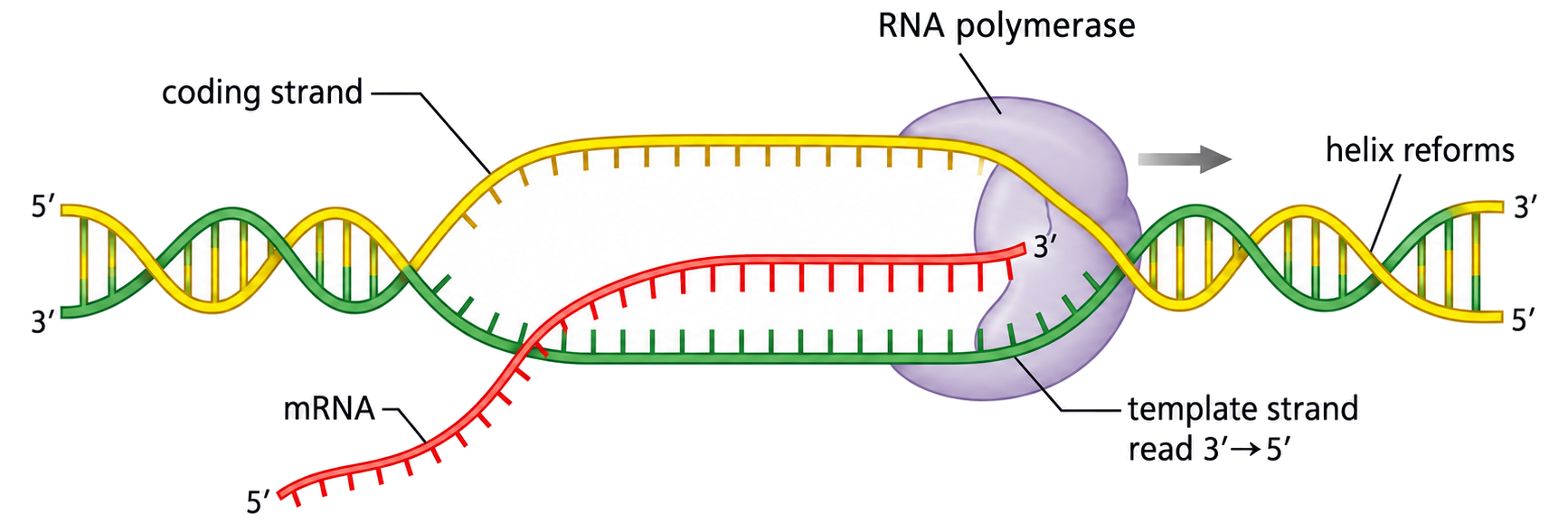
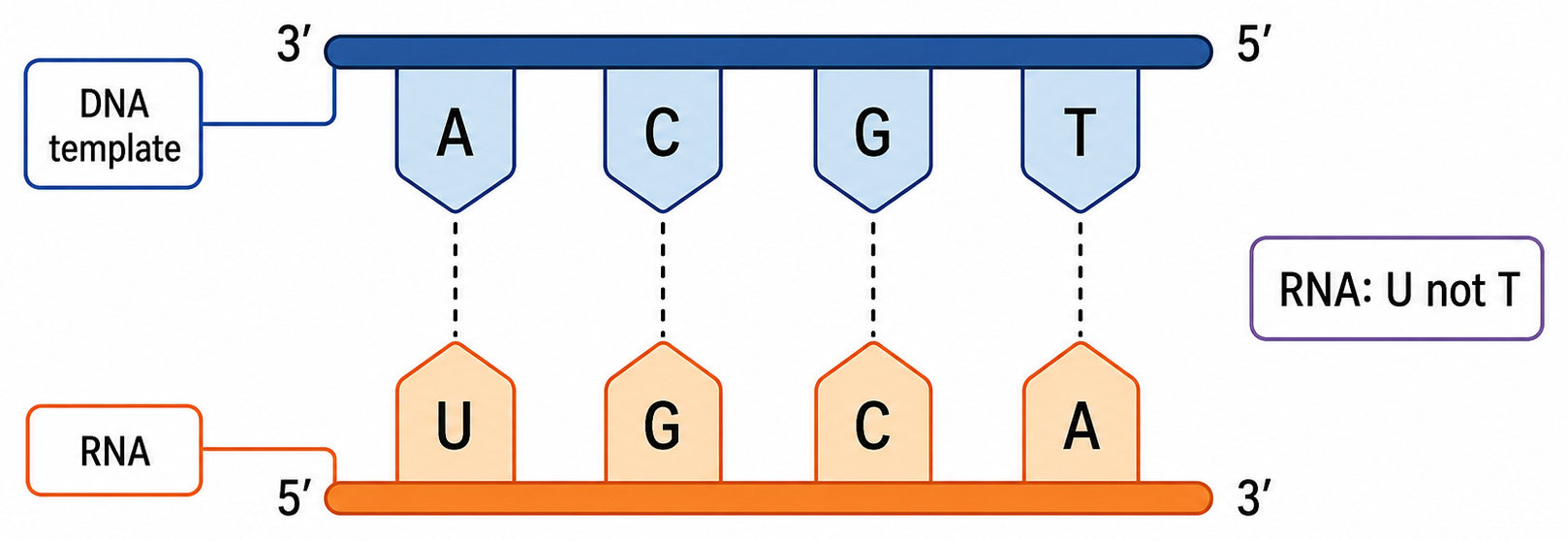
Free RNA nucleotides align by complementary base pairing: DNA A pairs with RNA U, DNA T with RNA A, and C with G.
RNA polymerase joins the RNA nucleotides into a sugar–phosphate backbone. The mRNA separates, and the DNA strands pair again.
| Strand | Relationship to the new mRNA |
|---|---|
| DNA template | antiparallel and complementary |
| DNA coding strand | same base order as mRNA, except DNA has T where RNA has U |
DNA template: 3′–TAC CTT GCG–5′
mRNA: 5′–AUG GAA CGC–3′
Codon tables are read from mRNA 5′→3′. Do not look up a DNA template triplet directly.