Q BankQuestion BankDocsDocuments

B1.1.6—Cellulose structure and function

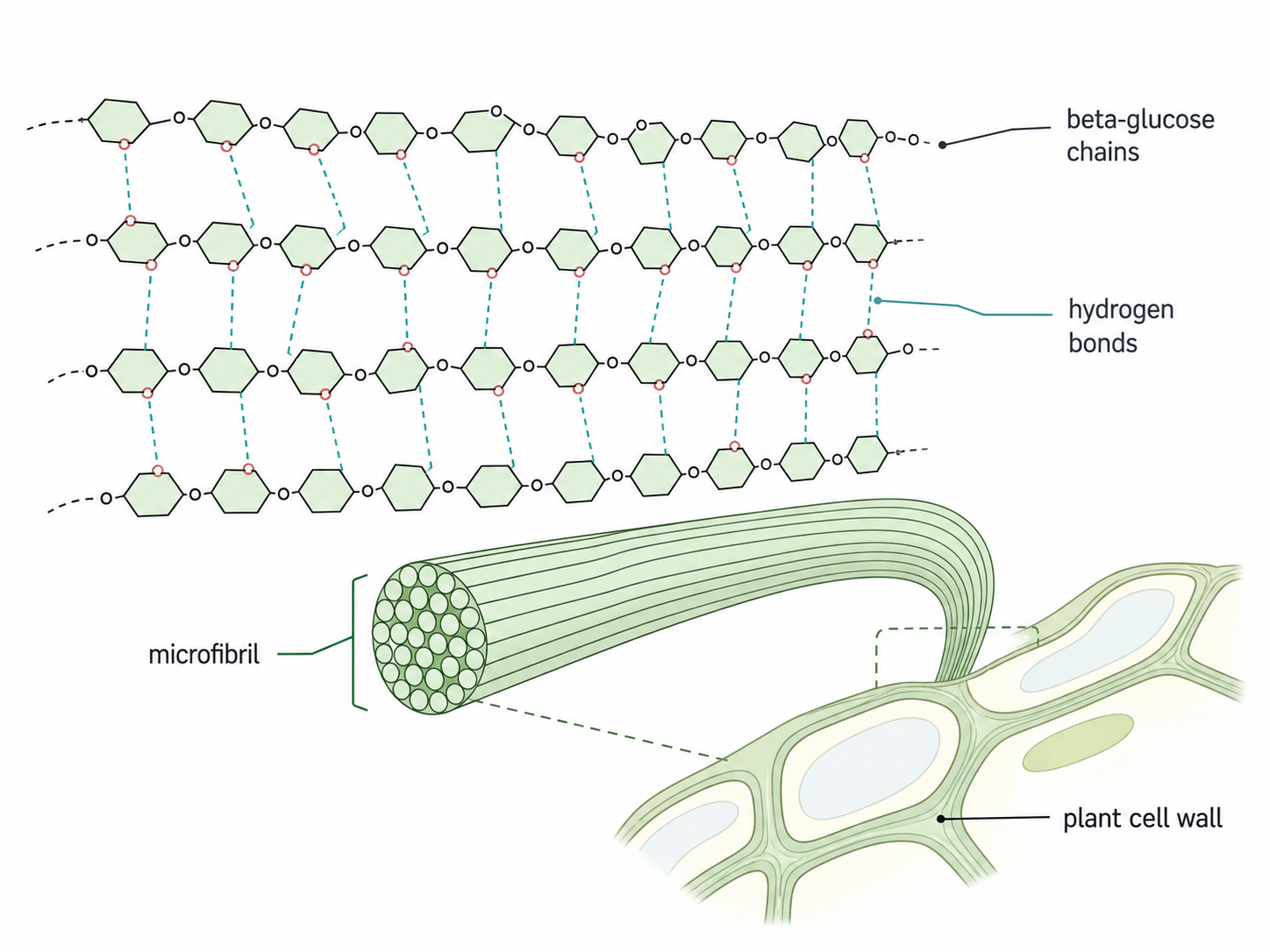
Cellulose is a beta glucose polysaccharide whose straight unbranched chains and hydrogen-bonded microfibrils strengthen plant cell walls structurally and mechanically.

Syllabus
First assessment 2025
Objective
B1.1.6
Level
HL

Exam analysis

Chance of appearing4%of analysed past papers
Latest appearanceMay 2024
Most common paperPaper2
Typical marks1–3

Common command terms

  • Label
  • Describe
  • Outline
  • Identify

Scoring notes

Common mistake
Describing cellulose as branched or made from alpha-glucose.

Recent exam appearances

May 2024Paper2 ["HL"] · TZ18(a)[ 3 ]B1.1.6—Cellulose structure and function
November 2023Paper2 ["HL"] · TZ25(a)[ 3 ]B1.1.6—Cellulose structure and function
May 2021Paper1 ["HL"] · TZ17[ 1 ]B1.1.6—Cellulose structure and function
May 2019Paper2 ["HL"] · TZ14(c)[ 2 ]B1.1.6—Cellulose structure and function
May 2016Paper1 ["HL"] · TZ04[ 1 ]B1.1.6—Cellulose structure and function
Practice this objective

Coverage 2016–2024 · Updated 15 Jul 2026

Cellulose Fibres Gain Strength from Parallel Chains

Cellulose supports plant cell walls because its straight glucose chains align and hydrogen-bond to form strong fibres.

The β-linked arrangement keeps each chain extended. Many weak hydrogen bonds between neighbouring chains add together, producing tensile strength without covalently joining every chain.

Link structure to strength:

  • β-linked glucose forms straight chains
  • chains align side by side
  • many hydrogen bonds reinforce the microfibril

A cellulose microfibril can resist pulling because force is shared across many aligned chains; the same glucose monomers in a branched storage polymer do not form that fibre architecture.

Hydrogen bonds are individually weak, but their combined effect is strong. Do not say cellulose is strong because its chains are covalently bonded to one another.

Cellulose structure and function

Assessment in practice

1–2 marks
How it is assessed

This objective is assessed through structured response, commonly using Label / Describe / Outline.

Command terms

Label / Describe / Outline / Identify

What earns marks

Build the answer around this relationship: Cellulose is made from beta-glucose monomers joined by 1,4 glycosidic bonds.

Watch for

Describing cellulose as branched or made from alpha-glucose.

Representative question

Question 1

[Maximum number: 3]

Describe how cellulose is formed from monosaccharides.

Structure To Function

B1.1 becomes easy when every answer follows structure -> property -> function. Carbon skeletons and functional groups create molecular diversity. Condensation builds larger molecules and hydrolysis breaks them. Alpha-glucose stores energy as starch and glycogen; beta-glucose forms strong cellulose. Surface carbohydrates enable recognition. Lipids are hydrophobic, triglycerides store energy, phospholipids self-assemble into bilayers, and steroids cross membranes because they are mostly non-polar.

  • Carbon bonding and functional groups explain molecular diversity.
  • Condensation releases water; hydrolysis uses water.
  • Carbohydrates can store energy, build cell walls, and mark cell surfaces.
  • Lipids are hydrophobic and not true polymers.
  • Triglycerides store energy; phospholipids form membranes; steroids signal across membranes.

Concept essentials

  • Cellulose is made from beta-glucose monomers joined by 1,4 glycosidic bonds.
  • Alternating glucose orientation creates straight, unbranched chains.
  • Hydrogen bonding between chains forms strong microfibrils.
  • Cellulose provides structural strength in plant cell walls.
ConceptIB Biology HL